6 min read
On 31 October 2008, someone using the name Satoshi Nakamoto posted a nine page paper to a cryptography mailing list. It was called Bitcoin: A Peer-to-Peer Electronic Cash System.
This Saturday is 18 years since that paper. Bitcoin (BTC) now trades around $80,000, with a total market value of about $1.6 trillion. Some of what Satoshi described has played out almost exactly as written. Other parts went somewhere the paper never mentions.
What the whitepaper set out to do
The problem was simple to explain. Online payments needed a bank or payment company in the middle, mainly to make sure nobody spent the same money twice. The paper proposed a way to remove that middleman.
- Peer to peer payments: money sent directly from one person to another, with no financial institution involved
- A public record: every transaction is timestamped and added to a shared chain of blocks
- Proof of work: computers compete to add the next block, which makes rewriting past transactions extremely expensive
- Rewards for miners: new coins for whoever adds a block, with transaction fees taking over once a set number of coins is in circulation
The 21 million cap itself isn’t in the whitepaper. It came with the software Satoshi released in early 2009, after the first block was mined on 3 January.
The supply schedule has worked as designed
This is where the original design has held up best. Every 210,000 blocks, roughly every four years, the reward for mining a block is cut in half. It started at 50 BTC. Since the fourth halving in April 2024, it’s 3.125 BTC.
On 9 March 2026, the network mined its 20 millionth coin. That means more than 95% of all the bitcoin that will ever exist is already in circulation. The last million coins will be released slowly over more than a century, with full supply expected around 2140.
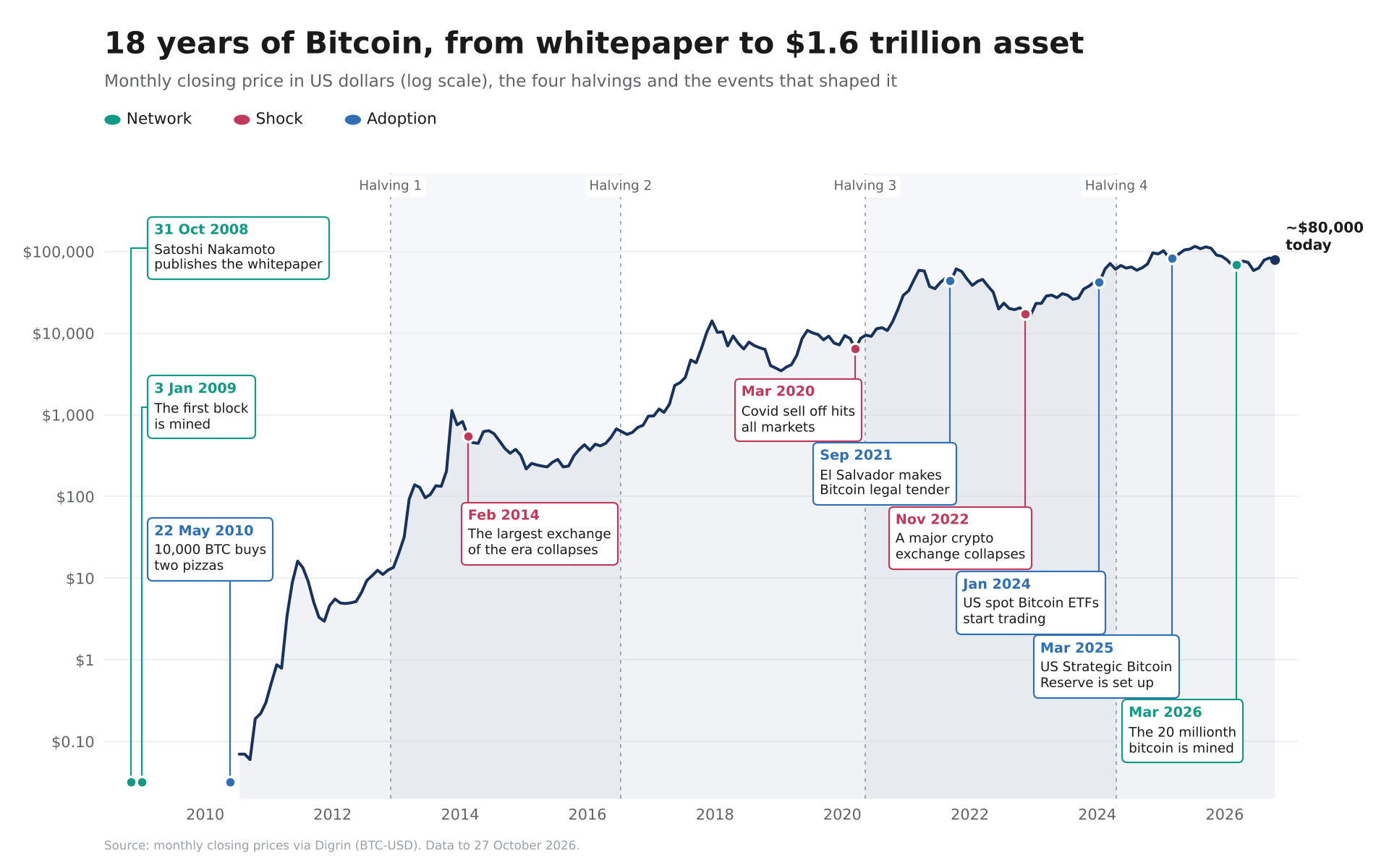
Each halving cuts new supply in half. The reward has fallen from 50 BTC per block in 2009 to 3.125 BTC today, which is why more than 95% of all bitcoin already exists.
Where Bitcoin went that the paper didn’t predict
The whitepaper was about cutting out financial institutions. Eighteen years later, some of the biggest Bitcoin buyers are financial institutions.
- Spot Bitcoin ETFs: US funds started trading on 11 January 2024. As of 26 October, they held about $102.8 billion in total net assets, around 6.4% of Bitcoin’s total market value, with cumulative net inflows of $57.3 billion.
- Companies: Strategy held about 848,517 BTC as of 25 October 2026. That’s around 4% of all the bitcoin that will ever exist.
- Governments: an executive order on 6 March 2025 set up a US Strategic Bitcoin Reserve, funded only with bitcoin seized in criminal or civil cases rather than bought on the market.
The rules of the network haven’t changed. What’s changed is who holds it. For a lot of people, owning Bitcoin today means owning it through a fund or a broker, not holding their own keys.
Key price milestones
- 22 May 2010: 10,000 BTC paid for two pizzas, the first documented purchase of goods with Bitcoin
- 5 December 2024: Bitcoin crossed $100,000 for the first time
- 6 October 2025: an intraday all time high of $126,223
- 10 October 2025: more than $19 billion of leveraged crypto positions were forcibly closed within 24 hours
- 30 June 2026: the lowest daily price of 2026 so far, at $58,585.96
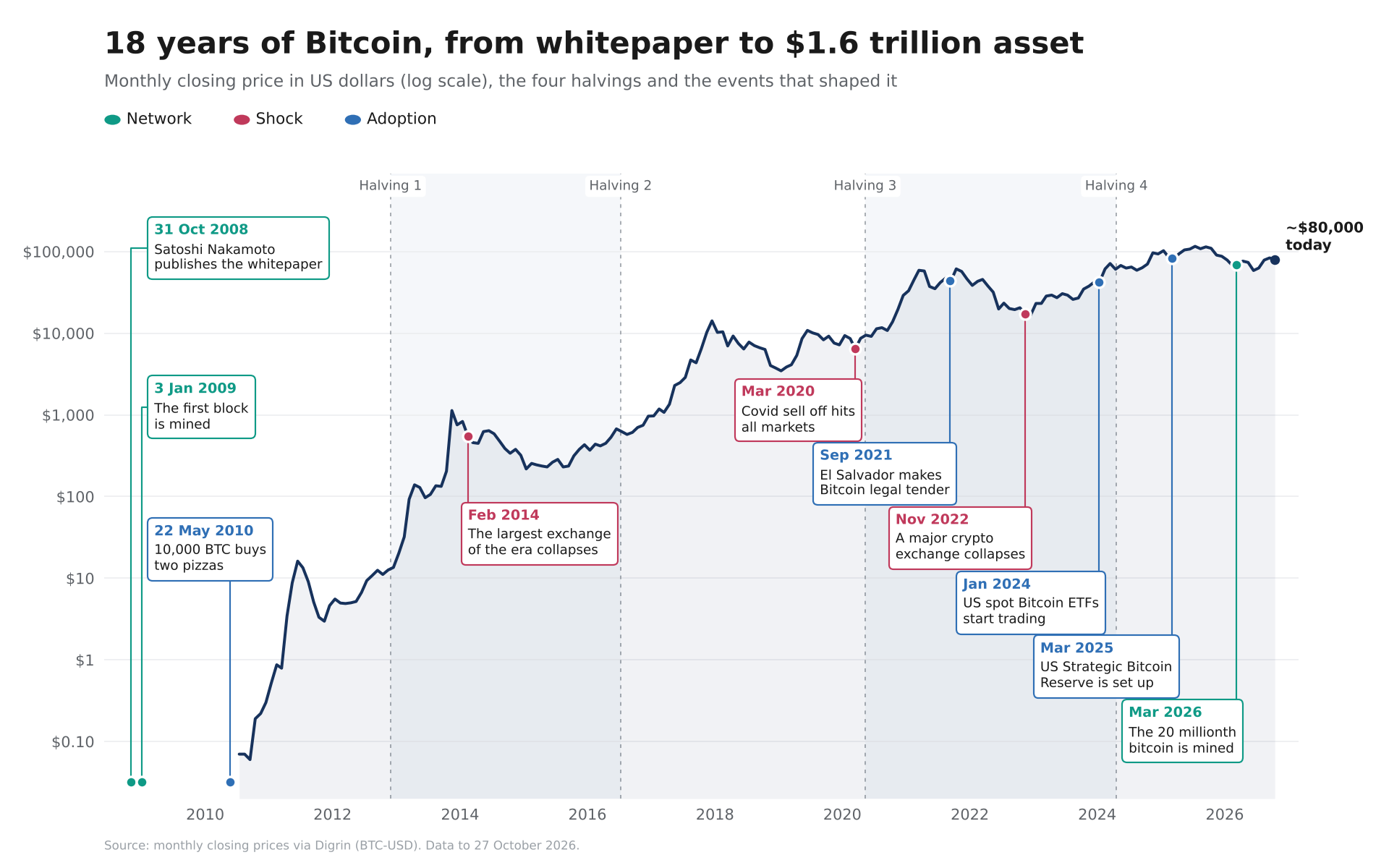
Bitcoin’s monthly closing price since 2010 on a log scale, with the four halvings and the events that shaped its history. Each major low so far has come in above the one before it.
Eighteen years in
Volatility hasn’t gone anywhere. From the October 2025 high to the June 2026 low, Bitcoin fell more than 50%, even with ETFs and companies buying. It has since recovered part of that, but it’s still well below the record.
The paper described a payment system. The market has mostly treated Bitcoin as a long term store of value and a trading asset instead. Whether it ends up being both is still an open question, 18 years after nine pages on a mailing list started it all.
Trading involves risk.
Author



 Risk Disclaimer
The content provided here is for informational purposes only. It is not intended as personal investment advice and does not constitute a solicitation or invitation to engage in any financial transactions, investments, or related activities. Past performance is not a reliable indicator of future results.
The financial products offered by the Company are complex and come with a high risk of losing money rapidly due to leverage. These products may not be suitable for all investors. Before engaging, you should consider whether you understand how these leveraged products work and whether you can afford the high risk of losing your money.
The Company does not accept clients from the Restricted Jurisdictions as indicated in our website/ T&C. Some services or products may not be available in your jurisdiction.
The applicable legal entity and its respective products and services depend on the client’s country of residence and the entity with which the client has established a contractual relationship during registration.