6 min read
 The Nasdaq is caught between two macro headwinds
The Nasdaq has come under renewed pressure this week as two forces that drove markets higher through mid-June have started to reverse at the same time.
The first is the US-Iran peace deal, which now looks far less settled than it did a week ago. After both sides signed a memorandum of understanding aimed at ending the conflict, talks were called off late last week and tensions have flared again, with the status of the Strait of Hormuz back in question. A 60-day roadmap toward a final agreement is still in place, but markets had largely priced the deal as done, with the war premium unwinding across oil and the safe-haven bid fading in gold. That move is now partially reversing, and risk appetite has cooled as traders reassess how durable the agreement really is.
The second is the Federal Reserve. Chair Kevin Warsh’s first FOMC meeting on 17 June delivered a hawkish message that continues to weigh on rate-sensitive assets. The Fed held rates at 3.50 to 3.75% but shifted its dot plot in a more hawkish direction, removed its easing bias, and dropped its forward guidance. The 10-year Treasury yield has since pushed toward 4.50%, and higher yields tend to pressure the long-duration growth and technology names that dominate the Nasdaq.
Why this matters for the Nasdaq
The index is more exposed to both of these forces than the broader market. Its heavy weighting in technology and AI-linked names makes it particularly sensitive to moves in yields, and the recent risk-on rally it rode higher was partly built on the same Iran-deal optimism that is now in doubt.
Adding to the pressure, SpaceX (SPCX), one of the most closely watched names of the recent rally, has fallen sharply since its record IPO, slipping back below its listing price as questions mount over its valuation and capital needs. As a high-profile Nasdaq-listed stock, its slide has added to the cautious tone around the index just as the broader macro backdrop has turned.
The result is a Nasdaq that has given back a meaningful chunk of its recent gains and is now trading at its lowest level in several weeks, with traders weighing whether this is a temporary pullback or the start of a deeper move lower.
The daily chart
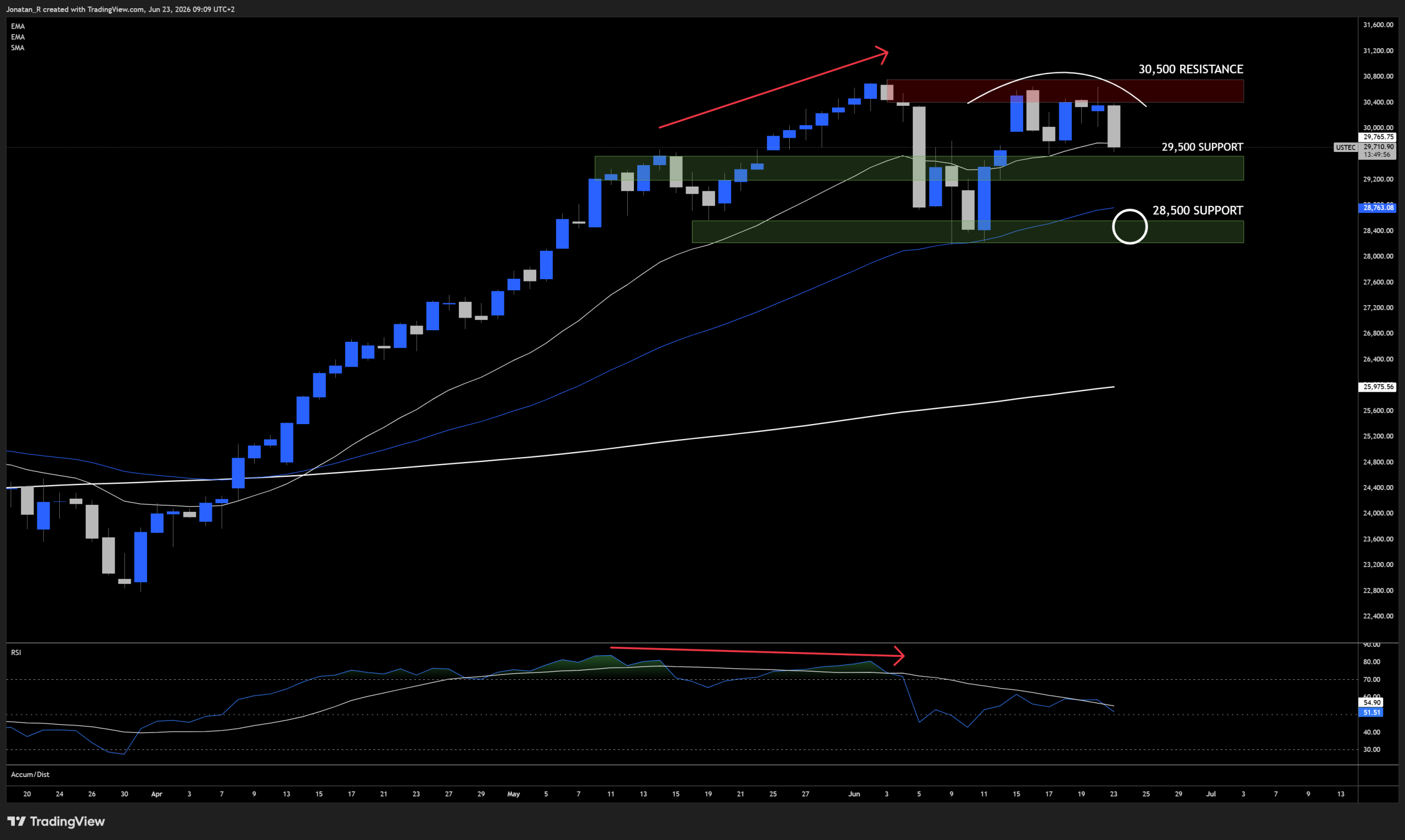
On the daily timeframe, the Nasdaq has completed a bearish divergence between price and RSI that began to form around the start of June, with price making higher highs while RSI failed to follow. That has now resolved into a lower high structure, marked by a heavy rejection around the 30,500 all-time high resistance area.
Today’s selling has been significant, pushing price back down toward the 29,500 support area, which also lines up with the daily 20 EMA. The market now appears to be forming a range between this support and the 30,500 resistance above.
The key level to watch is 29,500. A failure to hold this range low could open the door to a larger correction, with the 28,500 support area potentially coming into play on a deeper move.
The 4-hour chart
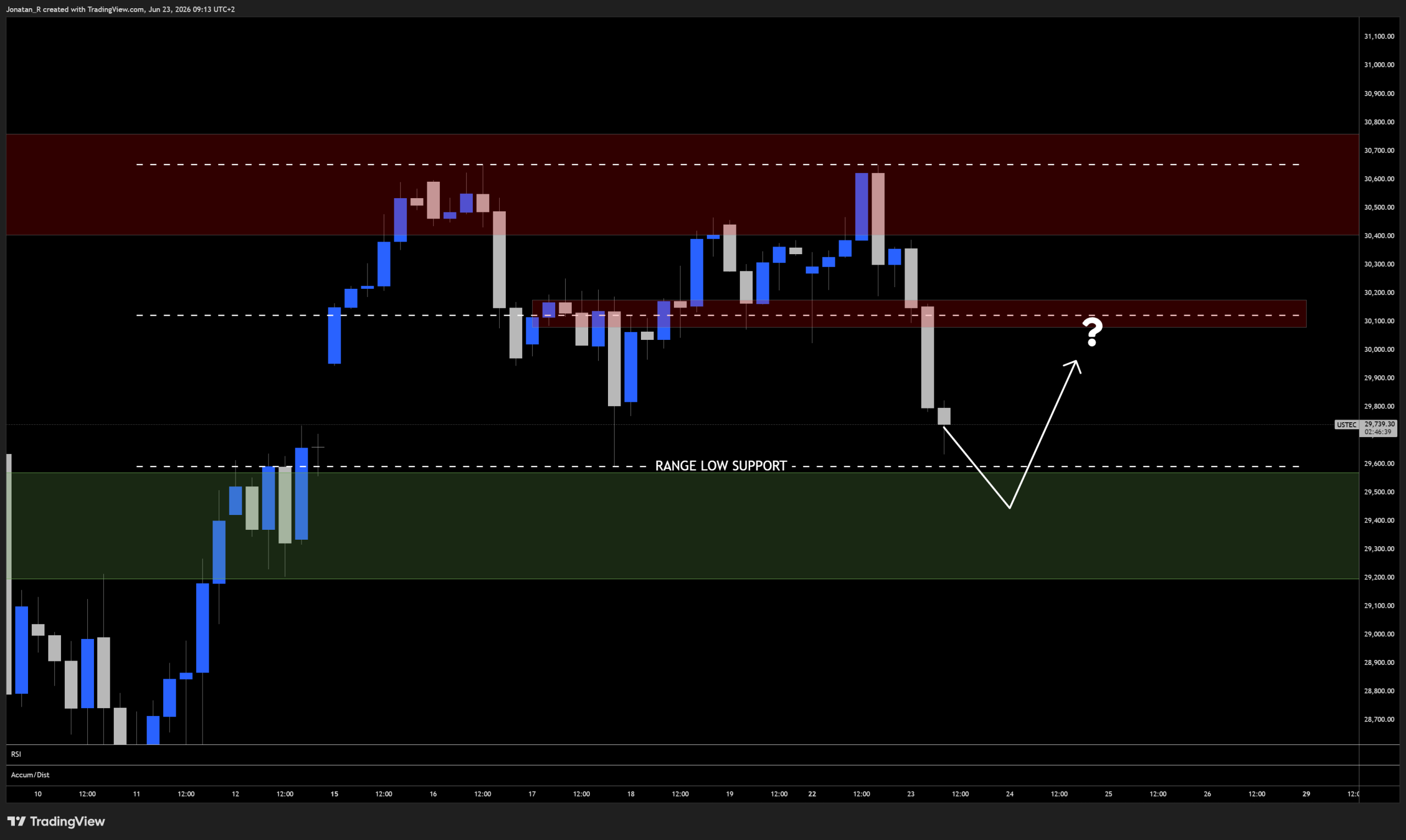
The 4-hour chart shows a clear range, with price now approaching the 29,600 range low support.
If buyers can defend this level and produce a bounce, the range equilibrium around 30,100 becomes the immediate resistance to watch above.
A failure to hold the higher timeframe support below could be the trigger for the bigger move lower described on the daily chart.
Key takeaways
- The Nasdaq is under pressure from two directions at once: a fading US-Iran peace deal and a hawkish Fed under Kevin Warsh
- Higher Treasury yields are weighing on the rate-sensitive technology and AI names that dominate the index
- The daily chart has completed a bearish divergence and shows a lower high structure, with 29,500 the key support to hold
- A break below 29,500 could open a deeper move toward 28,500
- On the 4-hour, 29,600 is the immediate range low support, with 30,100 the resistance above on any bounce
Trading involves risk.
Author



 Risk Disclaimer
The content provided here is for informational purposes only. It is not intended as personal investment advice and does not constitute a solicitation or invitation to engage in any financial transactions, investments, or related activities. Past performance is not a reliable indicator of future results.
The financial products offered by the Company are complex and come with a high risk of losing money rapidly due to leverage. These products may not be suitable for all investors. Before engaging, you should consider whether you understand how these leveraged products work and whether you can afford the high risk of losing your money.
The Company does not accept clients from the Restricted Jurisdictions as indicated in our website/ T&C. Some services or products may not be available in your jurisdiction.
The applicable legal entity and its respective products and services depend on the client’s country of residence and the entity with which the client has established a contractual relationship during registration.