8 min read
 Key takeaways
- The Bank of Japan (BoJ) raised its policy rate to 1.0% on Tuesday, its highest since 1995, yet USD/JPY is still holding above 160.
- Three forces are driving the pair right now: the US-Japan rate differential, the global risk mood, and the price of oil.
- The rate gap remains the dominant one. Even after the hike, the BoJ sits far below the Federal Reserve (Fed), keeping the dollar’s yield advantage intact.
- The Fed delivers its decision later today in Kevin Warsh’s first meeting as chair. A hold is near certain, so the tone and projections are what matter.
The BoJ delivered a historic move on Tuesday, lifting its short-term policy rate by 25 basis points to 1.0%, the highest level since 1995. The decision passed in a 7-1 vote and marked the bank’s fourth hike since it exited negative interest rates in 2024. The board also said it would pause the tapering of its government bond purchases from April 2027. Governor Kazuo Ueda was absent while recovering from a health issue, leaving Deputy Governor Shinichi Uchida to front the press conference.
For all the symbolism of a three-decade high, the yen barely responded, and USD/JPY has stayed pinned above 160. To understand why, and where the pair could go next, it helps to break the picture into the three forces currently pulling on it.
The rate differential
This remains the dominant driver. Even at 1.0%, the BoJ sits well below the Fed’s 3.50% to 3.75% range, a gap of roughly 250 to 275 basis points that continues to favour the dollar. That differential is what keeps the yen carry trade alive, where investors borrow cheaply in yen to buy higher-yielding assets elsewhere, and it puts persistent downward pressure on the currency. A single 25 basis point hike does little to close it. For the gap to narrow meaningfully, the market would likely need the Fed to turn dovish or the BoJ to signal a faster pace of hikes ahead, neither of which is the base case today.
The risk environment
The second force is global risk appetite, which works through that same carry trade. When markets are calm and risk-on, investors are happy to stay in yen-funded positions, which keeps the yen weak and supports USD/JPY. The danger runs the other way. A sharp risk-off shock, an equity selloff or a sudden spike in volatility, can trigger a rush to unwind those positions, forcing rapid yen buying and sending the pair lower fast. This is historically the most powerful source of yen strength, and it tends to override the rate gap when it hits. For now, with equities firm, the backdrop favours the carry trade rather than its unwind.
The price of oil
The third force is energy. Japan imports nearly all of its oil, so a higher crude price worsens its trade position and adds to the pressure on the yen. Oil’s earlier surge during the Strait of Hormuz crisis was part of the inflation case behind the BoJ’s hike. With the US-Iran deal now pulling crude lower, that pressure is starting to ease. The effect cuts both ways for the pair: cheaper oil is a relief for Japan’s import bill, but it also softens the inflation argument that justified the BoJ turning more hawkish in the first place.
Attention now turns to the Fed, which announces its latest decision later today. A hold at 3.50% to 3.75% is almost fully priced, so the focus is on the projections and the tone. May inflation came in at 4.2%, its highest since 2023, and some analysts expect the Fed to drop its remaining easing bias, with futures pricing even leaning towards a possible hike rather than a cut as the next move. A hawkish signal from Warsh could widen the dollar’s advantage and keep the pressure on the yen, making his first press conference the key swing factor for USD/JPY into the close.
3-day chart
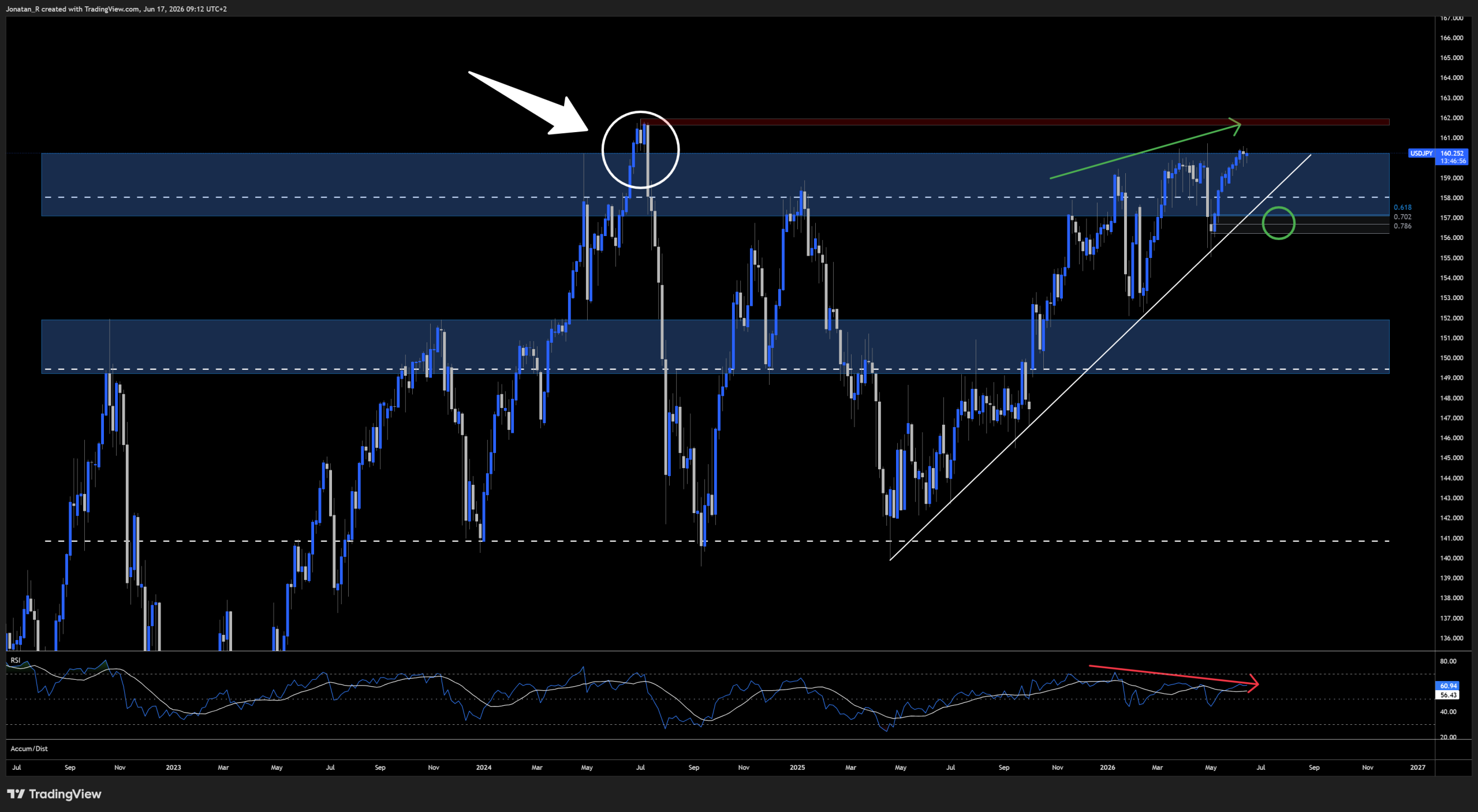
Stepping out to the 3-day chart gives a clearer view of where the pair sits in the bigger picture, and right now it sits at major higher-timeframe resistance. Price is pressing into the 160 area, the top of the broad range that USD/JPY has traded in since late 2022, and the same zone it has repeatedly stalled and turned lower from before.
The warning sign is in momentum. Price is grinding higher into that resistance while the RSI makes lower highs, a bearish divergence that signals the move up is losing strength under the surface. Notably, this is the same setup that preceded the mid-2024 carry-trade unwind, when the pair last reached this region before reversing sharply.
Just above current price sits a resistance zone around 162, which marks the high reached before that 2024 unwind. If price continues to push higher and breaks out on the lower timeframes, that level is the natural upside target to watch.
The more interesting story is to the downside. The pair is still supported by a long-running ascending trendline stretching back to the 2024 lows, which currently lines up with a local reload zone just beneath price. A clean break of that trendline and reload area would be the first technical signal that the trend is turning, and it would carry more weight if it lines up with a shift in the macro picture, a narrowing rate differential, a turn in risk sentiment, or further softness in oil.
For now, none of that has triggered, and the trend remains up while the trendline holds. But with price at multi-decade resistance, a bearish momentum divergence in play, and a history of reversals from this exact zone, this is an area worth watching closely. Should those signals start to align, it could set up an opportunity to short USD/JPY, with the caveat that the timing and the shape of any such move are impossible to predict in advance.
4-hour chart
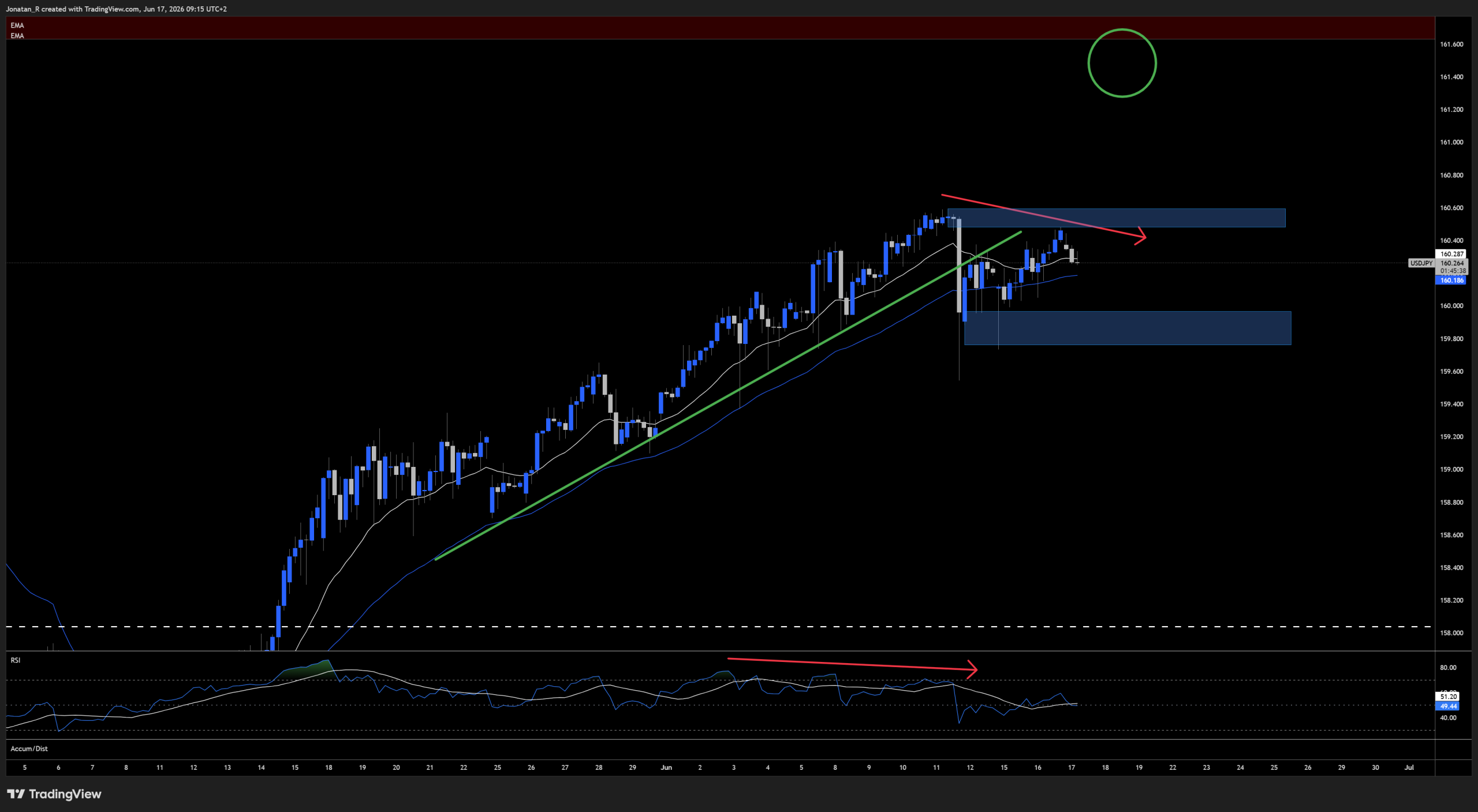
Zooming in to the 4-hour chart shows how the near-term picture is set up around current price. USD/JPY has printed a local lower high, an early sign that the short-term uptrend which carried the pair above 160 could be losing momentum. That same loss of strength shows up in the RSI, which has been making lower highs while price pushed up, echoing the bearish divergence on the higher timeframe.
For now the pair is caught between two clear levels, and the next move likely depends on which one gives way first.
- A break above local resistance at 160.6 would keep the bullish structure intact and could open the way towards the higher-timeframe targets noted above, including the 162 zone.
- A break below the 159.8 support area would suggest the short-term trend is starting to crack, and would be the first lower-timeframe confirmation of the weakness flagged on the 3-day chart.
The more compelling setup is the second one. A clean break below 159.8, particularly if it lines up with signs of the carry trade beginning to unwind or a shift in the macro drivers, could mark the start of a deeper move lower and set up a potential short. Until one of these levels breaks, the pair remains in a holding pattern, and patience for that break is the sensible approach.
Trading involves risk.
Author



 Risk Disclaimer
The content provided here is for informational purposes only. It is not intended as personal investment advice and does not constitute a solicitation or invitation to engage in any financial transactions, investments, or related activities. Past performance is not a reliable indicator of future results.
The financial products offered by the Company are complex and come with a high risk of losing money rapidly due to leverage. These products may not be suitable for all investors. Before engaging, you should consider whether you understand how these leveraged products work and whether you can afford the high risk of losing your money.
The Company does not accept clients from the Restricted Jurisdictions as indicated in our website/ T&C. Some services or products may not be available in your jurisdiction.
The applicable legal entity and its respective products and services depend on the client’s country of residence and the entity with which the client has established a contractual relationship during registration.