10 min read
 Weekly Recap
Earnings: Tesla leads the decline among megacap stocks as the AI trade fragments
The second-quarter reporting season became a test of the AI investment boom, with Tesla as the most significant loser. Tesla shares fell 14.6% on Thursday to $319.69, as improved revenue and deliveries were outweighed by a profit miss, compressed automotive margins, negative free cash flow, and guidance that 2026 will require substantial investment in AI, Robotaxi, and Optimus. Alphabet added to market concerns by raising its capital expenditure guidance to $205 billion for the year, resulting in a 7% decline in its share price the same day.
Not all reports missed expectations. Intel’s revenue grew 25% year-on-year to $16.1 billion, its fastest growth in over fifteen years, but shares still fell 7.89% on Friday as investors reacted to increased spending plans. The “Magnificent Seven” collectively lost nearly $800 billion in market value on Thursday, and a major semiconductor index dropped 4.4% on Friday. Investors are increasingly distinguishing between companies investing heavily in AI and those already generating returns from it.
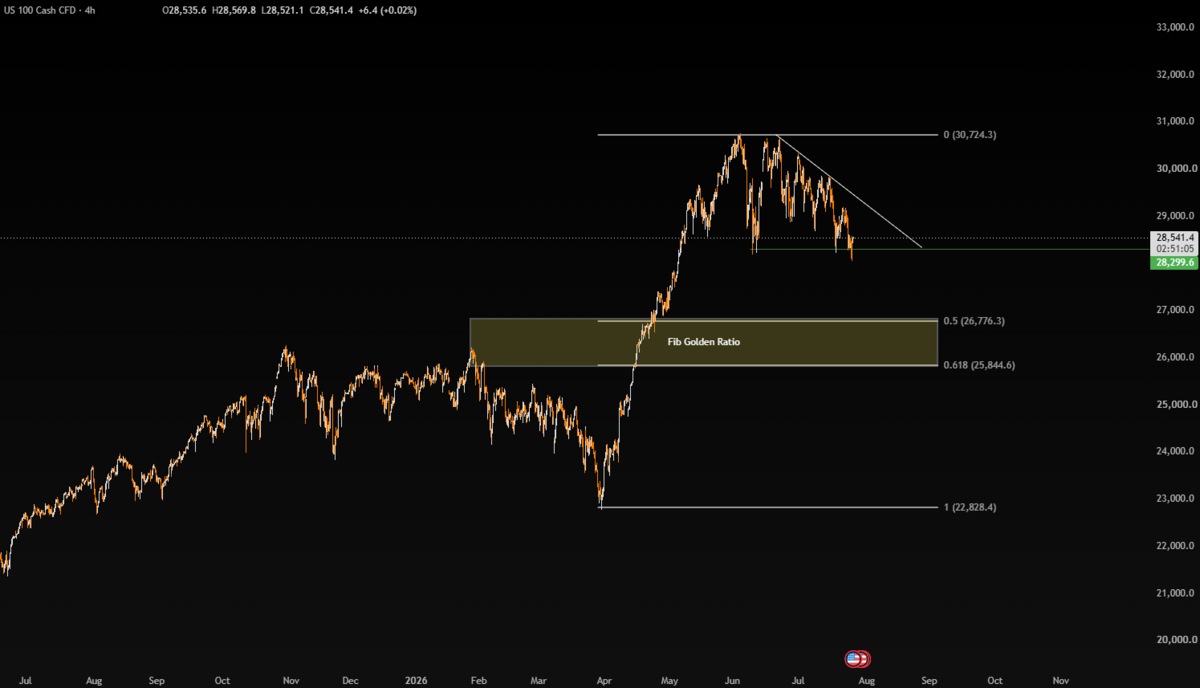
The US100 ended the week at 28,128.34, down 1.15% on Friday and about 1.6% for the week. This marks its second consecutive weekly decline and the first back-to-back loss since late March. With higher oil prices pushing the 10-year Treasury yield above 4.7% and new US tariffs adding pressure, upcoming results from Microsoft, Meta, Apple, and Amazon will determine whether the US 100 stabilizes or faces further declines.
Oil: UK Brent tops $100 as US-Iran strikes escalate
Brent briefly exceeded $100 a barrel for the first time since late May, reaching a two-month high, before retreating to $96.78 on Friday. This near-4% drop was its largest single-day decline since late June. Despite the pullback, Brent finished the week up approximately 12%, driven by escalating US-Iran tensions.
Multiple factors drove the volatility. US forces conducted a sixth consecutive night of strikes on Iranian military sites. Iran responded by targeting a Kuwaiti desalination plant and US bases in the Gulf, while Houthi forces attacked two Saudi tankers and threatened to close a key Red Sea chokepoint. Tanker traffic through the Persian Gulf and Red Sea was disrupted, prompting the White House to exempt some energy products from new tariffs to mitigate domestic impact.
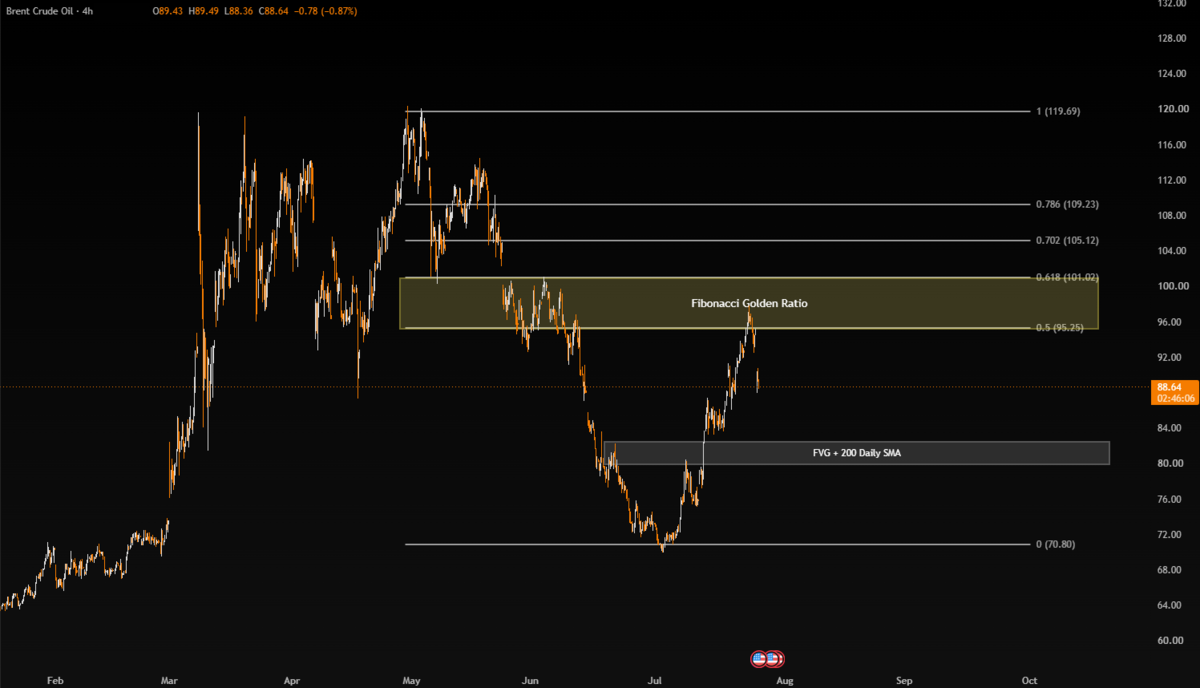
Friday’s pullback followed reports, attributed to Pakistani sources, that Islamabad is facilitating renewed US-Iran negotiations with support from China. This tentative diplomatic effort is pivotal: credible de-escalation could reduce the risk premium in Brent, while renewed disruptions to Gulf or Red Sea shipping could push Brent back toward $100.
Gold: a rising dollar caps the safe-haven bid
Gold closed the week at approximately $4,055 an ounce, up about 1%, as opposing forces kept prices range-bound. Escalating Middle East tensions and the AI trade derating increased safe-haven demand, while a stronger dollar and higher yields limited gains.
The dollar was the main constraint. The US Dollar Index reached a three-week high, and the 10-year Treasury yield rose above 4.7% mid-week, its highest since January 2025, as the oil spike renewed inflation concerns and reduced expectations for rate cuts. In this environment, investors favored the dollar and interest-bearing assets, limiting Gold’s advance despite heightened geopolitical risk.
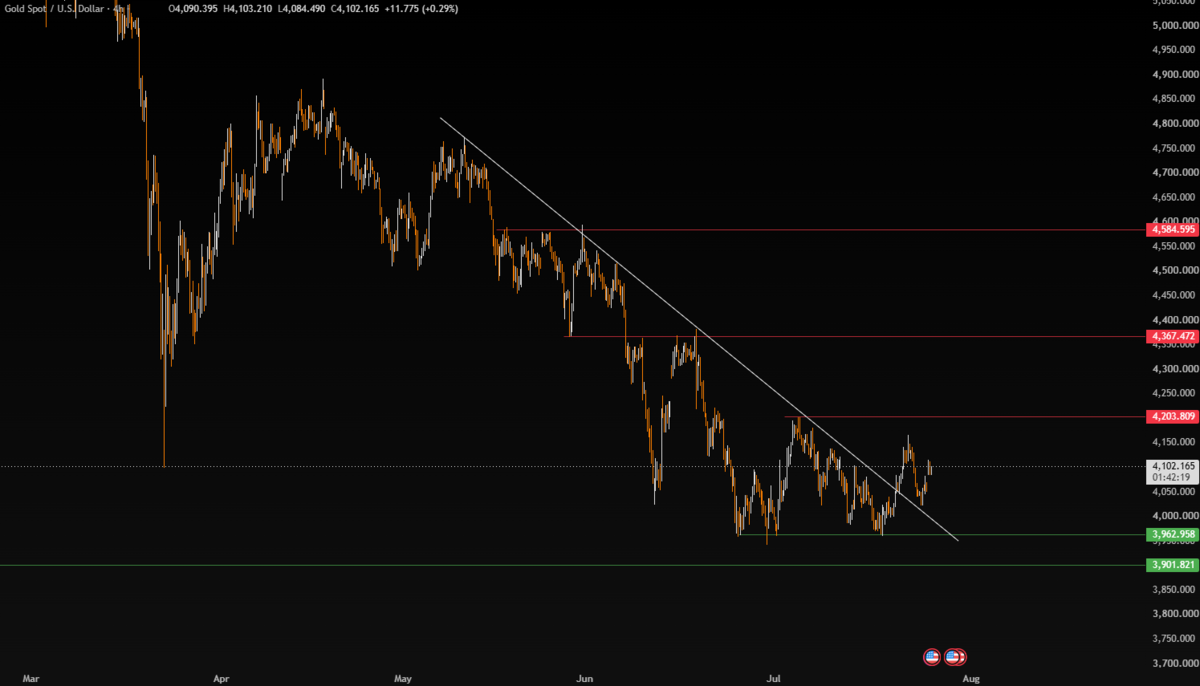
This balance makes the upcoming Federal Reserve decision a key test for Gold. If Chair Warsh’s committee adopts a dovish stance or highlights rising growth risks, the dollar may weaken and allow Gold to rally. Conversely, a hawkish hold that leaves further hikes possible would likely support the dollar and limit Gold’s upside.
Indian markets: Nifty 50 slides for a fifth day as oil bites
The Nifty 50 declined for a fifth consecutive session on Friday, falling 0.43% to close at 23,767.45, below the 23,800 level. The Sensex ended at 76,059.77. For the week, the Nifty 50 dropped about 2.3%, as high crude prices, with UK Brent above $100, and the Iran conflict kept investors cautious. Selling was concentrated in auto, metal, and energy stocks.
Earnings provided limited reassurance. Infosys reported a 12% increase in first-quarter profit, but cautious FY27 revenue guidance of 1.5–3.0% tempered the positive result. IndusInd Bank declined 6%. Broader indices underperformed, with midcap and smallcap indices down about 1.9% and 2.2%, respectively. Further caution arose as the HSBC flash India Composite PMI dropped to a three-year low of 54.3 in July from 57.1, reflecting a services-led slowdown amid firming price pressures.
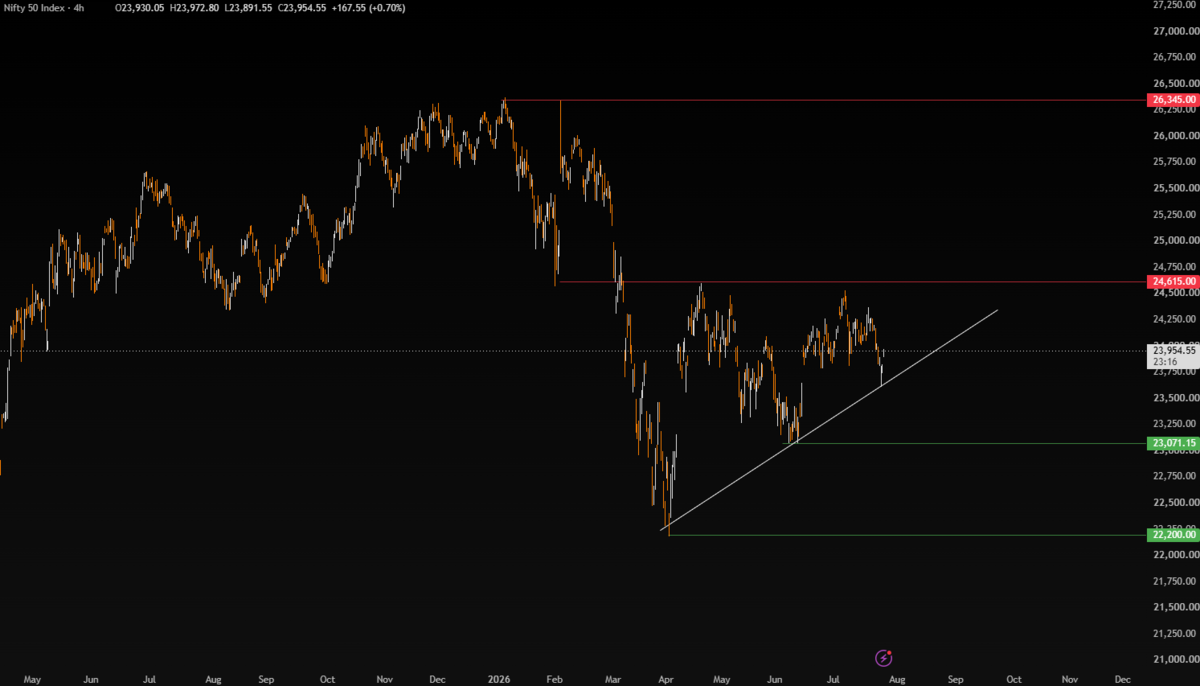
The rupee remained near record lows at around 96.50 per dollar, with reports indicating that the Reserve Bank of India sold dollars near 96.80 to stabilize the currency. The near-term outlook for the Nifty 50 depends on crude prices: sustained de-escalation would provide relief, while another spike in UK Brent would keep both equities and the rupee under pressure.
Eurozone: ECB delivers a hawkish hold, September hike still live
The European Central Bank left all three key rates unchanged on 23 July: the deposit rate at 2.25%, the main refinancing rate at 2.15%, and the marginal lending rate at 2.40%. This pause came just one month after its first hike since 2023. The decision was unanimous and widely anticipated, shifting focus to President Christine Lagarde’s remarks.
Lagarde’s tone was firm, describing the hold as a tactical pause rather than the end of tightening. She warned that prolonged high energy prices are “more likely…to drive up broader inflation” through indirect and second-round effects. Although euro-area inflation eased to 2.8% in June, the ongoing energy shock has markets expecting another hike at the 10 September meeting.
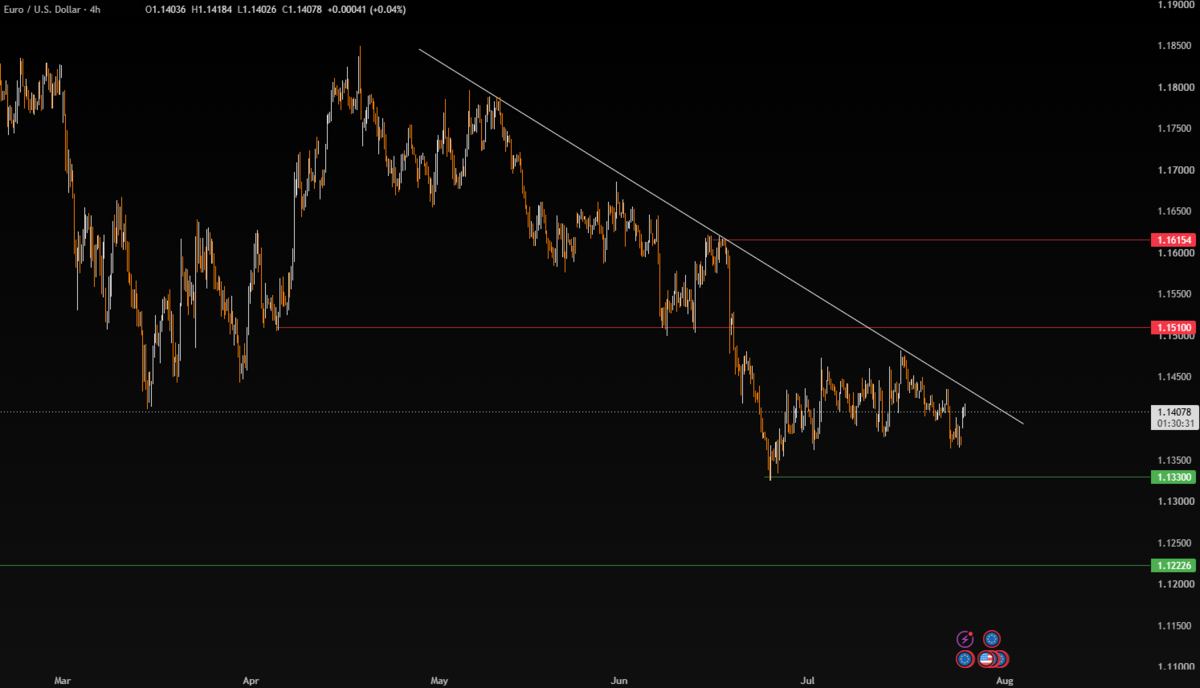
EUR/USD traded near 1.138, down from its mid-July high of around 1.148 as the dollar strengthened ahead of the Fed decision. This week’s euro-area Q2 GDP and July inflation data will test the ECB’s stance. Stronger data and a hawkish outlook could support EUR/USD, while a stronger dollar following the FOMC could keep the pair under pressure.
Pakistan markets: KSE-100 drops 2.7% into the SBP decision
The KSE-100 declined 2.72% for the week, losing 4,782 points to close at 171,021.20 on Friday, as the US-Iran conflict and rising oil prices weighed on sentiment. The index briefly fell below 170,000 intraday before a late-session rebound faded, reflecting the market’s sensitivity to energy costs due to Pakistan’s import-dependent economy.
In addition to geopolitical concerns, investors were cautious ahead of the State Bank’s Monetary Policy Committee decision on 27 July. Brokerages expect the policy rate to remain at 11.5%, following April’s unexpected 100-basis-point hike, as the Bank assesses external risks to inflation. The week also saw the introduction of a new 10% US tariff on Pakistani goods as part of recent US trade measures.
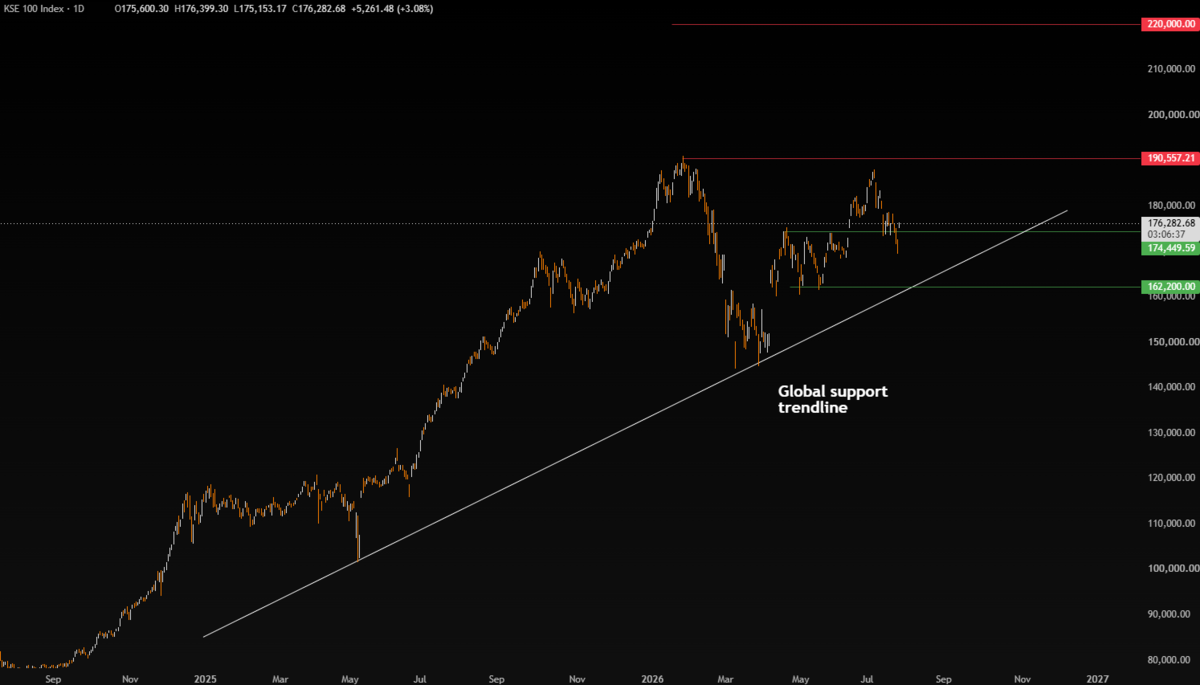
The rupee provided rare stability, strengthening slightly to 277.87 against the dollar. With the SBP expected to maintain current rates, the KSE-100’s outlook depends on external factors, including the conflict’s trajectory and UK Brent prices, as well as anticipated strong June-quarter earnings.
Week Ahead
FOMC Decision — Wednesday, 29 July, 18:00 UTC
The Federal Reserve will announce its decision on Wednesday at 18:00 UTC, followed by Chair Kevin Warsh’s press conference at 2:30 pm. Markets broadly expect the committee to keep the federal funds rate at 3.50–3.75% for a fifth consecutive meeting, though a quarter-point hike remains a possibility.
As this is a non-projection meeting, the statement’s language will be key. The June dot plot indicated nine members expect at least one hike this year, with none projecting cuts. Softer June CPI at 3.5% and lower PPI suggest patience, but oil-driven inflation concerns have led markets to price in an 82% chance of a September hike. The advance Q2 GDP reading and June PCE price index, the Fed’s preferred inflation measure, will be released Thursday. Chair Warsh has also moved away from traditional forward guidance.
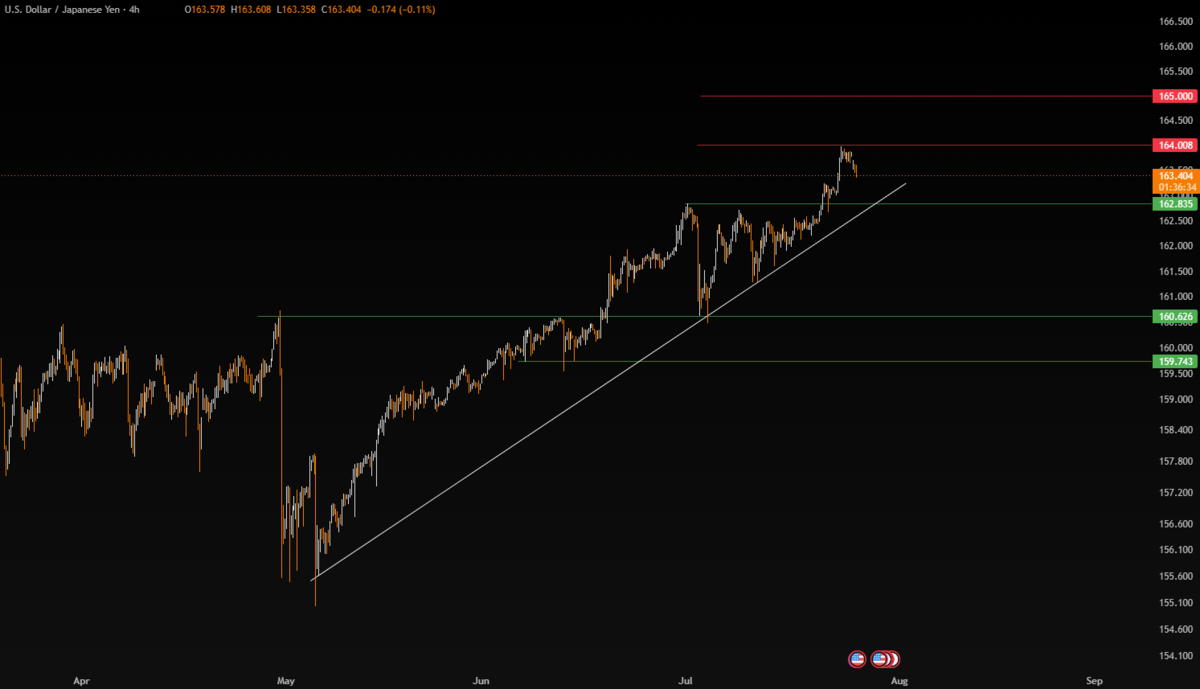
USD/JPY trades near 163.81, close to a four-decade low for the yen, as the wide rate gap between the Fed and Bank of Japan supports the carry trade. The BoJ meets on 30–31 July. A hawkish Fed hold that keeps a September hike likely would widen the gap and could push USD/JPY higher. A dovish stance acknowledging growth risks could lower USD/JPY and provide relief for the yen.
Bank of England Decision — Thursday, 30 July, 11:00 UTC
The Bank of England will announce its decision on Thursday at midday UK time, alongside its quarterly Monetary Policy Report, which provides updated forecasts and typically the clearest guidance on future policy. This is the first meeting since June CPI came in lower than expected, intensifying debate within the committee.
The Monetary Policy Committee kept the Bank Rate at 3.75% in June by a 7–2 vote, with two members, including Chief Economist Huw Pill, favoring a hike. June inflation eased to 2.6%, a fuel-driven, softer-than-expected result, reviving some expectations of easing. However, the Bank projects inflation will rise above 3.25% later this year due to the energy shock and persistent services inflation. The report will show how the MPC balances declining headline inflation against these upside risks.
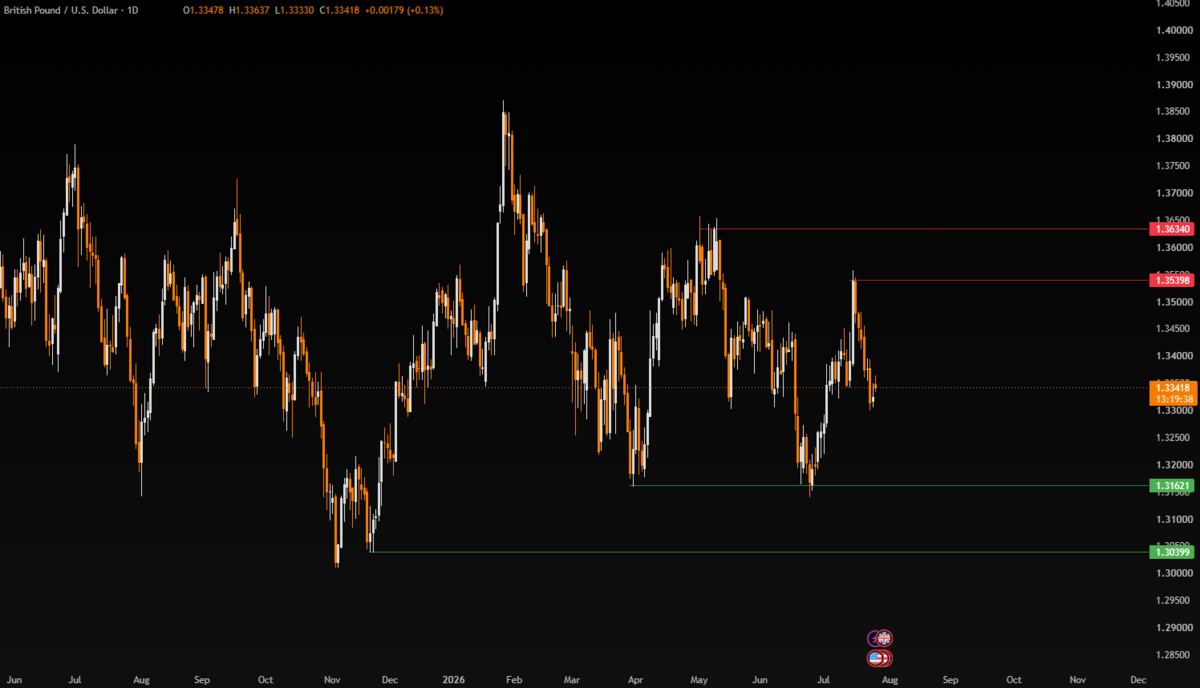
GBP/USD trades near 1.3315, weakened by lower CPI and a stronger dollar. A hawkish hold or an upward revision to the inflation outlook that reduces expectations of rate cuts would support GBP/USD. Conversely, a dovish shift or an unexpected cut would likely pressure the pair, especially if the dollar strengthens further after the FOMC decision.
Bottom line
The main driver this week is a series of major central bank meetings—the Fed, Bank of England, Bank of Japan, and Pakistan’s State Bank—coinciding with the US-Iran oil spike and a sharp decline in AI-related stocks. The Fed and BoE must assess whether the energy surge is temporary or signals broader inflation, and their guidance will influence USD/JPY and GBP/USD.
Trading involves risk.
Author



 Risk Disclaimer
The content provided here is for informational purposes only. It is not intended as personal investment advice and does not constitute a solicitation or invitation to engage in any financial transactions, investments, or related activities. Past performance is not a reliable indicator of future results.
The financial products offered by the Company are complex and come with a high risk of losing money rapidly due to leverage. These products may not be suitable for all investors. Before engaging, you should consider whether you understand how these leveraged products work and whether you can afford the high risk of losing your money.
The Company does not accept clients from the Restricted Jurisdictions as indicated in our website/ T&C. Some services or products may not be available in your jurisdiction.
The applicable legal entity and its respective products and services depend on the client’s country of residence and the entity with which the client has established a contractual relationship during registration.