8 min read
 US stocks and the jobs surprise
August payrolls landed at 162,000 on Friday against a consensus near 55,000, with the two previous months revised up by a combined 55,000 and unemployment steady at 4.1%. Bonds reacted first. The 10-year Treasury yield rose to 4.78%, its highest since November 2023, while the 2-year at 4.37% and the 5-year at 4.55% both set 52-week highs. Odds of a hike at the 15 and 16 September 2026 FOMC moved to roughly 65%, up from a coin flip a day earlier.
Equities gave part of the week back on Friday, with the S&P 500 down 0.38% to 7,718, the Dow 0.51% to 53,413 and the Nasdaq 0.29% to 26,506. On the week the S&P 500 still added 0.1% and the Nasdaq 0.4%, a second straight positive week, while the Dow lost 0.3%. AI spending stayed the main support, with Nvidia up almost 6% on its confirmed $12.9 billion purchase of Hugging Face.
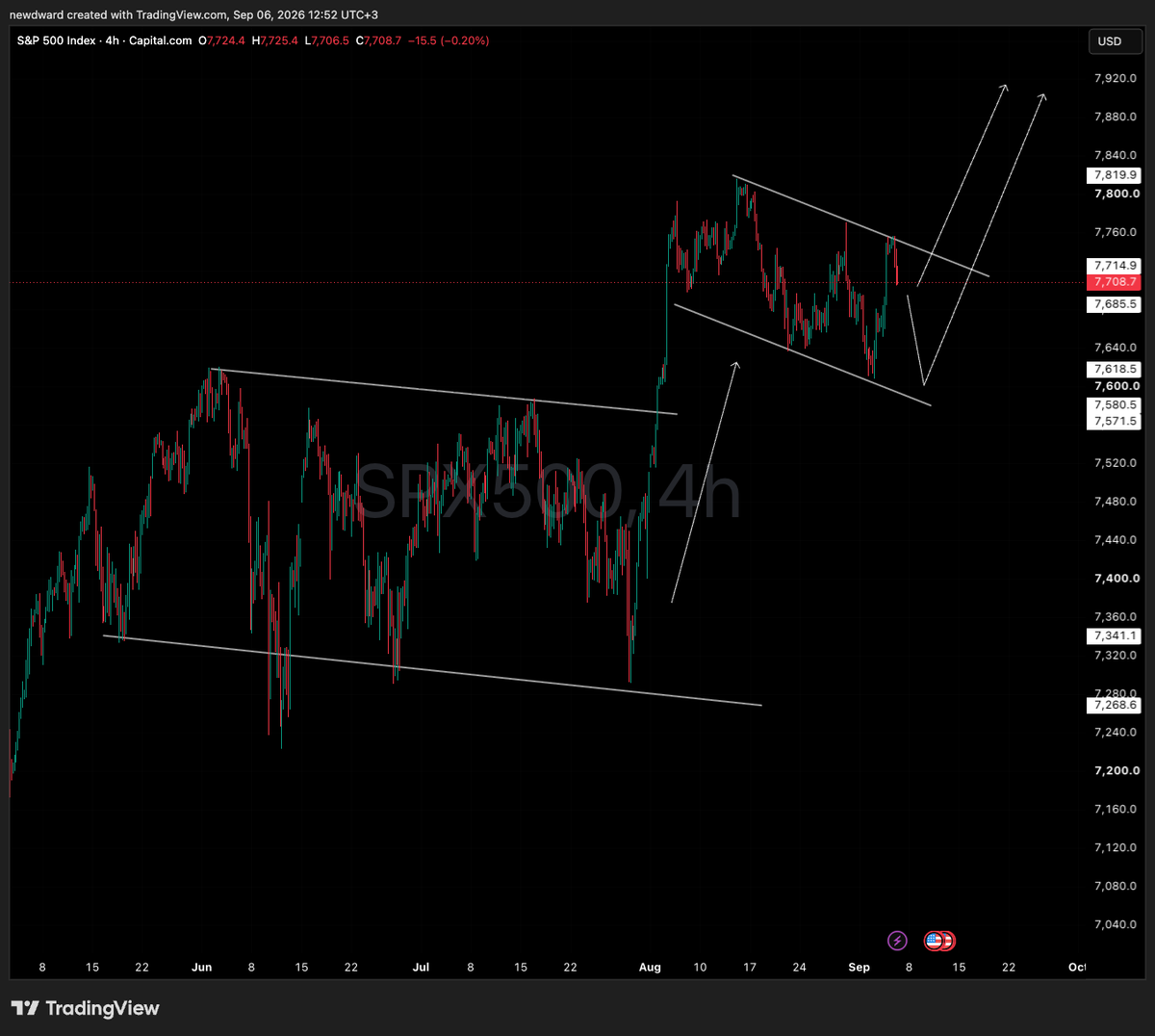
The index trades at 7,708 and has spent three weeks inside a descending channel that began at the 7,819.9 record on 17 August. The upper boundary now runs near 7,715 and the lower near 7,580, with 7,685.5 the first support inside it and 7,618.5 below that. A close above the channel top and 7,714.9 would open the way toward 7,900 and 8,000, both fresh records. A rejection there leaves the 7,618.5 to 7,571.5 band, where the channel floor sits, as the next test.
Oil, Hormuz and the OPEC+ pause
Brent settled at $96.28 on Friday after gaining more than 8% on the week, its strongest weekly performance since July. The move came from the conflict, not the balance sheet: the US and Iran exchanged missile strikes, Israel’s defence minister threatened attacks on Iranian energy infrastructure, and Vice President JD Vance said Washington will not talk while Iranian forces keep hitting ships in the Strait of Hormuz. Throughput there is near 4.9 million barrels a day against 21.6 million before the war. OPEC+ met on Sunday and was expected to hold October output.
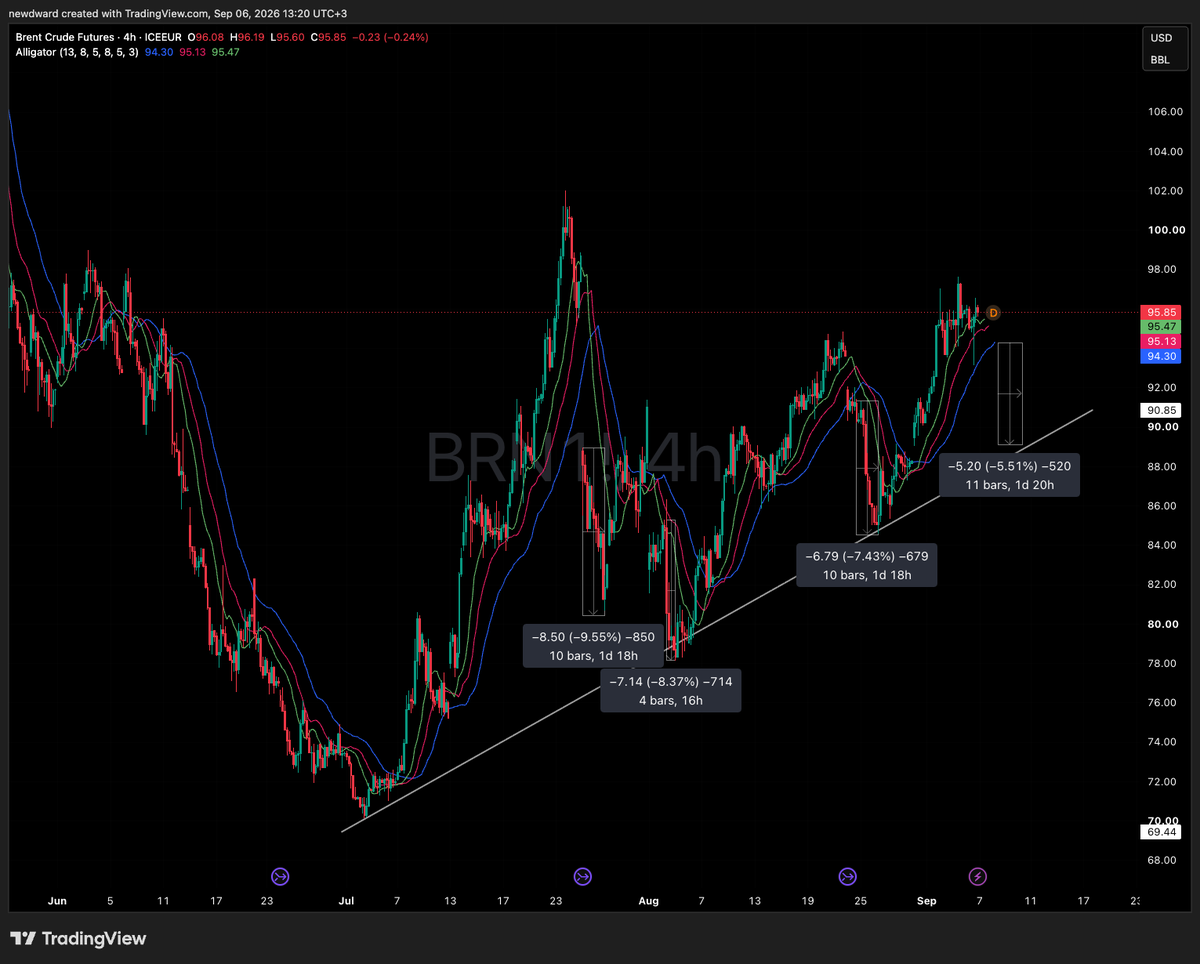
Brent trades at 95.85 with the Alligator lines at 95.47, 95.13 and 94.30, and the rising trend line from the early-July low at 69.44 now passing through roughly 90.85. The indicator has been a workable trigger this quarter: on each of the four occasions price closed down through all three lines, the leg that followed ran 9.55%, 8.37%, 7.43% and 5.51%. Another close below 94.30 would put 90.85 and the trend line in play, while holding above leaves the early-September high near 98 as the level to clear.
ECB Main Refinancing Rate (Thursday)
The week starts slowly. US markets close on Monday for Labor Day and Tuesday and Wednesday carry nothing first-tier, so the calendar opens on Thursday. All 65 economists in the Reuters poll expect 25 basis points, taking the deposit rate to 2.50% and the main refinancing rate to 2.65% from 2.40%. August flash inflation was 3.3% from 2.9%, driven almost entirely by energy at 14.3% year on year against 10.3% in July, while core eased to 2.4%. Pressure is imported rather than broad, which is why 91% of economists see 2.50% as the peak while futures price a third increase.
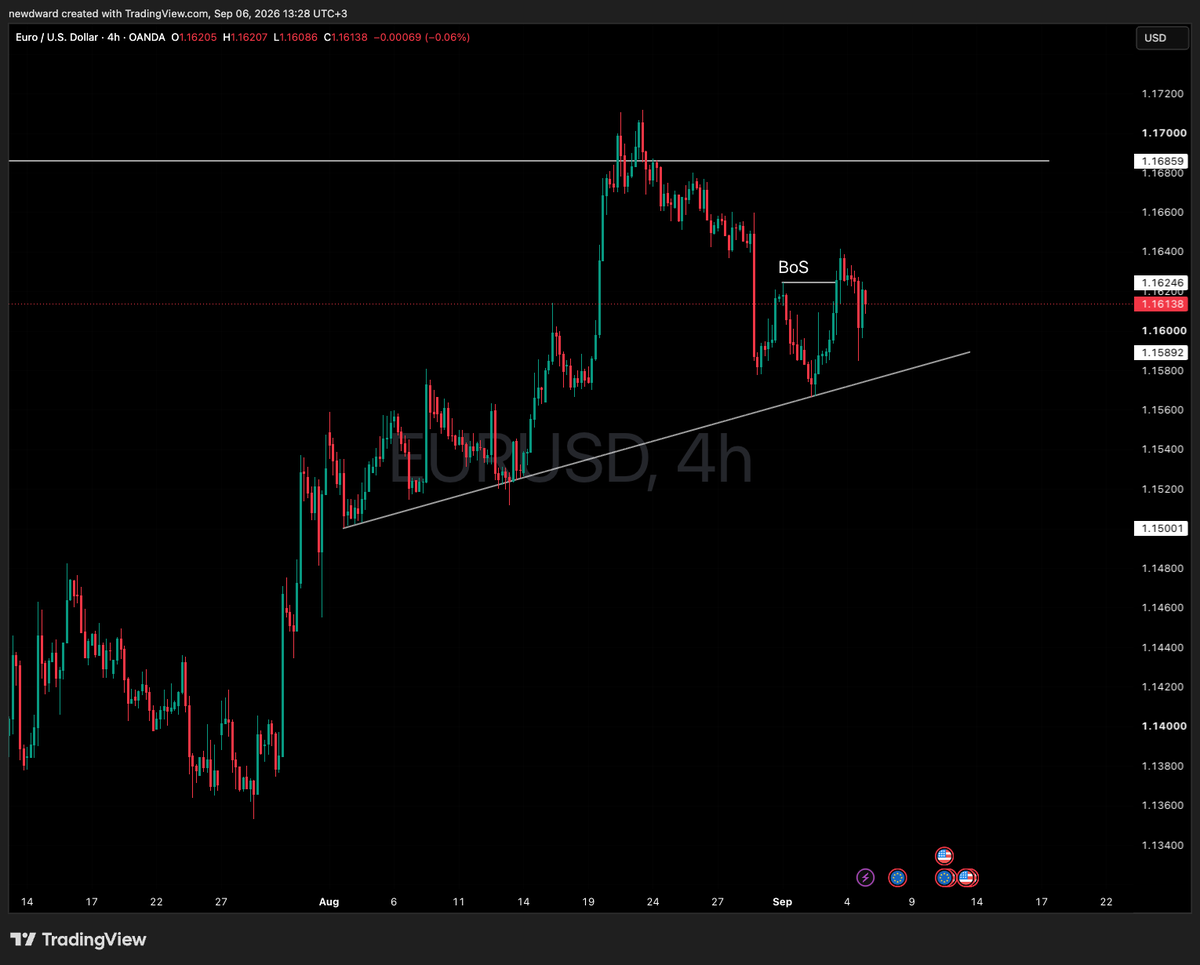
EUR/USD trades at 1.16138. The rising trend line from the 3 August low near 1.15001 now runs close to 1.15892, and the pair broke structure at 1.16246 in early September before stalling below the 1.16859 line from late August. With a hike this well telegraphed, the pricing tends to happen before the release rather than on it, and a move that runs too far into Thursday leaves room for a fade once the statement lands. A close back under the trend line would shift attention toward 1.15001.
US PPI m/m (Thursday)
August producer prices follow at 8:30 ET the same day. July final demand was flat against a 0.2% forecast and up 4.7% on the year, with core at 0.4% monthly. The flat headline was an energy story: energy fell 3.1% and gasoline 5.7%, covering more than half of the 0.7% drop in goods. That offset is unlikely to repeat after Brent gained 21% in August, which makes this the first read on whether the shock is moving down the pipeline.
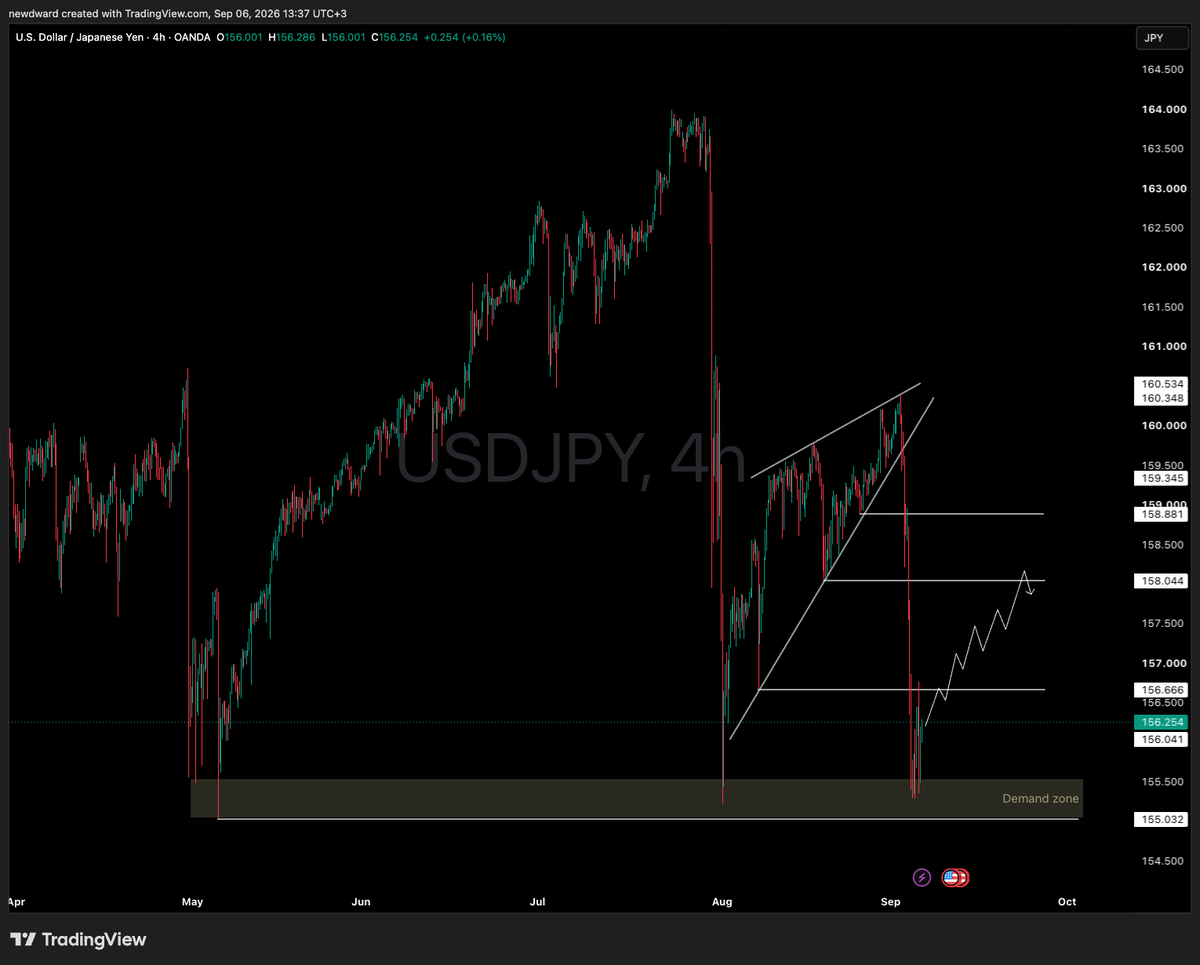
USD/JPY trades at 156.254 after a rising wedge from the early-August low broke down. Price fell from 160.534 into the demand zone at 155.03 to 155.50 over 2 and 3 September, when the yen gained about 1.5% on Bank of Japan hike bets. A move at the 17 and 18 September meeting is close to fully priced. A retracement toward 158.044, roughly the midpoint of the drop, is standard after a wedge break, with 156.666 the first level on the way. Losing 155.00 would take the demand zone out of the picture.
UK GDP m/m (Friday)
The ONS publishes July monthly GDP at 7:00 UK time. June grew 0.3% after a flat May, and the three months to June ran 0.4% against 0.6% to May. Services did the work at 0.4% on the month, with IT up 2.7%, while production fell 0.2% and construction 0.1%. The Bank of England held Bank Rate at 3.75% on 30 July on a 6-3 vote, the dissenters preferring 4.00%, and the next MPC decision is 17 September. The pound sits between a central bank that is not moving and two that may.
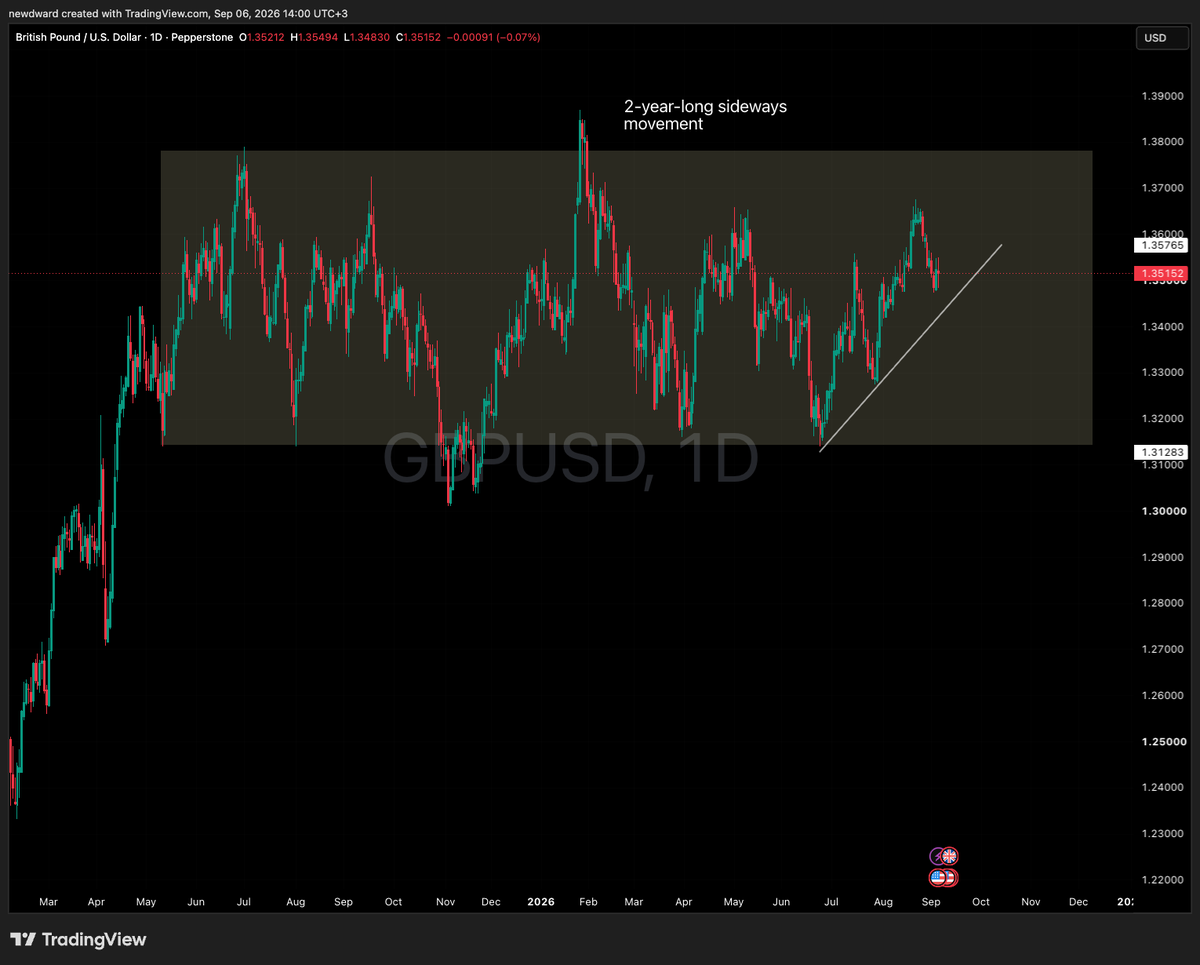
On the daily chart GBP/USD trades at 1.35152 and has spent two years inside roughly 1.31283 to 1.38000. The rising line from the July low near 1.3128 is intact and nothing in the higher-timeframe structure has changed.
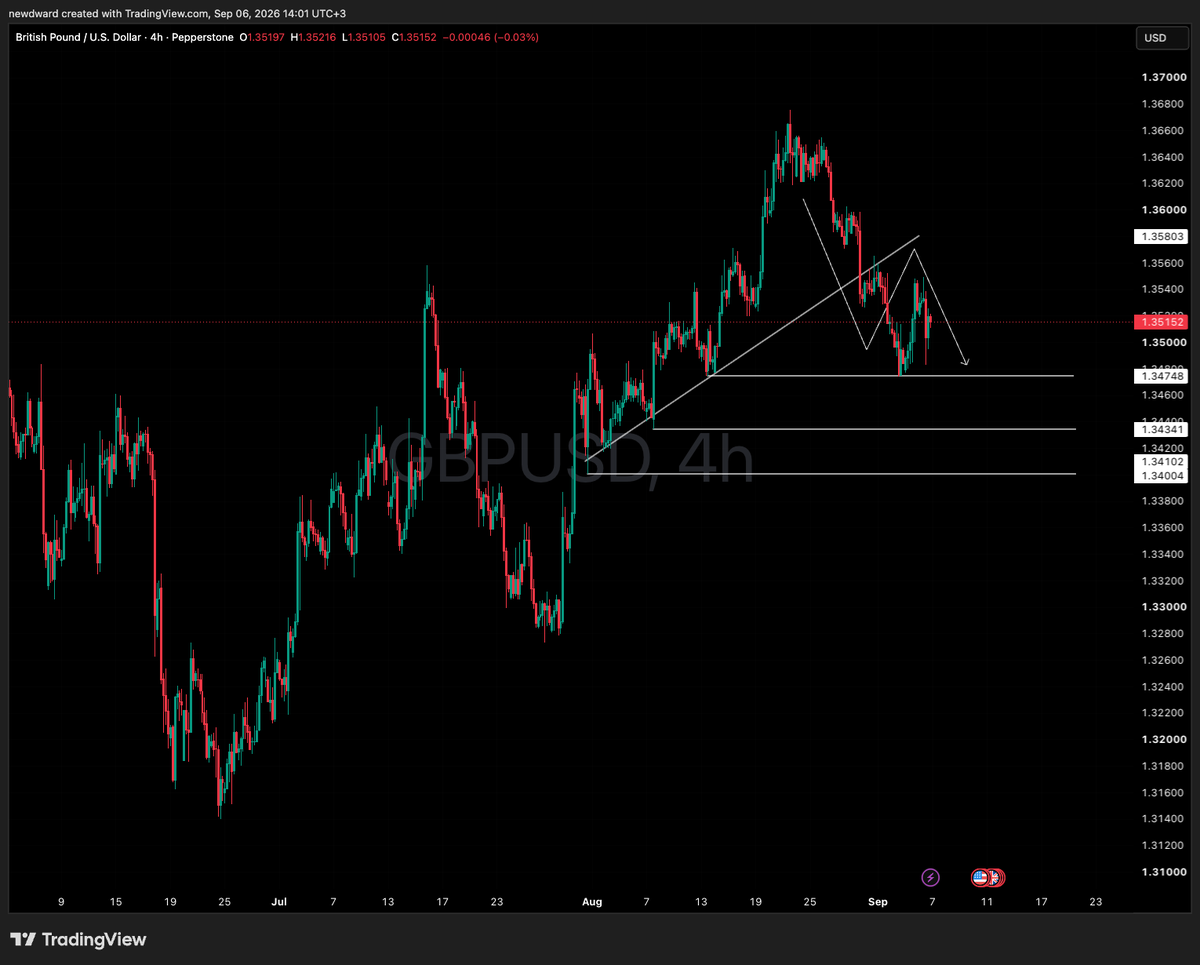
The four-hour chart tells a different story. The rising line from the early-August low broke in the first days of September, price failed at 1.35803 and has traded below it since. Support sits at 1.34748, then 1.34341 and 1.34102. A soft print would test 1.34748 first, still well inside the daily range, while a stronger one puts 1.35803 back in play.
US CPI y/y (Friday)
August CPI arrives at 8:30 ET with consensus at 3.4% year on year, unchanged from July. July was 0.1% on the month, with core at 0.2% and 2.5% annual. Shelter accounted for roughly two thirds of the monthly increase, and energy fell 1.5% on the month while running 14.7% higher on the year. The split is the whole argument: headline is an energy shock, core is close to target, and Kevin Warsh has said underlying inflation has not meaningfully improved. This release decides how much of the 65% hike pricing survives the weekend.
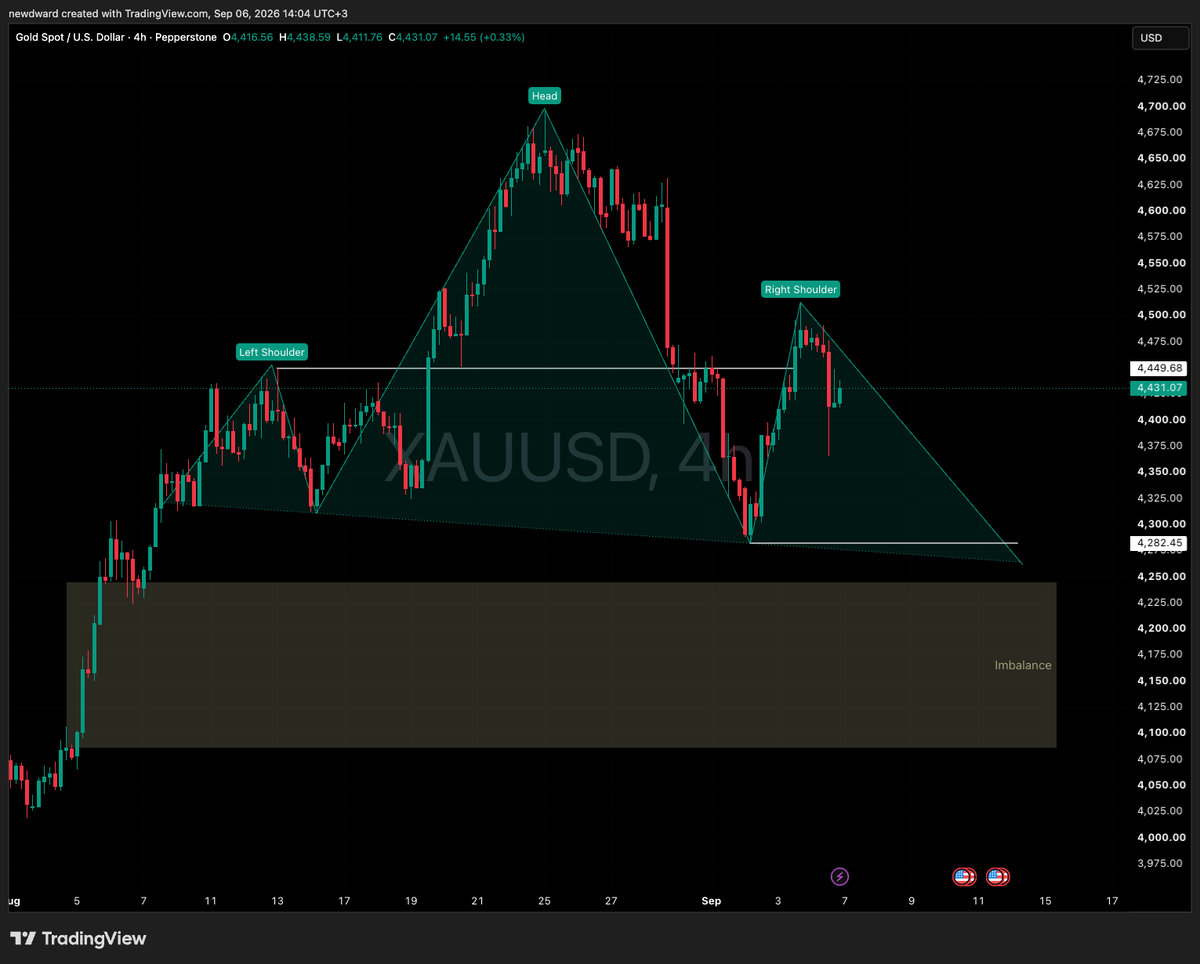
Gold trades at 4,431.07 and is drawing a head and shoulders on the four-hour chart: left shoulder at 4,449.68 on 13 August, head near 4,700 on 25 August, right shoulder near 4,510 on 4 September. The neckline slopes down to about 4,282.45, and below it sits the imbalance left by the early-August advance between 4,090 and 4,250. A close under the neckline would put that gap in range, while a reclaim of 4,449.68 takes the right shoulder apart. The structural bid is still there: the People’s Bank of China added 20 tonnes in July, a 21st straight month, lifting reserves to 2,366 tonnes.
Bottom line
The week is back-loaded. Nothing first-tier lands before Thursday, and then the ECB decision, US PPI, UK GDP and US CPI arrive inside 30 hours, the last data the Fed sees before 15 and 16 September. A firm PPI followed by a hot CPI would harden the case for a hike, keep the 10-year near 4.78% and leave the equity channel and gold’s neckline under pressure. A soft pair would do the opposite. Oil sits outside that logic, where the Hormuz headlines set the range.
Trading involves risk.
Author



 Risk Disclaimer
The content provided here is for informational purposes only. It is not intended as personal investment advice and does not constitute a solicitation or invitation to engage in any financial transactions, investments, or related activities. Past performance is not a reliable indicator of future results.
The financial products offered by the Company are complex and come with a high risk of losing money rapidly due to leverage. These products may not be suitable for all investors. Before engaging, you should consider whether you understand how these leveraged products work and whether you can afford the high risk of losing your money.
The Company does not accept clients from the Restricted Jurisdictions as indicated in our website/ T&C. Some services or products may not be available in your jurisdiction.
The applicable legal entity and its respective products and services depend on the client’s country of residence and the entity with which the client has established a contractual relationship during registration.