12 min read
 Weekly Recap
U.S. global stocks: Dow scales record high as Great Rotation deepens
The Dow Jones closed at a record high of 52,900.07 on Thursday, July 2, rising 594.83 points or 1.14% after a softer-than-expected June jobs report delayed Fed rate hike expectations and supported the Great Rotation trade. The index ended the holiday-shortened week with a 2% gain. The S&P 500 rose 1.8% to 7,483.24.
Technology stocks remained under pressure. The Nasdaq declined 1.61% on Thursday amid a semiconductor sell-off, with Micron down over 10%, Applied Materials falling 7.4%, and AMD dropping 4.3%. Tesla fell 7.5% despite Q2 deliveries of 480,126 vehicles, exceeding Wall Street forecasts. Additional catalysts included reports that OpenAI was discussing a 5% stake sale to the US government and that Meta (-4.9%) was considering monetizing excess compute capacity, both of which raised new questions about the sustainability of AI infrastructure.
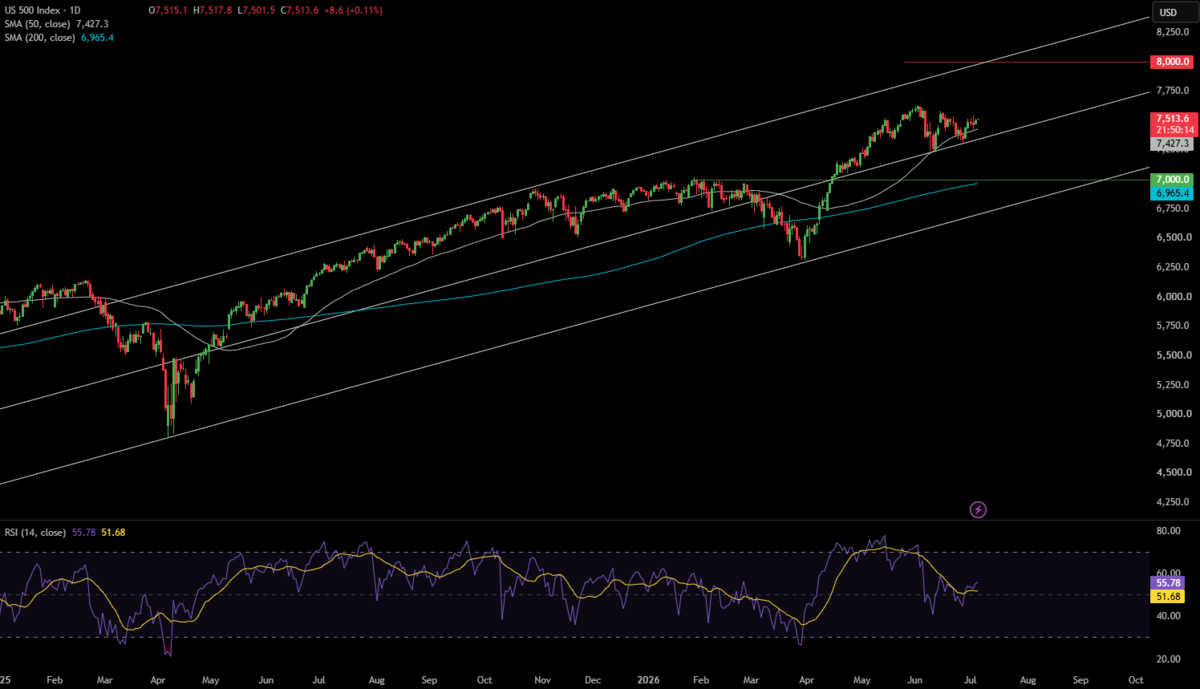
A strong ISM Services reading and hawkish FOMC minutes could push the S&P 500 down toward 7,350 by reinforcing concerns about persistent services inflation and potential Fed tightening. Conversely, a softer services print and dovish Fed minutes could allow the index to reach new highs above 7,600.
NFP misses trigger Fed rate hike repricing
The June Nonfarm Payrolls report, released Thursday, July 2, was the largest downside surprise of 2026. The US added only 57,000 jobs, well below the Dow Jones consensus estimate of 115,000. April and May figures were revised down by a combined 74,000 jobs, ending a three-month streak of positive surprises. Leisure and hospitality lost 61,000 jobs, reflecting the end of the World Cup tourism boost that had supported May’s numbers.
The unemployment rate fell unexpectedly to 4.2% from 4.3% as more workers left the labor force. Average hourly earnings increased 0.3% for the month and 3.5% year-on-year. The ISM Manufacturing PMI for June was 53.3, down from 54.0 in May and below expectations, marking the 20th consecutive month of expansion. However, employment remained in contraction at 49.7. The Prices Index dropped sharply to 73.0 from 82.1, marking the largest monthly decline since July 2022, reflecting lower energy costs following the ceasefire in Iran.
The US Dollar Index (DXY) fell to a two-week low around 100.75 as September rate hike odds dropped from 66% to 50%, marking the greenback’s largest weekly decline since April. Fed Chair Warsh’s remarks at Sintra reinforced the pivot narrative, noting that inflation expectations are moderating while reaffirming the commitment to price stability. Ten-year Treasury yields eased alongside the dollar, further supporting non-yielding assets.
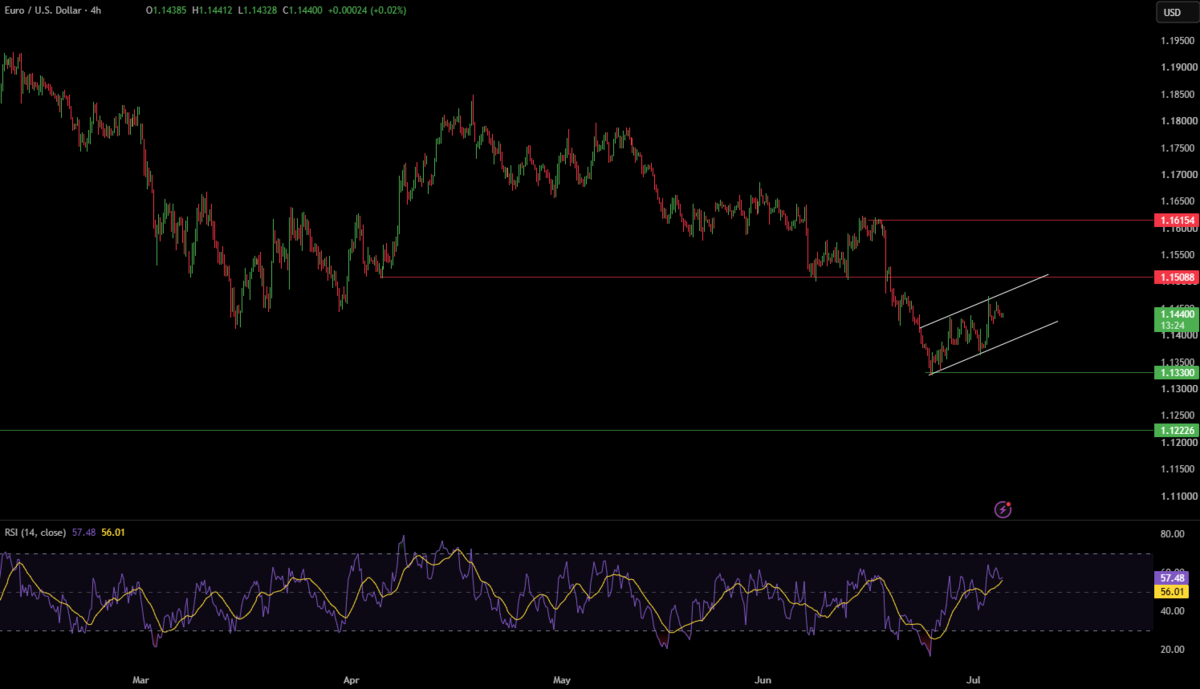
The US dollar experienced selling pressure over the past week. However, a hawkish set of Fed minutes on Wednesday, combined with persistent services inflation, could support the dollar and pull EURUSD toward 1.1330 and 1.1220.
Gold moves: metal snaps four-week losing streak on NFP shock
Gold climbed to approximately $4,170 per ounce by Friday, July 3, posting a 2% weekly gain and ending four consecutive weeks of declines. The rebound was triggered by Thursday’s weak NFP print, prompting traders to scale back near-term Fed-hike bets. Gold briefly tested $3,980 mid-week, its lowest level since November 2025, before recovering 3% from those lows over Thursday and Friday.
Central bank demand continued to provide structural support. The World Gold Council reported that central banks added a net 41 metric tons of gold to reserves in May. The Council’s Central Bank Gold Reserves Survey 2026 found that 89% of respondents expect global gold reserves to increase over the next 12 months, and a record 45% plan to increase their own holdings. Physical demand from India softened as prices rose, while Chinese buying interest improved slightly.
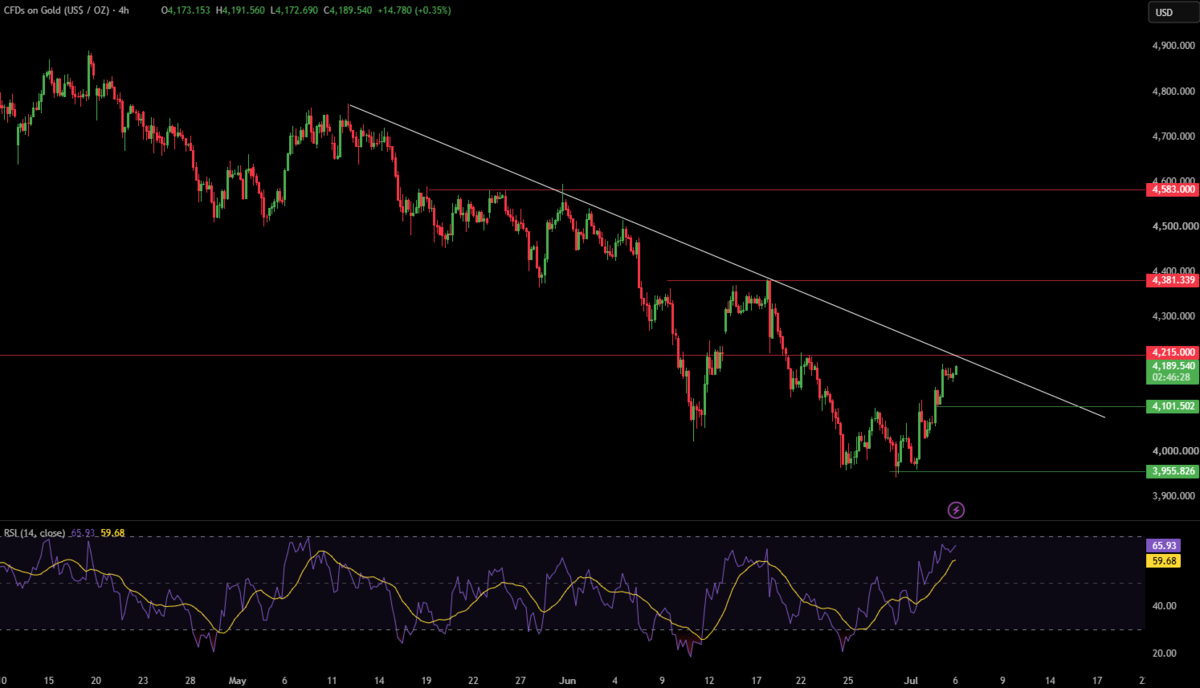
Hawkish FOMC minutes indicating a continued tightening bias could pull gold back toward $3,950. Dovish minutes combined with a soft ISM Services print would support further recovery toward the $4,380 resistance zone.
UK Brent stabilizes near pre-war levels on Doha talks
UK Brent held around $72.12 per barrel through Friday, July 3, near levels last seen before the Iran conflict began in late February. The international benchmark posted a 2.04% weekly decline as commercial shipping through the Strait of Hormuz continued to recover. Saudi Arabia’s crude exports rebounded to approximately 90% of pre-war levels, the UAE restored exports to over 3.9 million barrels per day, and total daily flows through the strait climbed above 10 million barrels.
OPEC+ is widely expected to approve another production quota increase for August as Gulf oil output gradually recovers. J.P. Morgan Global Research now projects UK Brent will average around $60 per barrel through 2026, given soft supply-demand fundamentals. However, the EIA warned that it will likely take several months to restore Hormuz traffic to pre-conflict levels, projecting that full flows will not return until early 2027 even under an optimistic scenario.
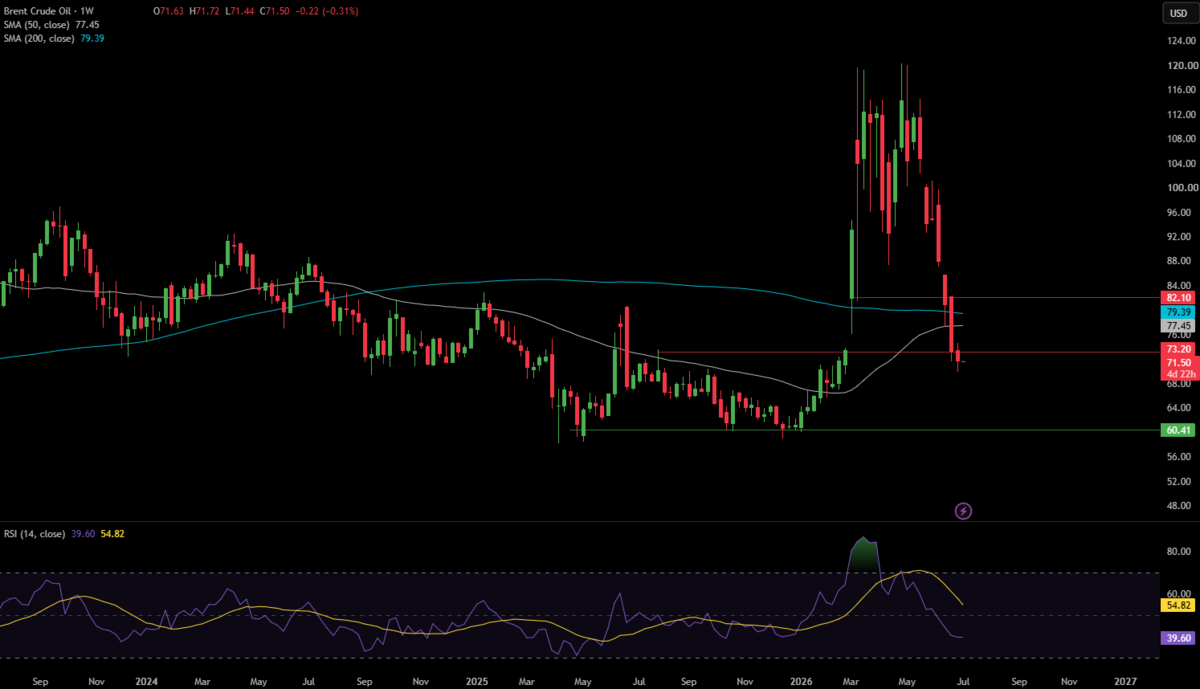
Sustained implementation of the Iran deal, combined with the OPEC+ August production hike, could pull UK Brent toward $60. Any breach in Doha, a talk incident in the s or a new Hormuz incident would push the benchmark above $82.
Nifty 50 recovers as PMIs signal moderating growth
The Nifty 50 closed Friday, July 3, at 24,175.70, up 0.71% on the day, while the Sensex finished at 77,502.12, up 0.75%. Indian benchmarks recovered from earlier-week weakness after Thursday’s soft US NFP eased pressure from FII outflows and supported broader emerging-market sentiment. The rupee held at 95.42 against the dollar, benefiting from the DXY pullback to two-week lows.
The HSBC India Manufacturing PMI eased to 54.2 in June, a three-month low, from 55.0 in May. New orders continued to rise, but at a slower pace, and business confidence fell to a four-year low. Export orders grew at the slowest pace since March 2023, while employment increased only marginally, marking the weakest hiring pace in six months. Manufacturers cited competitive pressures, subdued domestic and export demand, and elevated input costs despite some easing.
The HSBC India Services PMI declined to 57.3 from May’s revised 59.8, marking the weakest expansion since January 2025. New order growth eased, with firms citing rising fuel prices and gas shortages as headwinds, though foreign sales growth accelerated. Input and output price inflation moderated amid challenging demand and competitive pressures. Business sentiment remained positive but at reduced levels across both surveys.
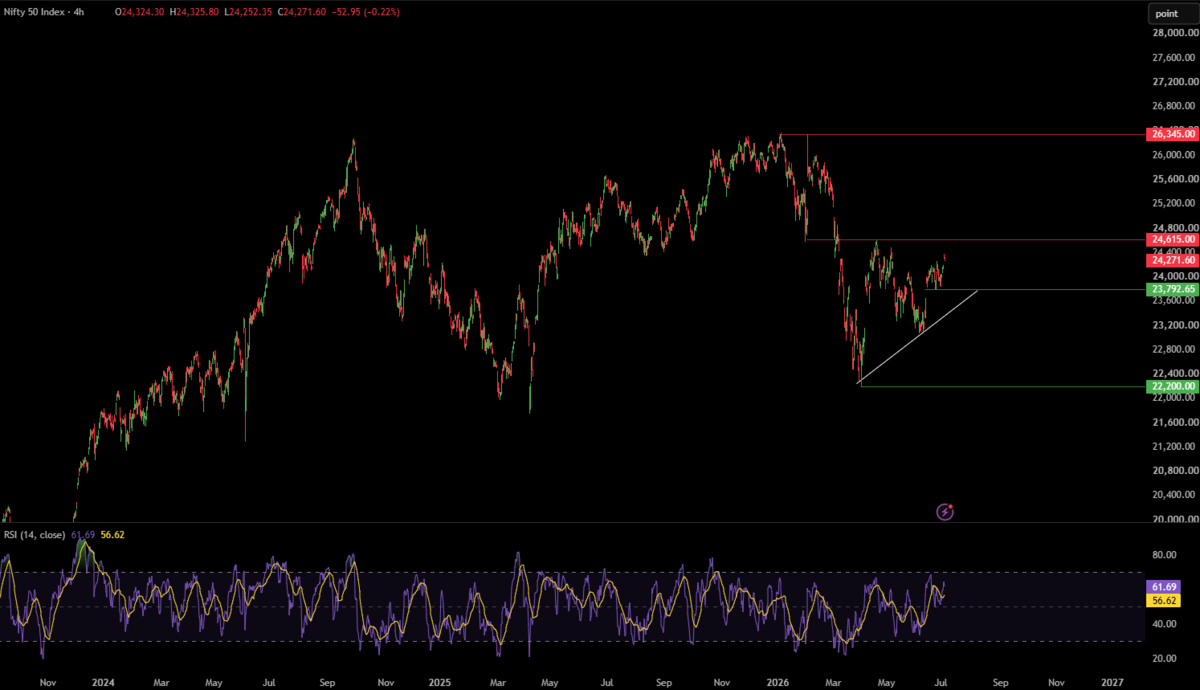
A dovish set of FOMC minutes supporting sustained dollar weakness, combined with a soft ISM Services print, could lift the Nifty 50 back toward 24,600 via increased FII inflows and softer imported inflation. Hawkish minutes or renewed dollar strength would pressure the index back toward 23,700.
KSE-100 elevated as CPI eases to 11.1%
The KSE-100 traded near 184,903 by Friday, July 3, close to its all-time high of 191,032 set on June 24 and up nearly 48% over the past 12 months. The benchmark benefited significantly from the Pakistan CPI release on Wednesday, July 1, which showed headline inflation easing to 11.1% year-on-year in June from 11.7% in May, marking the first monthly deceleration in the current cycle. On a month-on-month basis, prices fell 0.3%, down from a 0.5% rise in May.
Urban CPI eased to 11.2% from 11.8%, while rural CPI moderated to 10.9% from 11.5%. Core NFNE inflation in urban areas dropped to 8.7% from 9.0%, and the Wholesale Price Index slowed to 10.7% year-on-year from 12.7%, reflecting a substantial deceleration due to lower international oil prices following the Iran ceasefire. Full FY26 average inflation was 7.05%, up from 4.49% in FY25 but still contained.
The Ministry of Finance noted that easing Middle East geopolitical tensions have improved global market sentiment, with international crude oil prices declining from recent highs. Arif Habib Limited indicated that the year-on-year uptick in inflation was still driven by energy and transportation costs from geopolitical tensions, but the trend has clearly reversed. The State Bank of Pakistan held its policy rate at 11.50% on June 15 and now appears more comfortable with that stance, given the moderation in the June CPI.
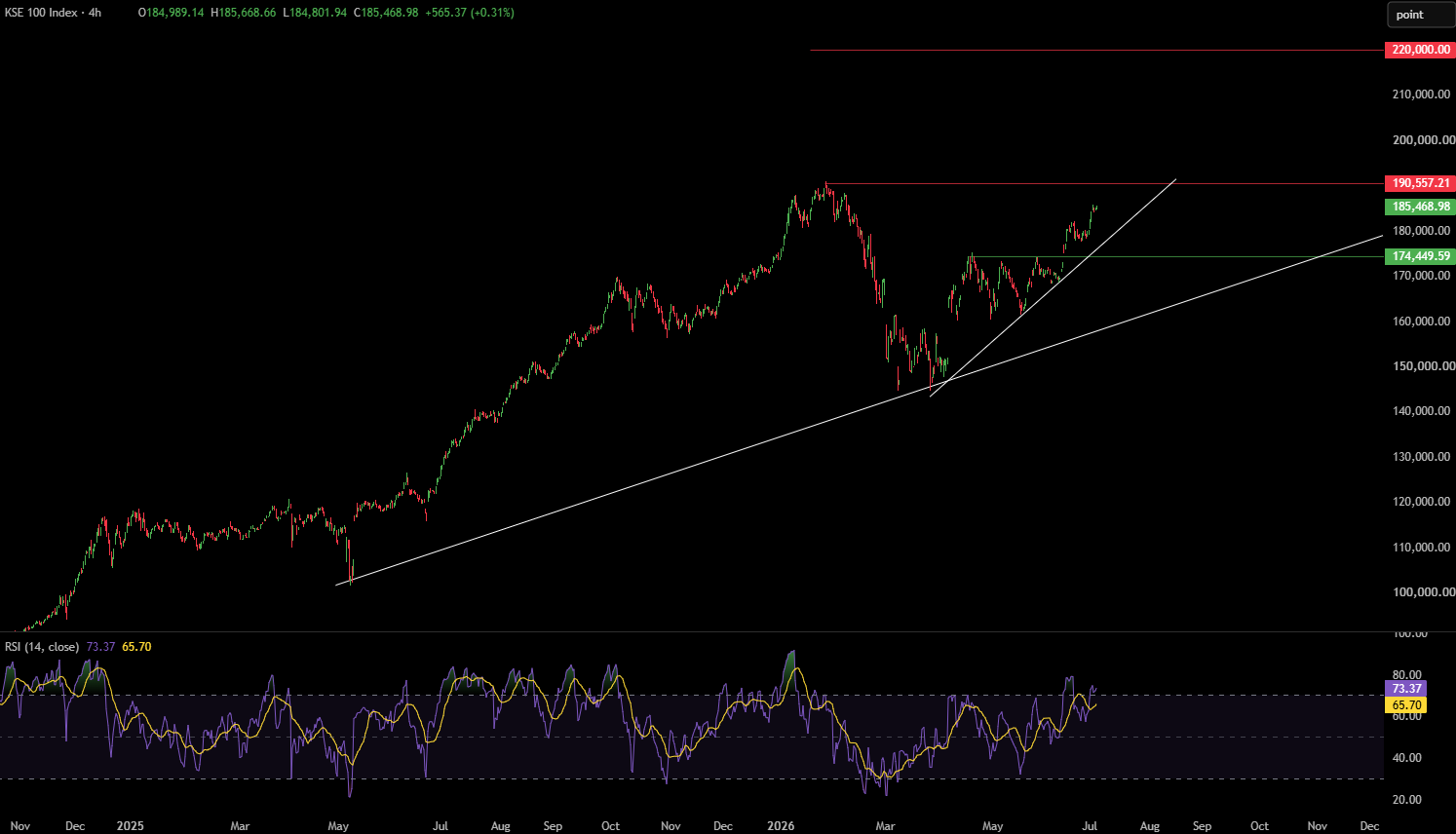
Sustained oil price stability, combined with continued CPI moderation, could push the KSE-100 through 190,000 toward new record highs around 220,000, especially if global risk appetite improves on dovish Fed minutes. A rebound in oil above $75, combined with hawkish FOMC minutes, would pressure the index back toward 175,000.
Week Ahead (US & Asia)
ISM Services PMI June — Monday, 6 July, 14:00 UTC
The ISM Services PMI for June will be released at 10:00 ET (14:00 UTC) on Monday, July 6, rescheduled from its usual third-business-day slot due to the July 3 Independence Day holiday. May’s Services PMI was 54.5, marking the 23rd consecutive month of expansion. The Business Activity Index reached 57.7 in May, while New Orders climbed to 57.3. The Employment Index contracted for a third consecutive month at 47.9, and the Prices Index surged to 71.3, the highest reading since August 2022.
The June release is the first major post-NFP data point and is especially important given Thursday’s labor market miss and the ISM Manufacturing prices deceleration to 73.0. Services account for over two-thirds of the US economy, so an improvement in the Services PMI Employment sub-index, following the manufacturing sector’s rise to 49.7, would help reduce recession risk concerns that resurfaced after the jobs data. Moderation in the prices sub-index would reinforce the disinflation trend from the ISM Manufacturing report and support the Fed’s ability to hold rates.
The Dow Jones enters the week at a record high of 52,900.07 after Thursday’s 594-point surge. Strength in industrial and defensive sectors has driven the benchmark’s outperformance, with Apple, McDonald’s, and Walt Disney leading Thursday’s gains as capital shifted from AI-focused technology to more traditional cyclical and defensive stocks. The blue-chip benchmark has reached multiple record intraday highs since June 30.
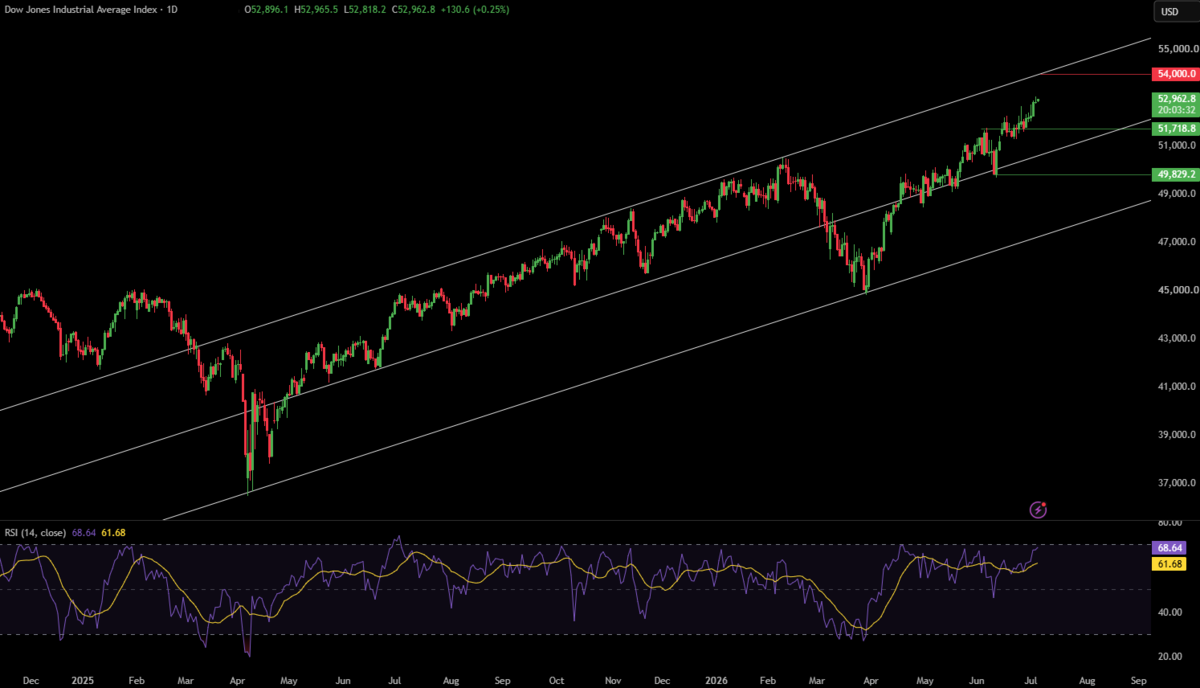
A firm Services PMI above 54, combined with elevated prices, would pressure the Dow Jones toward 51,700 by reintroducing rate hike concerns. A softer print, indicating moderating services demand and easing prices, would allow the benchmark to extend record highs above 54,000.
FOMC Minutes — Wednesday, 8 July, 18:00 UTC
The Federal Open Market Committee minutes from the June 16-17 meeting will be released at 14:00 ET (18:00 UTC) on Wednesday, July 8. This is Kevin Warsh’s first full set of FOMC minutes as Fed Chair, following his 54-45 Senate confirmation and the hawkish June Summary of Economic Projections, which raised the median 2026 dot to 3.8% from 3.4% in March. At the June meeting, 9 of 18 participants projected at least one rate hike before year-end.
Markets will closely examine the minutes for internal committee dynamics under the new Chair, focusing on three key areas: the extent of division between hike and hold camps, whether Warsh’s concise 130-word statement reflects broad consensus or Chair discretion, and how officials assess the balance between tariff and energy inflation pass-through and softening labor market signals. The June minutes precede two important data releases, June CPI and PPI, which will further inform September policy expectations.
USD/JPY has traded near 40-year lows for the yen over the past week, with the Japanese currency remaining under pressure despite the BoJ’s June rate hike to 1.00%. The pair briefly touched intervention territory before pulling back on rumors of possible Tokyo action. Weak US NFP data has since eased the pair, though the Fed-BoJ policy differential remains wide enough that carry trade dynamics still favor the dollar.
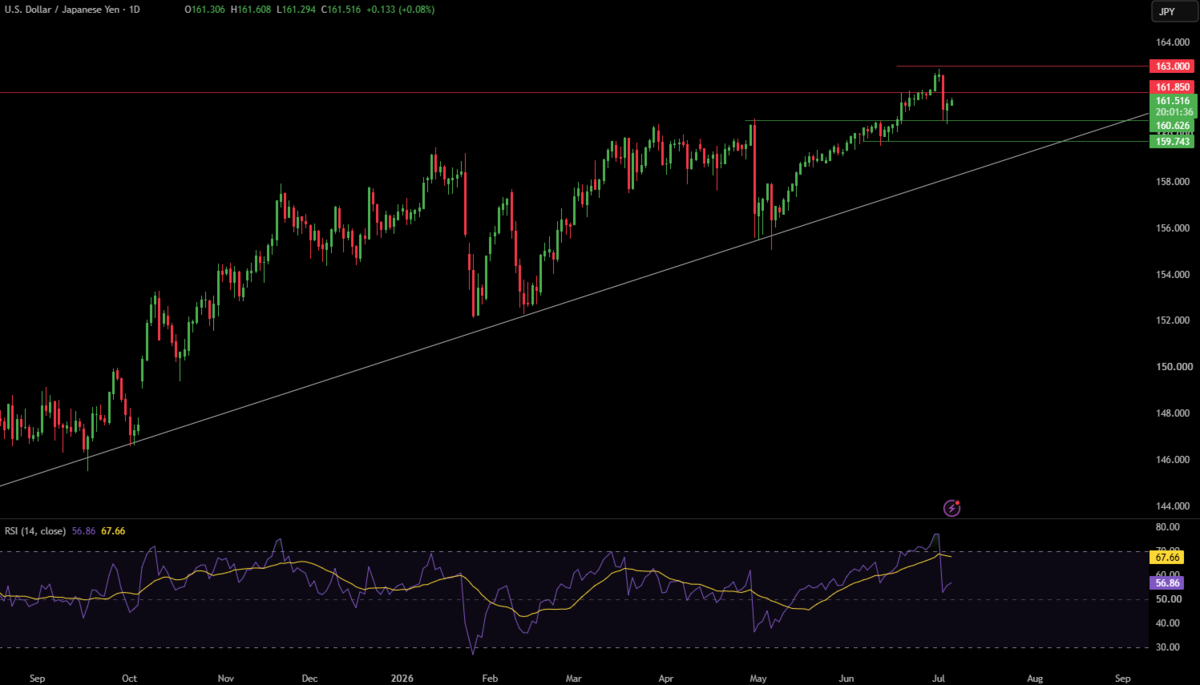
Hawkish minutes indicating broad committee support for a September or October rate hike would push USD/JPY back to 163 by reinforcing carry-trade dynamics and triggering renewed speculation about intervention. Dovish minutes signaling a wait-and-see approach after the NFP would allow USD/JPY to consolidate around 159.75 as the pair prices in a longer Fed pause.
Bottom line
The week ahead features two key US data points in a lower-volume calendar following the June NFP shock. Monday’s ISM Services PMI will test whether labor market softness extends into the broader economy, while Wednesday’s FOMC minutes will reveal the extent of division within the Warsh-era committee regarding the path to year-end 2026.
Trading involves risk.
Author



 Risk Disclaimer
The content provided here is for informational purposes only. It is not intended as personal investment advice and does not constitute a solicitation or invitation to engage in any financial transactions, investments, or related activities. Past performance is not a reliable indicator of future results.
The financial products offered by the Company are complex and come with a high risk of losing money rapidly due to leverage. These products may not be suitable for all investors. Before engaging, you should consider whether you understand how these leveraged products work and whether you can afford the high risk of losing your money.
The Company does not accept clients from the Restricted Jurisdictions as indicated in our website/ T&C. Some services or products may not be available in your jurisdiction.
The applicable legal entity and its respective products and services depend on the client’s country of residence and the entity with which the client has established a contractual relationship during registration.