10 min read
 Weekly Recap
US Global stocks recap
US equities ended May with a ninth consecutive weekly gain, marking the longest winning streak since 2023. Optimism over a potential Iran ceasefire and strong AI earnings fueled the rally. The S&P 500 closed at 7,580.06, the Dow Jones surpassed 51,000 for the first time at 51,032.46, and the US 100 finished at 30,318.62 after 10.3% monthly gain.
President Trump announced he would soon make a “final determination” on a preliminary 60-day memorandum of understanding with Iran, a move that supported markets. However, conflicting signals from both sides continue to create uncertainty about a final agreement.
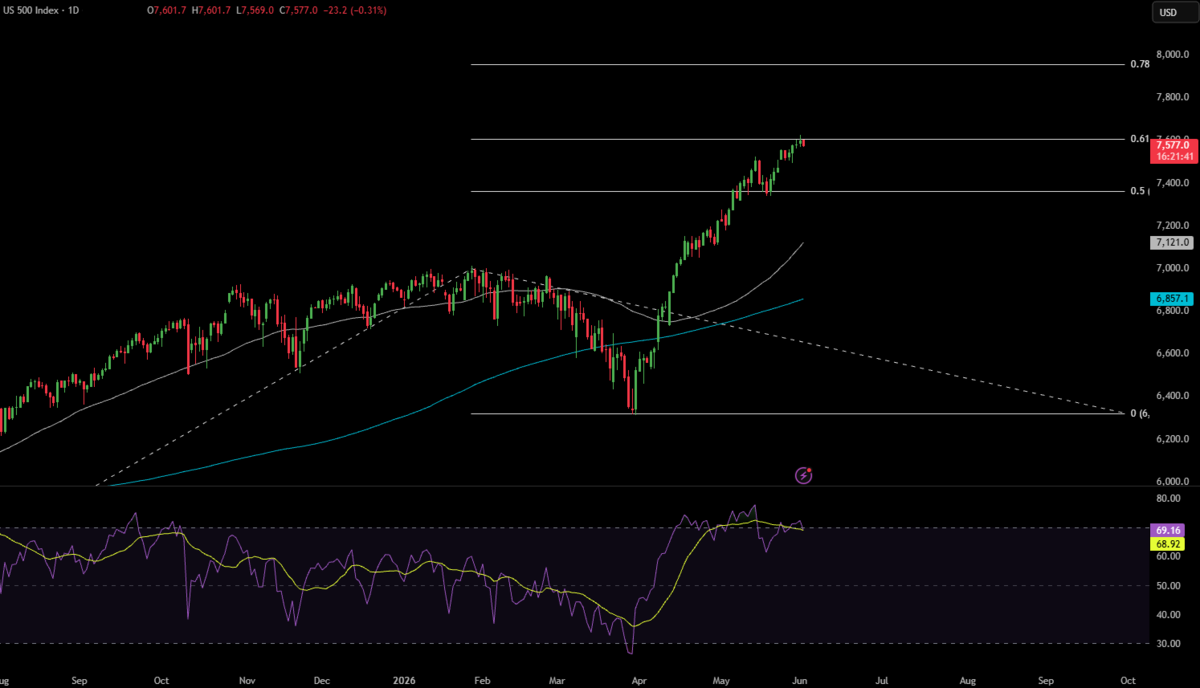
As US markets reopen after Memorial Day, a data-heavy week culminates in Friday’s NFP report. The S&P 500 faces stretched valuations and overbought conditions, with RSI near 73.
Major US data/themes
The April report released on Thursday, May 28, delivered the highest PCE inflation reading in nearly three years. Headline PCE rose 3.8% year-on-year and 0.4% on the month, in line with Dow Jones estimates, while core PCE rose 0.2% monthly and 3.3% annually, slightly below the 0.3% monthly forecast.
The data offered modest relief on the soft monthly readings, but the annual rates confirm that the Iran war and tariff impact have derailed disinflation. Personal income decreased less than 0.1% on the month, while personal consumption expenditures rose 0.5%, with the saving rate dropping to 2.6%.
Q1 GDP was revised down to 1.6% annualised from the initial 2.0%, reinforcing stagflation concerns. Traders now expect the Fed to hold rates until at least late 2026, with markets considering a possible rate increase early next year.
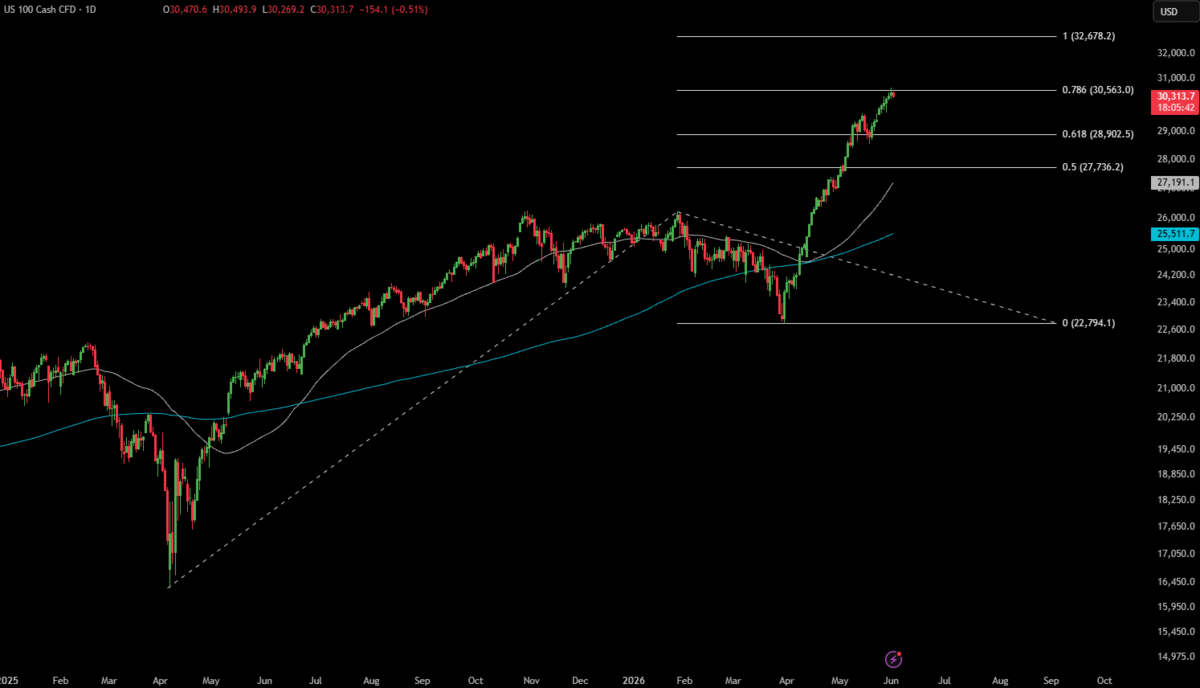
Fed Chair Kevin Warsh has suggested the benchmark rate could be lowered, though he may face opposition within the FOMC. Friday’s NFP and Wednesday’s ISM Services PMI will be key in determining if the US 100 can maintain its record highs amid stretched valuations.
Gold moves
Gold traded in the $4,500-4,545 range during the week, closing at $4,523 per ounce on Friday with a 0.89% daily gain after April PCE data eased Fed rate-hike concerns. On Monday, Gold fell nearly $70 to $4,479, testing the 200-day moving average for the first time since March.
Softer monthly core PCE and easing US-Iran tensions reduced the inflation premium in Gold. The US Dollar Index remained near 99.0, and Treasury yields stabilized, creating a more balanced environment for Gold compared to the rate-hike concerns two weeks ago.
World Gold Council data indicates structural demand is at a key inflection point, with central bank purchases supporting the trend. Despite May’s consolidation, Gold remains well below its January peak, pressured by high rates and a stronger dollar during the Iran conflict.
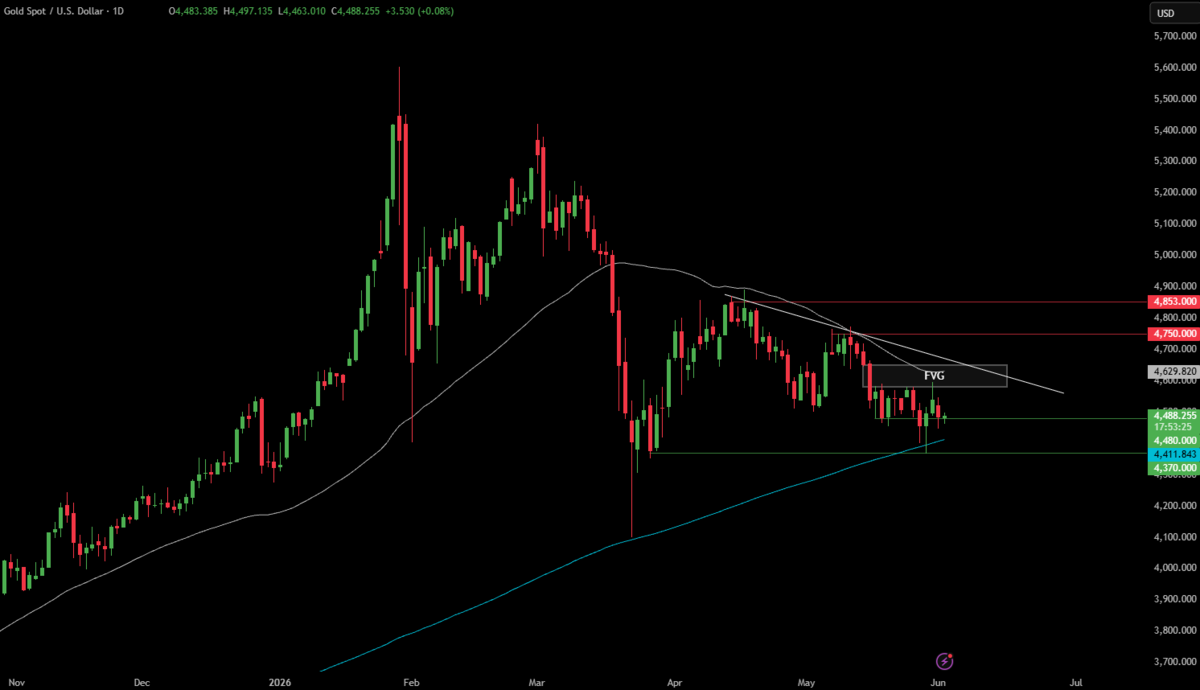
A weaker-than-expected NFP and dovish ISM Services data could lift Gold toward the FVG at $4,600. Conversely, strong jobs data or setbacks in Iran negotiations may push Gold toward the $4,370 support level.
Oil moves
Brent experienced its worst month since the Covid-19 pandemic, falling nearly 19% in May and closing at $92.56 on Friday, down 20% from 2026 highs. The decline followed reports of a US-Iran agreement on a 60-day memorandum of understanding to pause hostilities, increasing the likelihood of a ceasefire and potential reopening of the Strait of Hormuz.
Despite optimism, markets remain cautious. Investors note significant damage to Gulf infrastructure, refineries, and pipelines, as well as ongoing security risks for tanker traffic and low inventories. Even if the Strait of Hormuz reopens, it will likely be only partially. The IEA still expects significant supply disruptions through the second half of the year, with full capacity not restored until at least Q4.
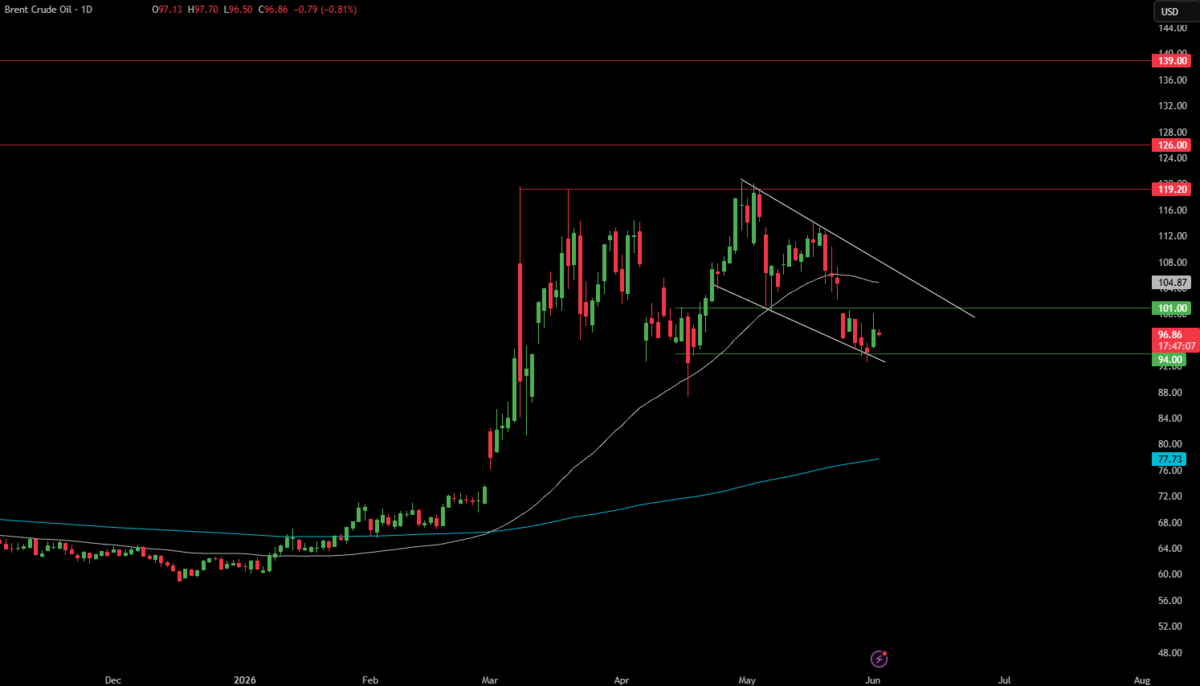
Brent’s near-term direction depends on whether Trump’s “final determination” leads to a lasting agreement. A confirmed deal could push prices below $90, while a breakdown may trigger a spike toward $105.
Week Ahead (US & Asia)
US ISM Services PMI (Wednesday)
The May ISM Services PMI will be released on Wednesday, June 3, and offer the first major insight into US business activity following the PCE report. This indicator, which covers over two-thirds of US economic activity, is closely watched as a signal of broader economic momentum.
April’s ISM Services reading fell below the 50 expansion threshold, raising concerns about contraction in the sector, even as manufacturing stabilized. Consensus expects a modest recovery, with particular focus on the prices-paid component amid ongoing inflationary pressures from the Iran conflict.
The ADP Employment Change report, also due Wednesday, will offer an early indication ahead of Friday’s NFP. Recent ADP data suggests a moderation in private payroll growth. The Beige Book, released Wednesday afternoon, will provide additional regional context. The Fed enters this data-heavy week with markets no longer expecting rate cuts in 2026.
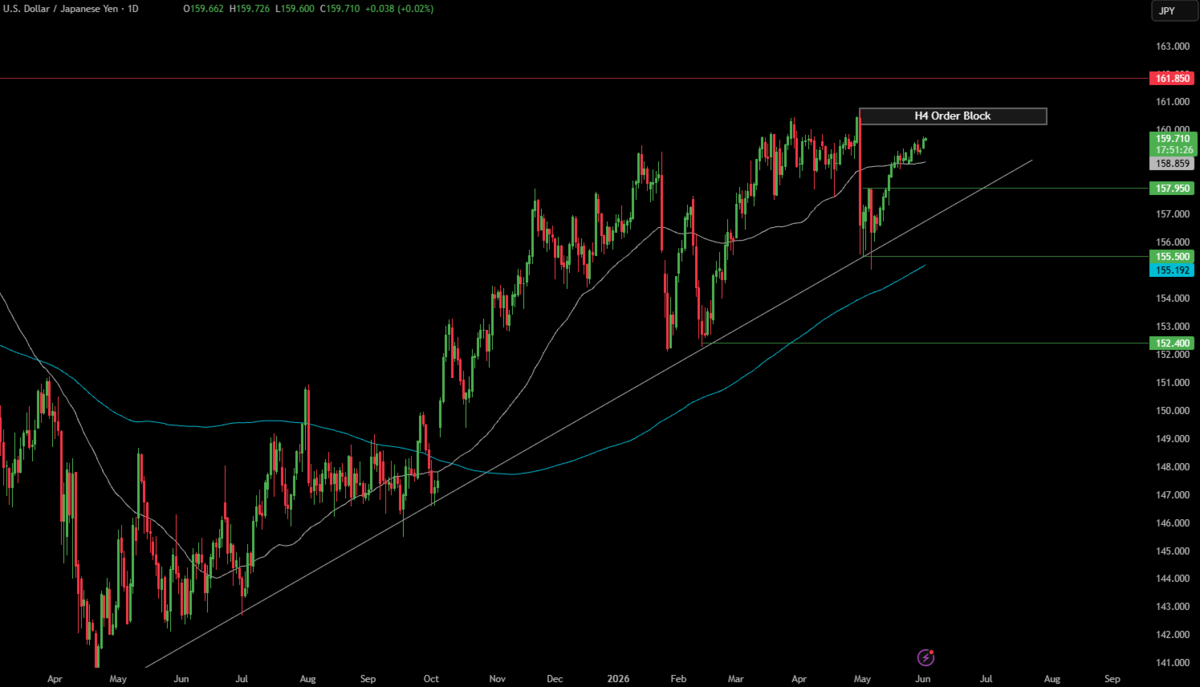
A weak ISM Services reading, combined with high prices paid, would reinforce stagflation concerns and pressure USD/JPY. Conversely, a reading above 54 with cooling prices would support the pair toward 160.5.
US Nonfarm Payrolls (Friday)
The May Nonfarm Payrolls report on Friday, June 5, is the most significant data point of the week. The release follows April’s reading of +115,000 payrolls, well above the 55,000 consensus, and an unemployment rate holding at 4.3%. Markets will look for confirmation that the labor market remains resilient despite the Iran-driven inflation shock.
Consensus expects payrolls to rise by 125,000 to 150,000 in May, with the unemployment rate likely to hold or increase to 4.4%. Average hourly earnings are forecast to rise about 0.3% month-on-month. The ADP report on Wednesday will set the tone for late-week positioning, while Thursday’s Initial Jobless Claims could amplify any directional bias.
The report comes at a critical juncture for the Warsh-era Fed. With markets pricing roughly 50% odds of a December rate hike, a weak jobs report would prompt a sharp repricing toward holds or cuts, while a strong reading would reinforce the hawkish outlook. The euro has remained firm in recent weeks despite ongoing dollar strength, partly due to better-than-expected eurozone data.
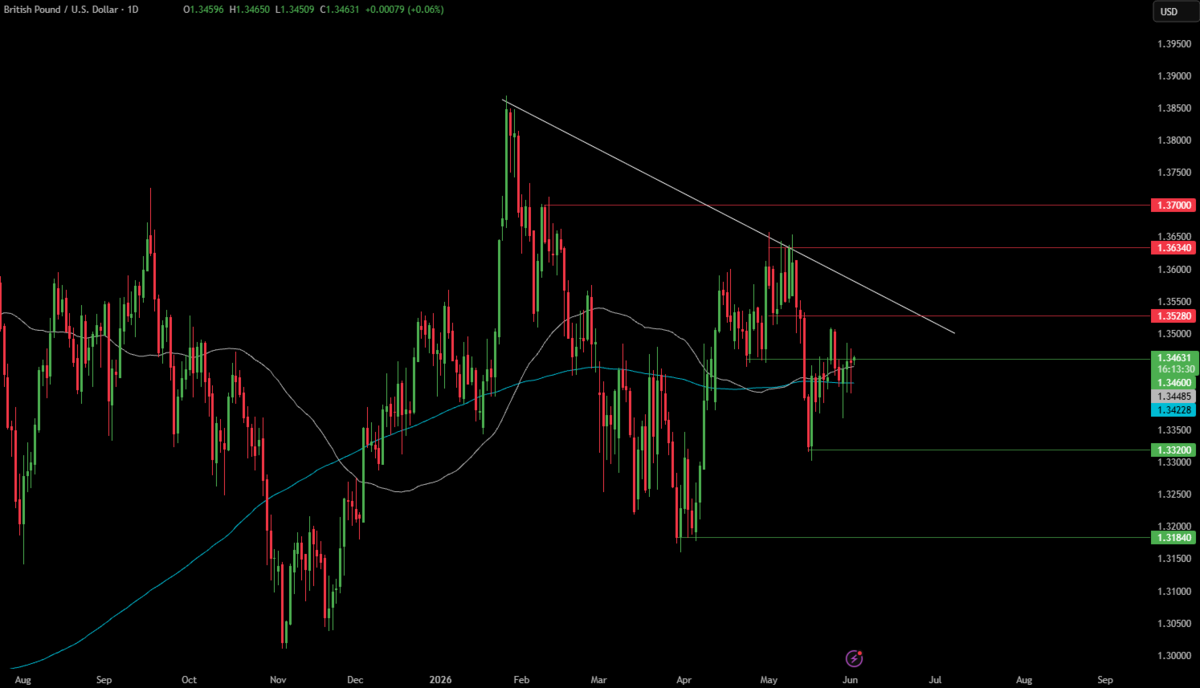
A weak NFP would lift GBP/USD toward 1.3634. A strong reading would push the pair back toward 1.3320.
India RBI MPC & Q4 FY26 GDP (Friday)
India faces a critical macro day on Friday, June 5, with two major releases scheduled simultaneously. The Reserve Bank of India Monetary Policy Committee will announce its rate decision at 10:00 AM IST after a three-day meeting starting June 3, while the National Statistical Office will release Q4 FY26 GDP and FY26 Annual Provisional Estimates the same day.
Market consensus expects the RBI to keep the repo rate unchanged at 5.25% for a third consecutive meeting, maintaining a neutral policy stance as the central bank assesses inflation passthrough from elevated oil prices and the rupee’s recent record lows. Inflation projections may be revised upward following recent fuel price hikes and likely food price pressures, with economists expecting 30-40 basis points of inflation passthrough in the coming months.
The Q4 GDP release, originally scheduled for May 29 but postponed to June 5 under a revised calendar, will close out FY26 against the NSO’s 7.6% Second Advance Estimate. ICRA projects Q4 growth slowed to a three-quarter low of 7.0% from 7.8% in Q3, with full-year FY26 growth estimated at 7.5%. SBI Research offers a more optimistic Q4 estimate at 7.2%. Indian equities came under pressure on Friday, May 29, with the Nifty 50 falling 359 points (-1.5%) to 23,547.75 and the Sensex losing 1,092 points to 74,775.74 amid uncertainty over the US-Iran deal.
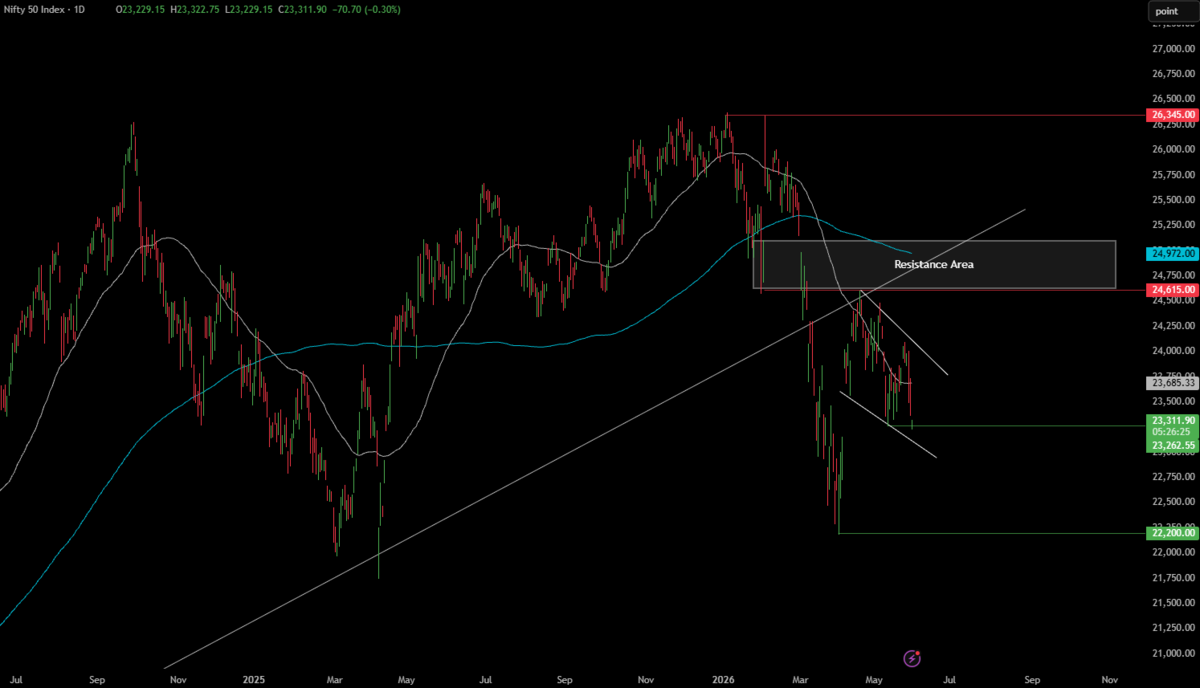
A weaker-than-expected Q4 print combined with dovish RBI guidance would weigh on the Nifty 50, pulling the index toward 22,200. Conversely, resilient growth data and a hawkish RBI stance could support a recovery toward 24,600, though FII outflows remain a structural headwind.
Pakistan FY27 Budget Presentation (Friday)
Pakistan’s federal budget for fiscal year 2026-27 will be presented to the National Assembly on Friday, June 5, at 5:00 PM PKT, with the Senate session following at 6:00 PM. Finance Minister Muhammad Aurangzeb will deliver the budget speech after a special federal cabinet meeting that approves the proposals earlier that day.
The government has proposed a total outlay of Rs17.1 trillion, with a GDP growth target of 4.1%, an average inflation projection of 8.4%, and a tax revenue target of Rs15.267 trillion. The budget was prepared in close consultation with the IMF, with most matters reportedly finalized under 11 new structural benchmarks issued as part of the Extended Fund Facility. These include a primary surplus target of 2% of GDP, semi-annual gas tariff adjustments from July 1, and an annual electricity tariff adjustment by January 2027.
The Pakistan Economic Survey FY26 will be released on Thursday, June 4, providing the macroeconomic backdrop. The National Economic Council meets on June 3 to approve the Public Sector Development Program. KSE-100 closed on Friday, May 29, after a relatively stable week, with the broader index sensitive to expected revenue measures, defense allocations, and potential salary increases for government employees. The All Government Employees Grand Alliance has demanded salary and pension increases of up to 100%, threatening to stage a protest outside Parliament ahead of the budget.
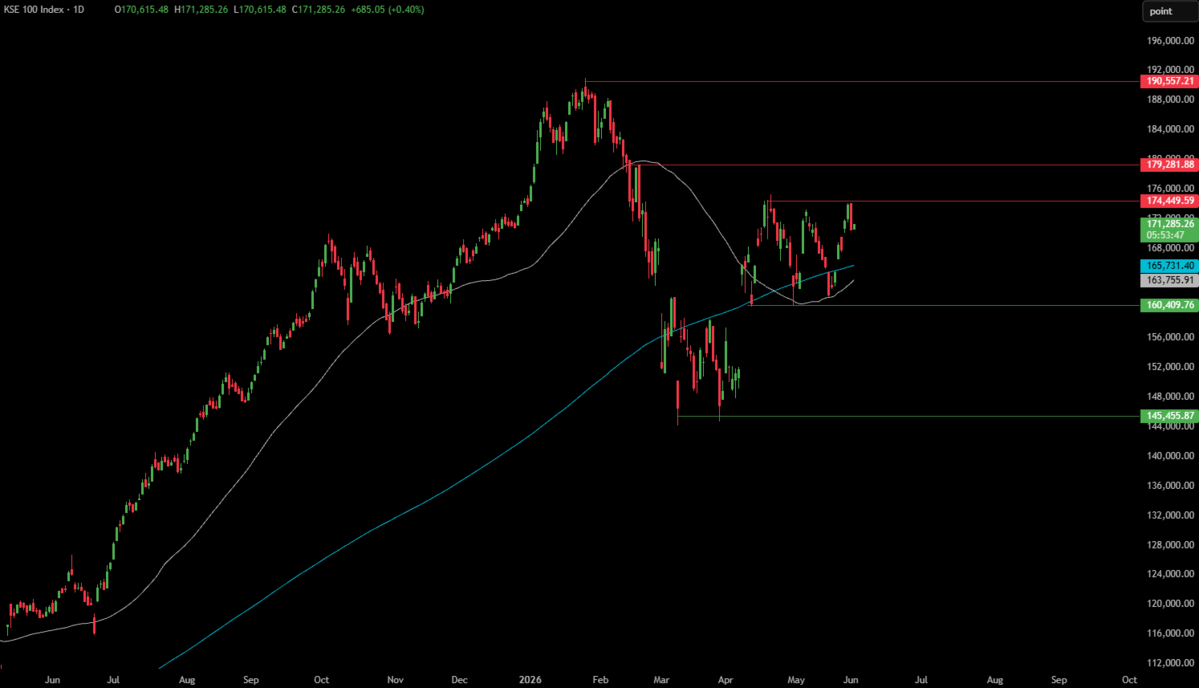
A market-friendly budget that delivers fiscal credibility and IMF approval would send the KSE-100 to 179,300. However, any signs of fiscal slippage, missed revenue targets, or public protests against austerity measures would weigh on the index and could test the 160,400 support level.
Bottom line
Friday, June 5, stands as one of the most consequential single trading days of 2026, with US NFP, India’s RBI MPC, and Q4 GDP, and Pakistan’s FY27 Budget all landing within hours of each other. The US-Iran ceasefire optimism and softer April core PCE have reset the global risk backdrop heading into the data, but stretched equity valuations and uncertainty around the Warsh-era Fed leave markets vulnerable to any negative surprise.
Trading involves risk.
Author



 Risk Disclaimer
The content provided here is for informational purposes only. It is not intended as personal investment advice and does not constitute a solicitation or invitation to engage in any financial transactions, investments, or related activities. Past performance is not a reliable indicator of future results.
The financial products offered by the Company are complex and come with a high risk of losing money rapidly due to leverage. These products may not be suitable for all investors. Before engaging, you should consider whether you understand how these leveraged products work and whether you can afford the high risk of losing your money.
The Company does not accept clients from the Restricted Jurisdictions as indicated in our website/ T&C. Some services or products may not be available in your jurisdiction.
The applicable legal entity and its respective products and services depend on the client’s country of residence and the entity with which the client has established a contractual relationship during registration.