8 min read
Technical picture: BTC climbs back above its trendline after the hack
Bitcoin lost about 3.3% over the week and trades near $78,000. The decisive move came late on October 29, when Binance disclosed that about $6.3 billion had been stolen from its wallets, the largest crypto theft on record. TRM Labs and Chainalysis linked the attack to North Korea’s TraderTraitor group. By Friday BTC had slid to about $76,100 on Bitstamp, and market-wide liquidations reached about $1.5 billion, $468 million of it in BTC, mostly longs.
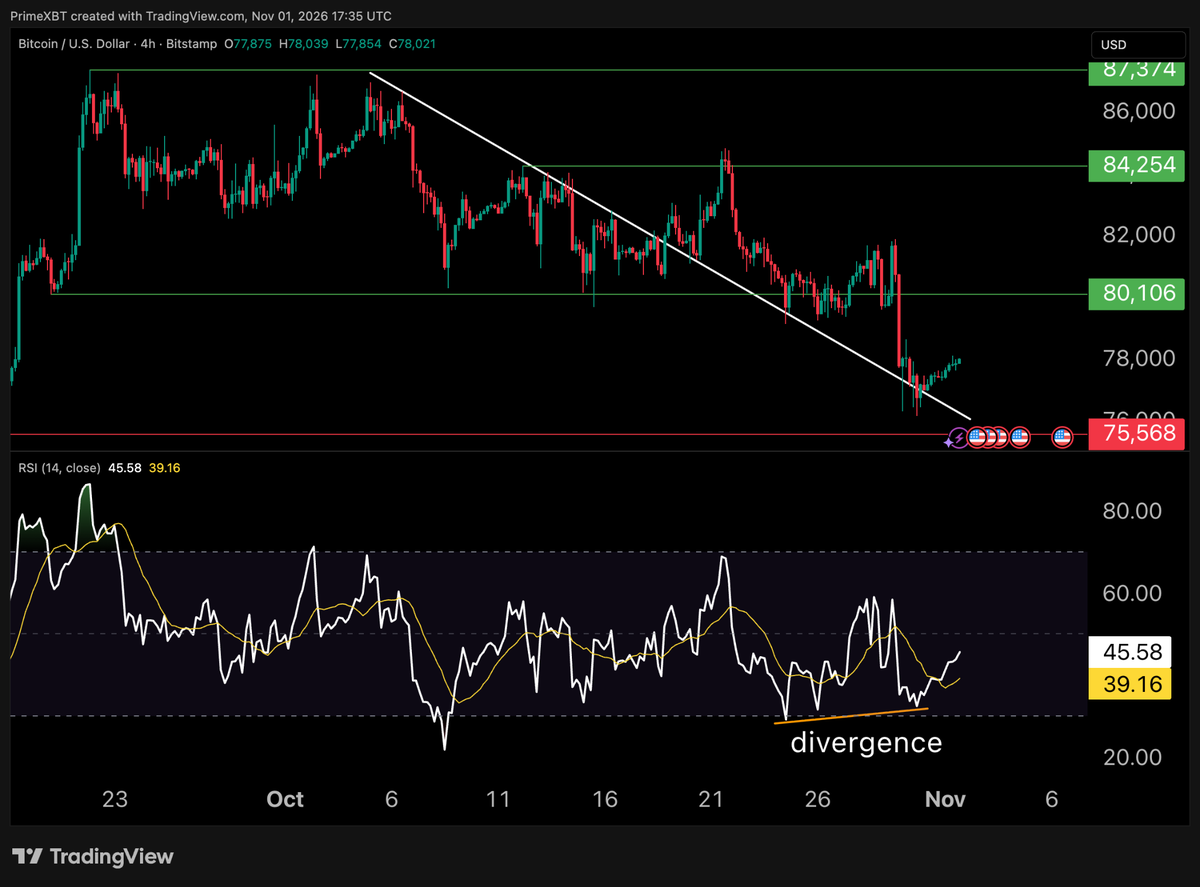
On the 4-hour chart, the hack sell-off broke the 80,106 floor that held through October and pushed price briefly below the descending trendline drawn from the early October highs. BTC has since recovered above that line. The RSI shows a bullish divergence, a higher low against a lower price low, and at 45.6 it sits above its signal line at 39.2. The indicator bottomed above 30, not in oversold territory, so the signal is modest, and the structure still reads as a rebound inside a downtrend rather than a reversal. A return above 80,106 would open the path to 84,254; a close back below the trendline and the 76,100 low would put 75,568 in focus.
Crypto heatmap: HYPE stands out as the majors slide
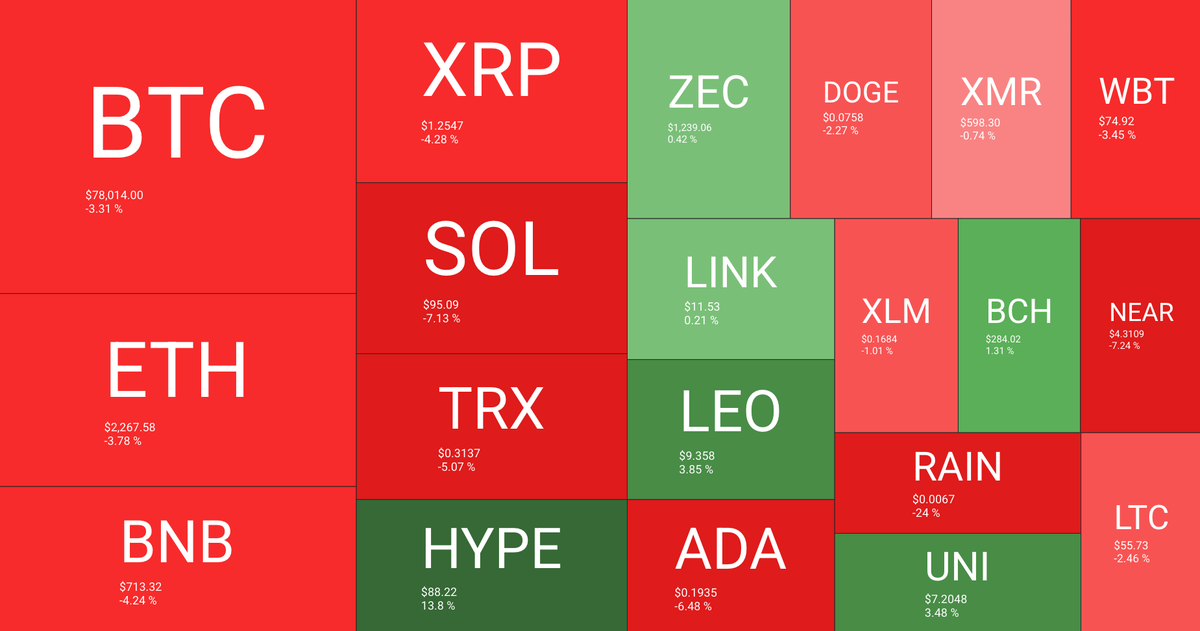
Losses were broad. BTC fell 3.31% to $78,014, ETH 3.78% to $2,267.58, XRP 4.28% to $1.2547 and BNB 4.24% to $713.32. BNB is notable for what did not happen: the hacked exchange’s token fell roughly in line with the majors, as Binance pledged to cover user losses from company funds.
Source: https://quantifycrypto.com/heatmaps
Among the leaders, HYPE gained 13.8% to $88.22. The main driver was ICE’s October 29 deal with Trade.xyz to bring Hyperliquid-based perpetual futures to US markets, pending approval; the timing does not support the idea that traders simply fled Binance for the DEX. LEO added 3.85% to $9.358. Among the laggards, RAIN dropped 24% to $0.0067 and NEAR lost 7.24% to $4.3109, with SOL close behind, down 7.13%. Privacy coins held up: ZEC rose 0.42% and XMR slipped only 0.74%.
Altcoin Season Index eases to 52
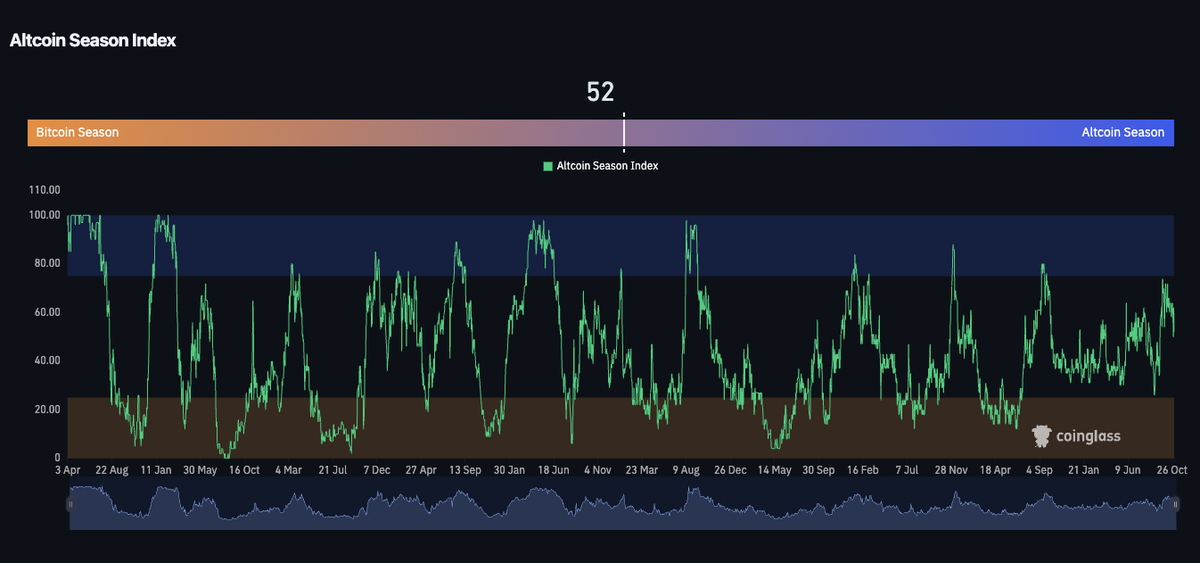
The index slipped to 52 from 58 a week earlier, after a run above 70 earlier in October. A mid-range reading means neither Bitcoin nor altcoins clearly lead. An altcoin season requires 75 or higher, and with BTC in a downtrend and risk appetite hit by the hack, the backdrop for one is weak.
Source: https://www.coinglass.com/pro/i/alt-coin-season
Fear and Greed slides into Fear
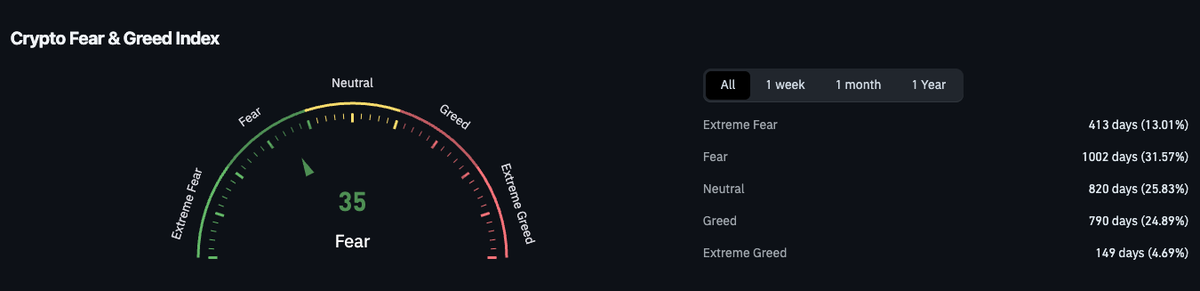
The Crypto Fear and Greed Index reads 35, in Fear. The hack did the sharpest damage: the index fell from about 51 to 30 within 24 hours on October 30 to 31, its lowest since mid-August, before recovering slightly. Fear readings cover 31.6% of all days in the index’s history, so the current level is common rather than extreme.
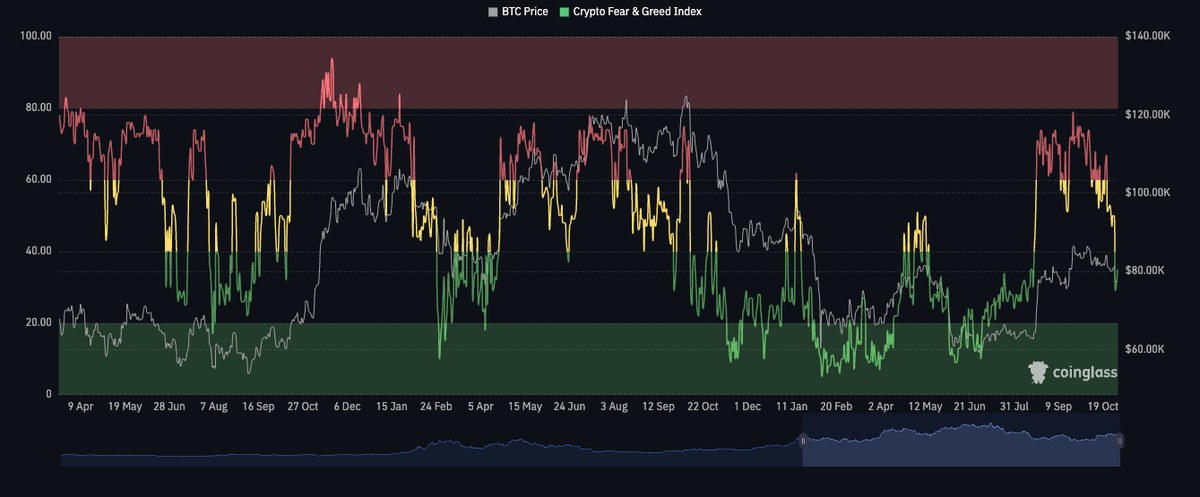
Source: https://www.coinglass.com/pro/i/FearGreedIndex
Moving from Greed near 79 in September to Fear took a decline of about 13% in BTC, from the 87,374 high to the 76,100 low. Contrarian traders watch such readings closely, but Fear has preceded both relief rallies and deeper drops in the past, so the index works better as context than as a timing signal.
Bitcoin and gold are 2026’s two weakest major assets
YCharts data compiled by Charlie Bilello of Creative Planning, as of October 30, show Bitcoin down 11.7% year to date and gold (GLD) down 10.2%, the two weakest results among 21 asset classes. Bilello’s records have never shown them as the two worst performers in the same year. A week earlier the losses were 7.3% and 7.5%, so the hack sell-off and gold’s margin-call slide on Friday widened them. Commodities lead with a 50.3% gain, lifted by oil.
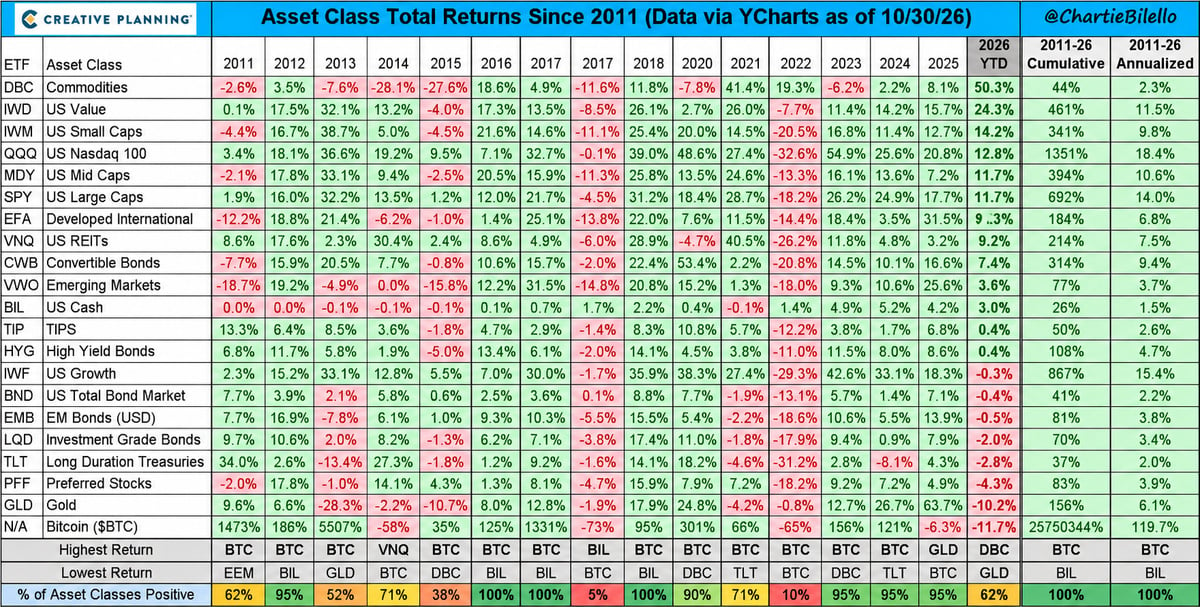
Neither number is a record on its own: the table shows Bitcoin losing 73% in 2018 and 65% in 2022, and gold 28.3% in 2013. Both have also fallen in the same year before, in 2014, 2018 and 2022. What is new is the ranking. If Bitcoin ends 2026 lower, it would be its second annual loss in a row after a 6.3% drop in 2025, a first in this dataset.
Short-term holders capitulate after the hack
Short-term holders, wallets that bought within the last 155 days, sent more than 36,600 BTC to exchanges at a loss over 24 hours as BTC tested $76,000 on October 30, according to CryptoQuant data. Over seven days they sent 45,400 BTC to Binance alone, the highest weekly total in October.
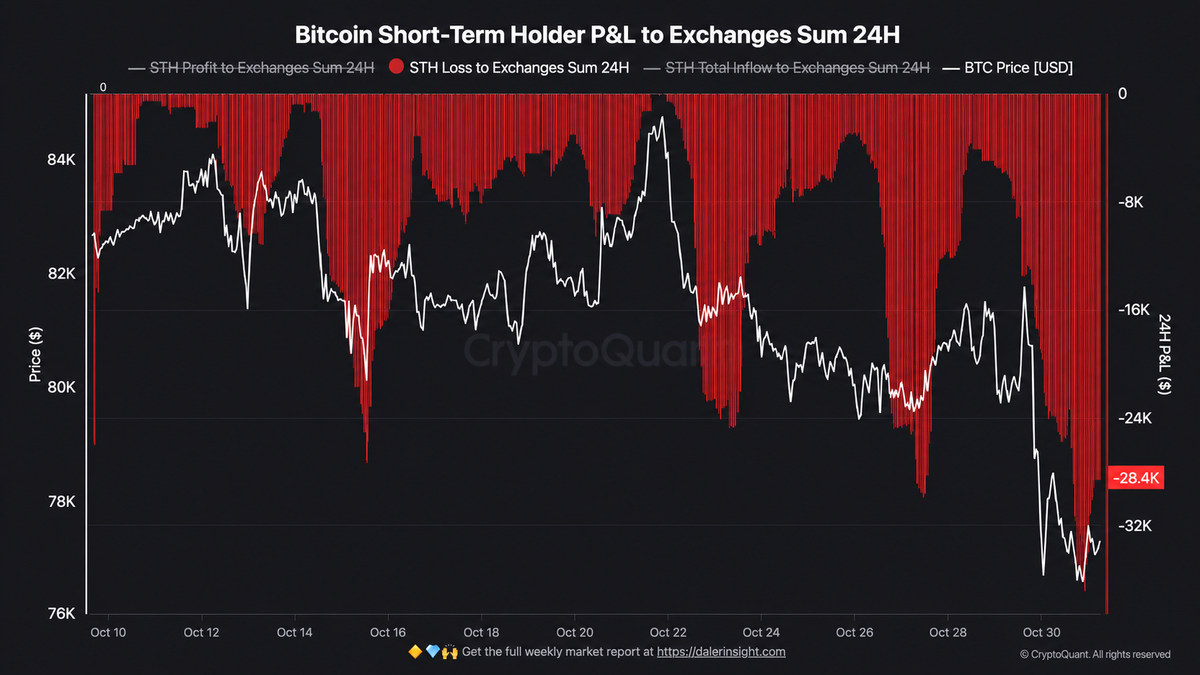
The chart shows loss-making inflows peaking right after the hack-driven drop, well above the earlier October spikes of about 24,000 to 30,000, with the latest 24-hour reading near 28,400. Transfers to exchanges do not prove sales, but loss-taking on this scale is typical of capitulation by recent buyers. If it fades while price holds above the trendline, pressure from this group would ease.
Coinbase Premium hits a four-year low
The Coinbase Premium Index, the gap between Bitcoin’s USD price on Coinbase and its USDT price on Binance, fell to about -0.2, with a dip near -0.27, its deepest since November 2022 after the FTX collapse. CryptoQuant CEO Ki Young Ju called sentiment “bearish enough to be bullish”, noting that the FTX-era low came at the cycle bottom.
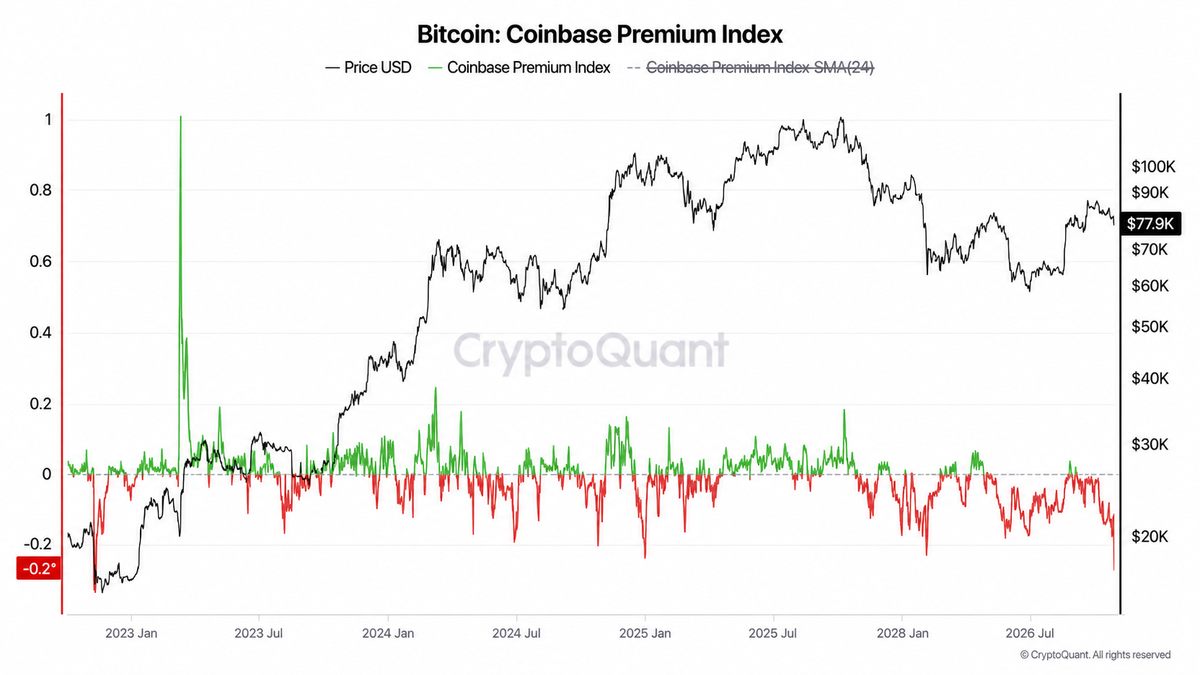
Two factors temper the reading. US demand did weaken: spot Bitcoin ETFs lost $643 million on October 30, turning the week into a net outflow of about $202 million after four days of inflows. But Binance froze withdrawals from October 29 until November 1, which blocked the arbitrage that normally keeps the two venues aligned, so part of the spread may reflect the hack rather than US selling alone.
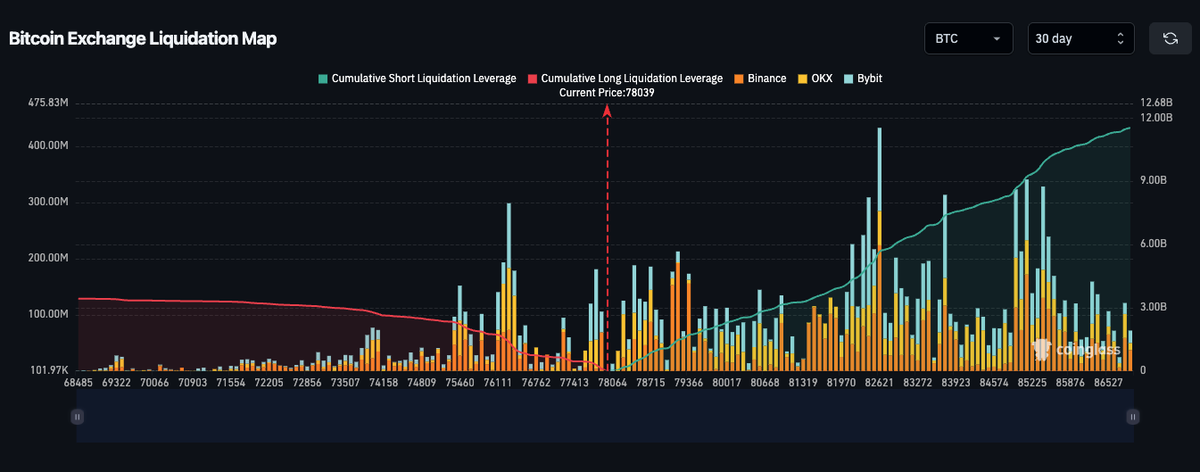
Liquidation map: short leverage stacks above price
CoinGlass’s 30-day map, with BTC at 78,039, shows the largest long cluster just below price near 76,111, at about $300 million. Below it, cumulative long liquidation leverage tops out near $3.5 billion. Above price, short leverage builds steadily to about $11.5 billion by 87,000, with the biggest single bar near 82,621 at roughly $430 million and dense clusters between 84,000 and 85,300.
Source: https://www.coinglass.com/pro/futures/LiquidationMap
The imbalance cuts both ways. A quick dip toward 76,000 could flush the nearby longs, as the hack sell-off already did once. A move back above 80,106, on the other hand, would press into short leverage roughly three times larger than the long side, which could accelerate a squeeze toward 82,600.
Conclusion
The Binance hack turned a fragile week into a test of trust in centralized exchanges. Binance says it has replenished most of the affected assets, reopened BTC withdrawals on November 1 and plans a full proof of reserves by November 3, while about $3 billion of the stolen funds is frozen. On the charts, BTC holds above its trendline with an RSI divergence, sentiment sits in Fear, short-term holders have sold at a loss and the Coinbase Premium is at a four-year low. Such conditions have preceded rebounds before, but 80,106 has to be reclaimed first; below 76,100, the next support is 75,568. The US midterms and Friday’s jobs report add macro risk this week, so position size and stops deserve extra care.
Trading involves risk.
Author



 Risk Disclaimer
The content provided here is for informational purposes only. It is not intended as personal investment advice and does not constitute a solicitation or invitation to engage in any financial transactions, investments, or related activities. Past performance is not a reliable indicator of future results.
The financial products offered by the Company are complex and come with a high risk of losing money rapidly due to leverage. These products may not be suitable for all investors. Before engaging, you should consider whether you understand how these leveraged products work and whether you can afford the high risk of losing your money.
The Company does not accept clients from the Restricted Jurisdictions as indicated in our website/ T&C. Some services or products may not be available in your jurisdiction.
The applicable legal entity and its respective products and services depend on the client’s country of residence and the entity with which the client has established a contractual relationship during registration.