7 min read
 Japan’s Nikkei 225 has been the standout performer among the world’s major stock indices in 2026. The index climbed to an intraday record high above 72,800 on 22 June, a level it had never reached in its more than 75-year history, capping a remarkable run that has left most of its global peers far behind.
The scale of the outperformance is striking. On a year-to-date basis the Nikkei has gained roughly 30%, comfortably ahead of the S&P 500 and the Nasdaq, both of which have posted far more modest single-digit returns over the same period. Europe’s major benchmarks, including the German DAX and the UK’s FTSE 100, have also lagged well behind, as has Hong Kong’s Hang Seng. Among the world’s most-watched indices, Japan has simply been in a different league.
What is driving the rally
Two forces have powered the move.
The first is the global artificial intelligence (AI) spending boom, which has flowed directly into Japan’s semiconductor supply chain. The Nikkei is heavily exposed to chip-related names such as Tokyo Electron and Advantest, alongside technology and investment heavyweights like SoftBank, and these stocks have been among the strongest contributors to the index this year. Tokyo Electron alone now carries the single largest influence on the index, at around 10% of its weighting. As global investors look for the most direct ways to play the AI infrastructure theme, a growing amount of capital has been finding its way into Japanese equities.
The second factor has been the yen. Despite the Bank of Japan (BoJ) raising interest rates, the currency has remained relatively weak, hovering around the 160 level against the US dollar for much of June. A softer yen boosts the value of overseas earnings for Japan’s large exporters, providing an additional tailwind for the index.
A more hawkish Bank of Japan
On 16 June the BoJ raised its policy rate by 25 basis points to 1.0%, the highest level in around 31 years, in a widely expected move. The decision passed on a 7-1 vote, with one board member preferring to hold. The Summary of Opinions from that meeting later showed policymakers generally favouring further rate increases, citing underlying inflation moving closer to the central bank’s 2% target.
For now the equity market has taken the tightening in its stride, in part because the hike was so well telegraphed. But a steadily more hawkish BoJ is a factor worth watching. Higher rates can weigh on the technology and growth names that have led the rally, and a sustained move stronger in the yen would remove one of the tailwinds that has supported the index through 2026.
A rally led by the few, not the many
The headline strength, however, comes with an important caveat that sits beneath the surface. While the Nikkei has been setting records, market breadth across the broader Tokyo market has been far less convincing.
Breadth simply measures how many stocks are participating in a move, rather than how the headline index is performing. And right now, participation is narrow. Looking at the percentage of Tokyo-listed stocks trading above their key moving averages, fewer than half sit above their 20-day, 50-day or 200-day averages, even with the index near record highs.
- Around 43% of stocks are above their 20-day moving average
- Around 34% are above their 50-day
- Around 41% are above their 200-day
In a broad, healthy rally you would typically expect a clear majority of stocks above these levels. What this tells us is that the record-setting move has been driven by a relatively small group of heavyweight names, concentrated in the AI and semiconductor space, rather than a market-wide advance. It does not invalidate the strength of the trend, but it does suggest the rally is less broad-based than the index alone would imply, which is worth keeping in mind as price pulls back from its highs.
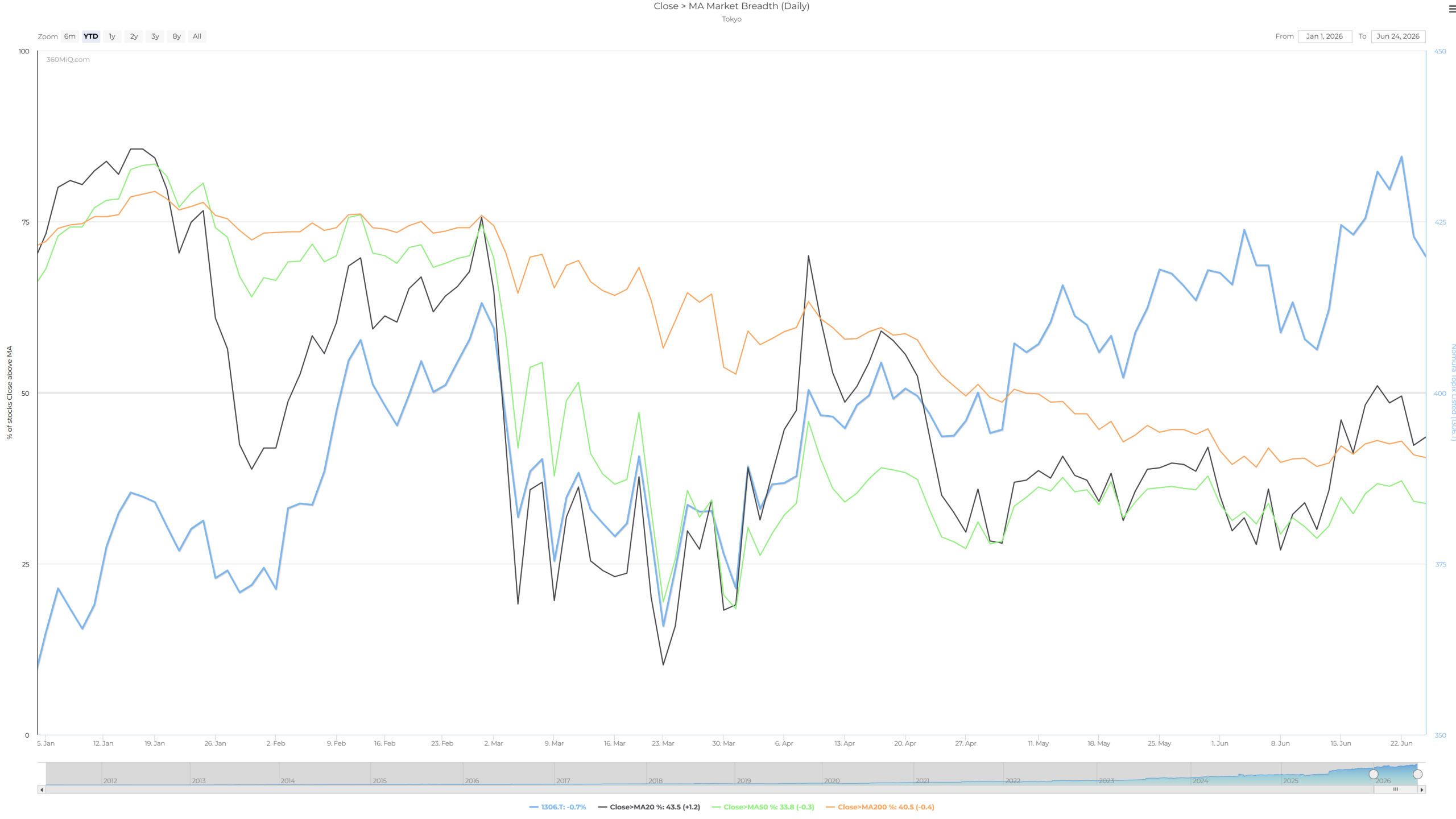
Tokyo market breadth, percentage of stocks above their moving averages. Source: 360MiQ.com
Nikkei daily chart: a strong, intact uptrend
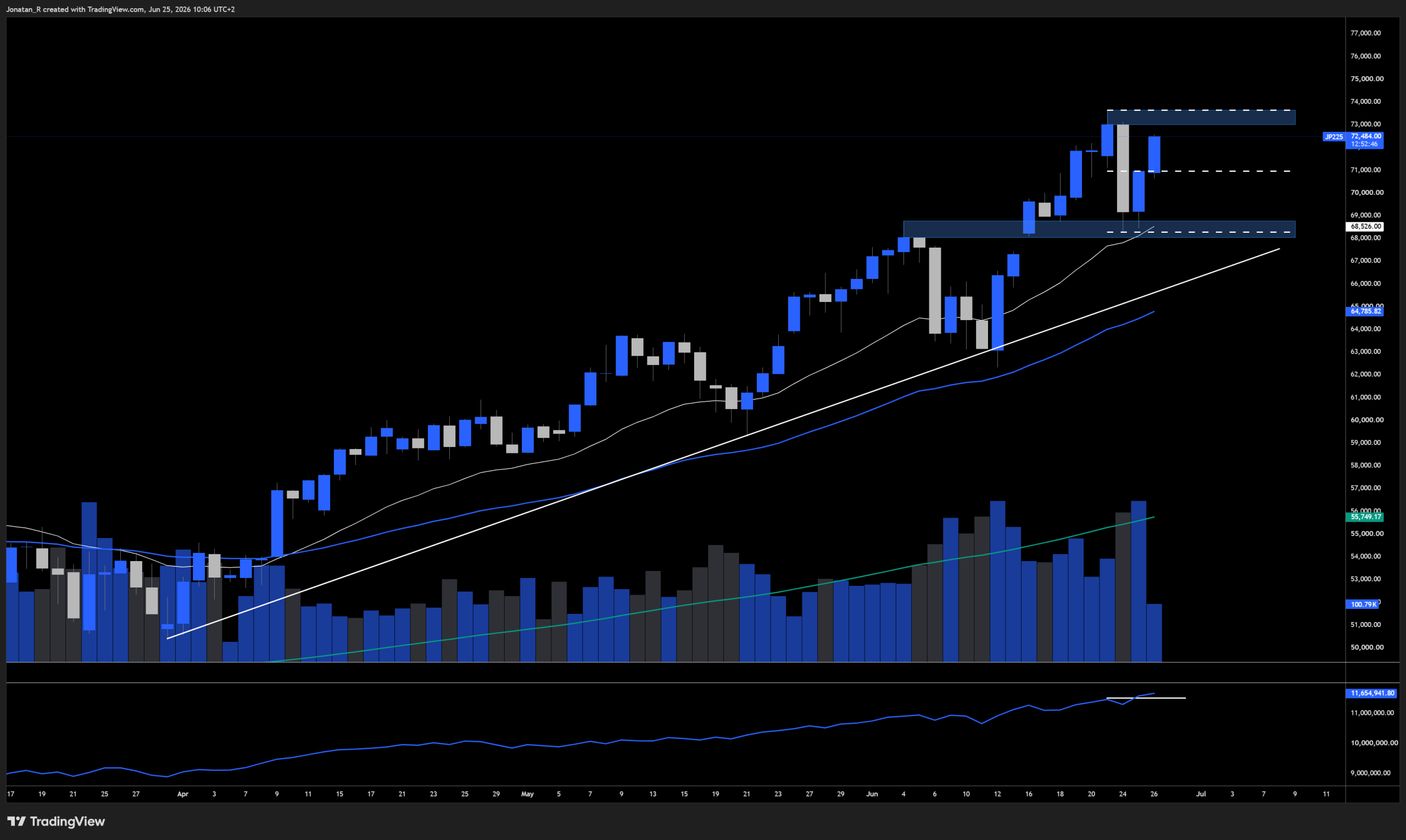
On the daily timeframe, the broader trend remains firmly intact. After reaching its record high, the index pulled back and found a bullish bounce around the 68,500 area, a level that also lines up with the daily 20-period exponential moving average (EMA).
The moving average structure underlines how strong the trend is. The 20 EMA is sitting well above the 50 EMA, which in turn is well above the 100 EMA, the kind of stacked alignment that typically reflects a clear and powerful uptrend.
Just as importantly, the index continues to print higher swing lows, and the most recent higher low formed well above the one before it. That points to building momentum rather than a fading trend, and suggests the breakout remains confirmed.
The internals support the move too. The bounce came on increasing volume, and the accumulation/distribution line has pushed above the high it made during the previous test of all-time highs. That tells us there is genuine volume participation behind the advance, rather than price drifting higher on thin trade.
Key levels on the daily:
- 68,500 is the immediate support to watch, reinforced by the daily 20 EMA
- As long as the index continues to hold its rising series of higher lows, the broader uptrend remains in control
Nikkei 4H chart: range in play beneath the highs
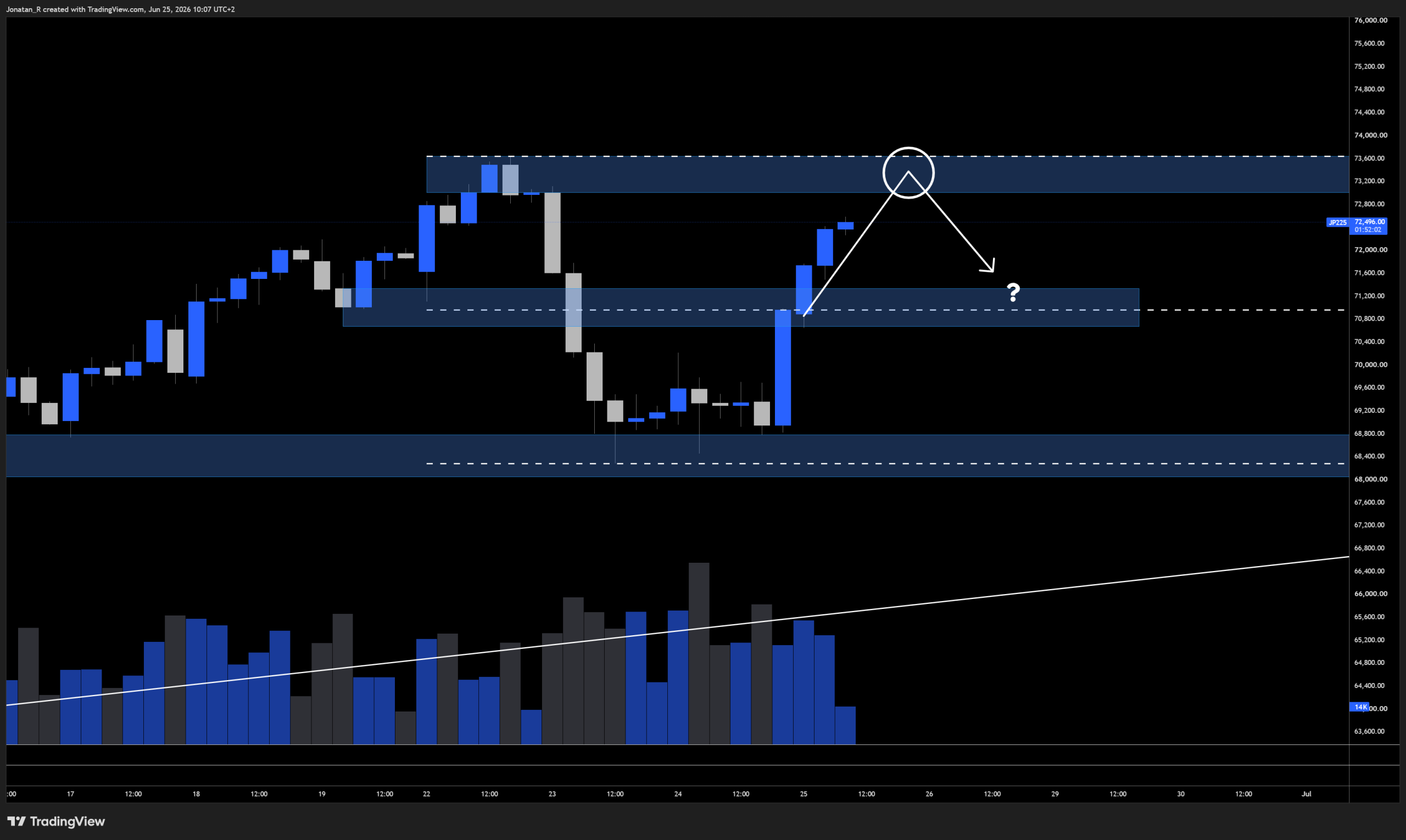
Zooming in to the 4-hour timeframe, the index is trading within a clearly defined range. The range equilibrium (EQ) sits at around 71,000, while the upper boundary lines up with the all-time high resistance area near 73,500.
The near-term question is how price behaves as it approaches that record-high resistance. A rejection from the 73,500 zone could open the door to a move back down towards range EQ at 71,000. That is the level bulls would want to see hold as support, as defending it would keep the broader upside potential intact.
Key levels on the 4H:
- 73,500 is the upper resistance, aligned with the all-time high
- 71,000 is range EQ, the level to watch as potential support on any pullback
Trading involves risk.
Author



 Risk Disclaimer
The content provided here is for informational purposes only. It is not intended as personal investment advice and does not constitute a solicitation or invitation to engage in any financial transactions, investments, or related activities. Past performance is not a reliable indicator of future results.
The financial products offered by the Company are complex and come with a high risk of losing money rapidly due to leverage. These products may not be suitable for all investors. Before engaging, you should consider whether you understand how these leveraged products work and whether you can afford the high risk of losing your money.
The Company does not accept clients from the Restricted Jurisdictions as indicated in our website/ T&C. Some services or products may not be available in your jurisdiction.
The applicable legal entity and its respective products and services depend on the client’s country of residence and the entity with which the client has established a contractual relationship during registration.