5 min read
 Isn’t BTC Rallying?
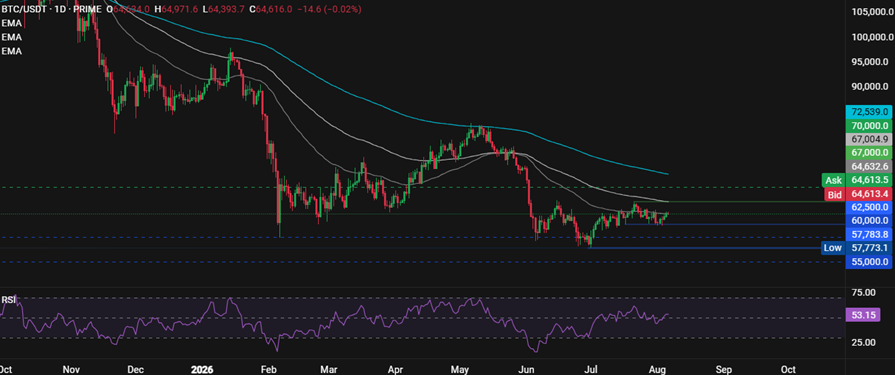
Bitcoin is rising on Thursday amid improving risk appetite on hopes of a deal to reopen the Strait of Hormuz and as institutional demand picks up.
The largest cryptocurrency is trading 0.7% higher over the past 24 hours and is flat over the past seven days. Major altcoins are also moving higher, with the total cryptocurrency market cap up 0.5% to $2.2 trillion.
Optimism surrounding a Hormuz deal
Hopes of a deal to reopen the Strait of Hormuz are a key focus this week after Iran indicated that it was close to reaching an agreement with Oman.
President Trump has also said talks with Tehran are going well, even though Tehran has largely denied any direct negotiations. On the other hand, a senior Gulf official said there was a 50% chance of a deal by Friday.
Still, the prospect of the key waterway reopening has pulled oil prices down more than 10% this week, calming inflationary concerns. Treasury yields are falling and the market is reining in hawkish Fed expectations, which is supporting risk assets such as crypto and equities.
US data and Fed expectations
On the economic data front, ADP payrolls showed 44k private-sector jobs were added in July, marking a notable slowdown from 98k in the previous month. This was also below expectations of 70k. Separately, the ISM Services PMI showed a slight improvement to 54.1 in July from 54 in June, although this was below expectations of 54.5.
Following the softer data, according to CME FedWatch, the probability of a September Fed hike has eased to 55% on Thursday, down from 67% at the start of the week. This is weighing on the U.S. dollar and supporting risk assets such as BTC and equities.
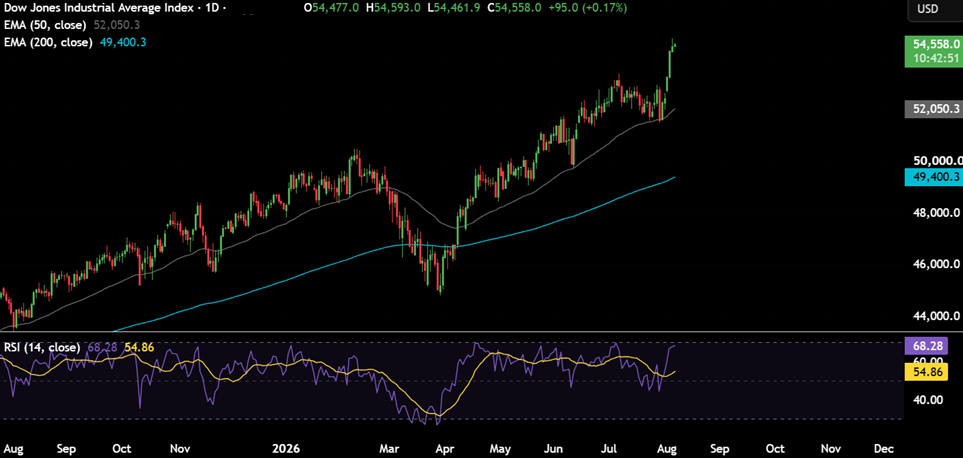
However, while Bitcoin trades within a familiar range, U.S. equities have surged to record highs, with both the Dow Jones and S&P 500 at record levels. Bitcoin’s failure to follow equities higher suggests that improving risk sentiment isn’t enough, at least for now, to push BTC out of its recent range.
The crypto Fear and Greed Index remains in Extreme Fear at 25, while US equities trade at record highs. This suggests that conviction among crypto investors remains weak.
Institutional demand picks up
Despite the muted price performance from Bitcoin, institutional demand is gaining momentum in early August.
According to SoSoValue data, spot BTC ETFs have recorded $626 million in net inflows so far in August, up from just $172.4 million in July.
However, it is still early days to see whether these inflows will persist, particularly given that Bitcoin ETFs lost almost $7 billion in net outflows across May and June. If inflows continue to pick up while Fed rate hike expectations fall, this could help BTC push higher. However, for now, the lack of a stronger price reaction suggests that buyers remain cautious.
Looking ahead
Looking ahead, attention will turn to tomorrow’s non-farm payroll report, which is expected to show that 80k jobs were added in July, up from 57k in June. The unemployment rate is expected to tick higher to 4.3% from 4.2%.
Weaker-than-expected numbers could see the market rein in hawkish Fed expectations further, offering support to two risk assets and BTC.
Trading involves risk.
Author

 Risk Disclaimer
The content provided here is for informational purposes only. It is not intended as personal investment advice and does not constitute a solicitation or invitation to engage in any financial transactions, investments, or related activities. Past performance is not a reliable indicator of future results.
The financial products offered by the Company are complex and come with a high risk of losing money rapidly due to leverage. These products may not be suitable for all investors. Before engaging, you should consider whether you understand how these leveraged products work and whether you can afford the high risk of losing your money.
The Company does not accept clients from the Restricted Jurisdictions as indicated in our website/ T&C. Some services or products may not be available in your jurisdiction.
The applicable legal entity and its respective products and services depend on the client’s country of residence and the entity with which the client has established a contractual relationship during registration.