9 min read
 Weekly Recap
Major US data: soft CPI relief buried by a semiconductor bear market
The week opened with a dovish surprise. June CPI, released Tuesday, showed headline inflation cooling to 3.5% year-on-year from May’s 4.2%, and prices fell 0.4% for the month, the largest decline since 2020 as energy costs corrected. Core CPI was unchanged, lowering the annual rate to 2.6%. This data sparked an early rally and reduced expectations of an imminent Fed hike. Chair Kevin Warsh, in his first congressional testimony, pledged a “regime change” on inflation but did not provide forward guidance or signal his next steps.
The relief was short-lived. The US 100 closed at 28,592.66, down 1.49% on Friday and about 4% for the week, as semiconductor losses weighed on the index. The Nasdaq fell 2.9%, and the S&P 500 lost 1.6%. A key chip gauge entered a bear market, dropping roughly 20% from its peak and posting its worst week since April 2025, driven by concerns that AI hyperscalers may reduce capital spending, heightened by a new model from Chinese startup Moonshot. Netflix declined 7.3% amid weak guidance, and Alphabet slipped after a reported delay in the launch of Gemini 3.5 Pro.
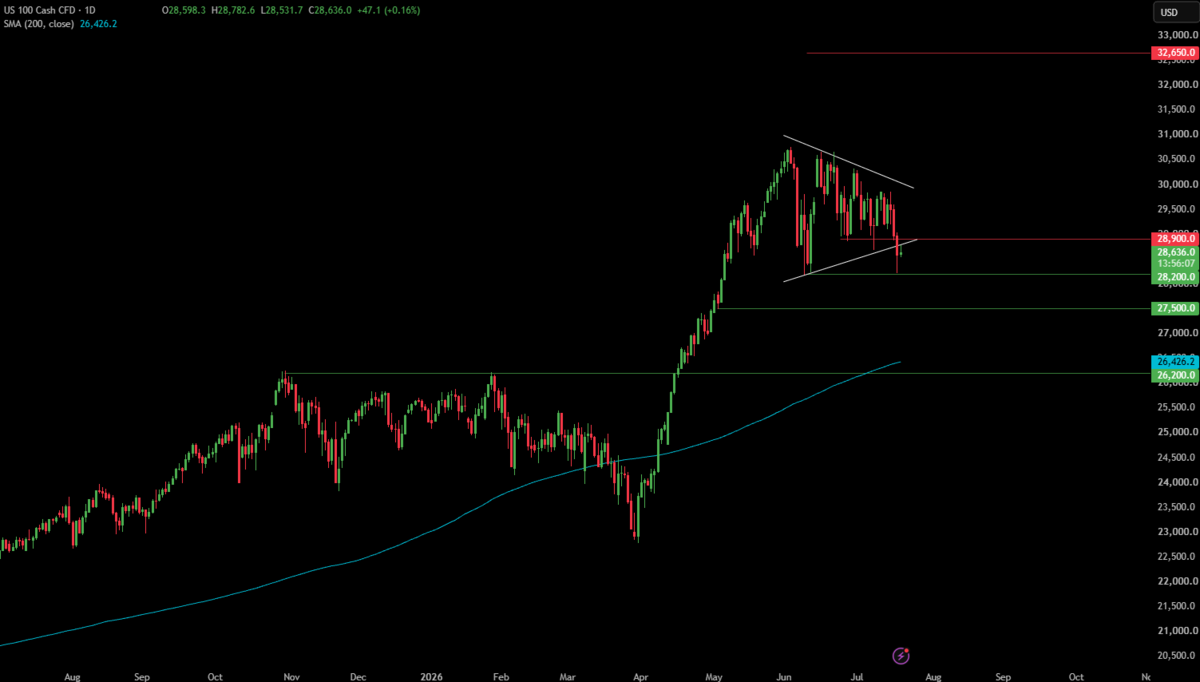
Renewed US-Iran strikes drove energy prices higher, reigniting inflation concerns following the soft CPI report. By Friday, markets priced a 53% chance of a September rate hike, up from 47% the previous week. The 10-year Treasury yield was near 4.55%, and the volatility index rose to 18.77. The US 100 now faces a near-term test: whether upcoming tech earnings can stabilize the AI trade ahead of the 28–29 July FOMC meeting.
Gold moves: oil-driven inflation fears trigger the worst week since June
Gold closed the week near $4,010 an ounce, rising 0.6% on Friday but recording its largest weekly decline since early June, down about 3%. The metal reached its lowest level since mid-week in early July, and Friday’s modest rebound did not offset the overall loss.
The same escalation that lifted oil drove gold lower. Renewed US strikes on Iran pushed energy prices higher, raising inflation expectations and supporting higher US interest rates, which is unfavorable for gold. With the 10-year yield near 4.55% and investors moving into the dollar and interest-bearing assets, gold struggled despite the soft June CPI, which might have supported it under calmer conditions.
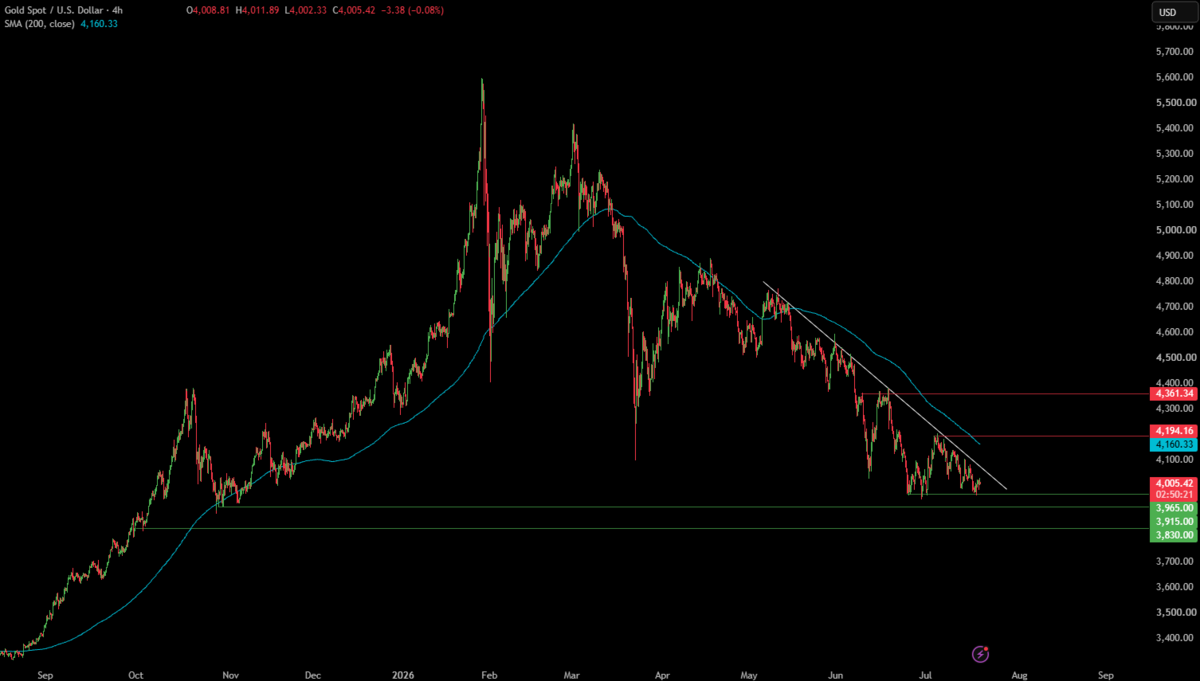
Analysts attributed the pullback to profit-taking and short-selling in a declining market, with further downside risk if oil prices continue to rise and inflation expectations remain high. Gold’s outlook next week depends on whether the energy shock worsens or the ECB and new data alter the rate outlook.
Oil moves: UK Brent surges ~10% as Hormuz traffic seizes up
UK Brent closed near $86 a barrel after its strongest weekly gain in months, driven by intensified hostilities between Washington and Tehran. US Central Command reported a sixth consecutive night of strikes on Iranian military sites, while Iran retaliated by striking a power and water desalination plant in Kuwait and targeting US bases across Bahrain, Jordan, Oman, Qatar, and Syria.
The supply threat was significant. Commercial traffic through the Strait of Hormuz, which carries about a fifth of global energy trade, remained restricted after the US reinstated a naval blockade of Iranian ports. Tehran reportedly instructed Houthi forces to prepare to disrupt Red Sea shipping. President Trump warned the US may target Iran’s energy infrastructure if no diplomatic breakthrough occurs, maintaining a substantial risk premium in prices.
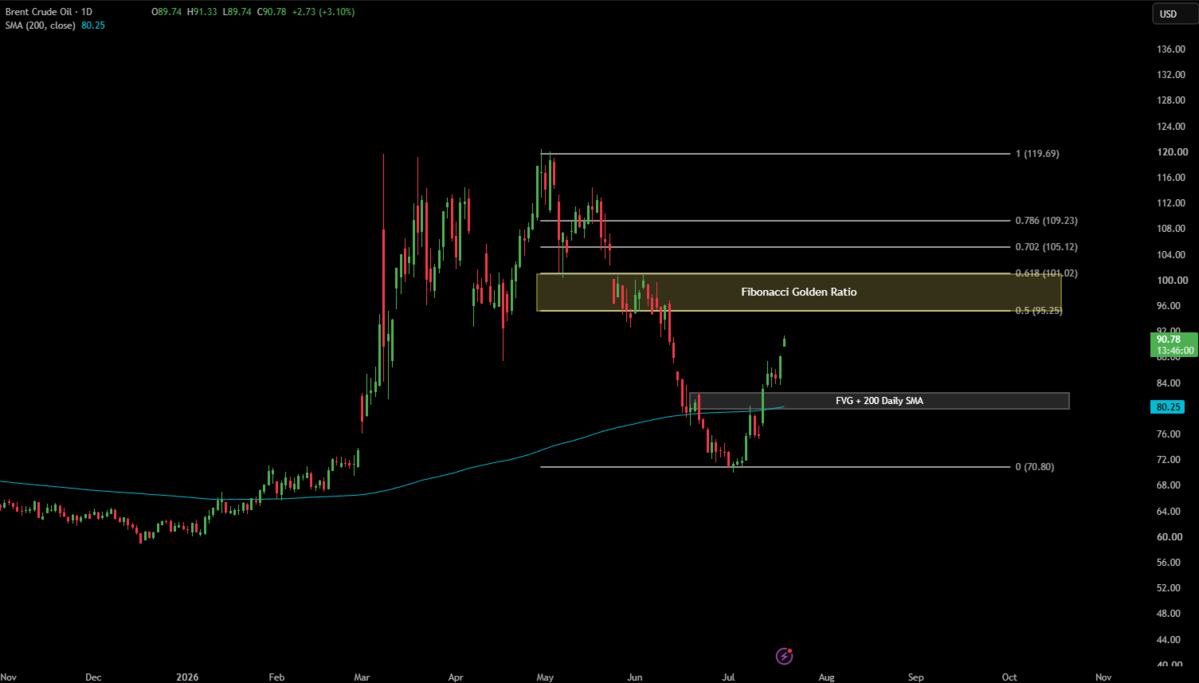
With physical flows restricted and no sign of de-escalation, UK Brent remains vulnerable to further price spikes if new disruptions occur. A confirmed escalation or damage to energy infrastructure would push prices higher, while a credible return to negotiations would reduce the risk premium.
Indian markets: IT and financials lift Nifty 50 as the rupee hits record lows
Indian equities outperformed despite the global tech sell-off, closing higher due to strong domestic earnings. The Nifty 50 rose 1.09% on Friday to 24,334.30, up 0.52% for the week, while the Sensex gained 1.25% to 78,151.45, advancing 0.75% weekly. Information technology and financials led the rally after positive results from Tech Mahindra and Jio Financial Services, with domestic institutions shifting from mid- and small-caps to large-caps.
The gains occurred despite elevated inflation. June CPI, released Monday, rose to 4.38%, exceeding the 4.30% consensus and breaching the Reserve Bank of India’s 4% target for the first time in 17 months, as the US-Iran conflict and delayed monsoon increased food and fuel costs. The Nifty 50 traded within a 368-point band, its narrowest weekly range of 2026, as investors consolidated ahead of results from Reliance Industries, HDFC Bank, and ICICI Bank. Reliance rose 2.4% on Friday.
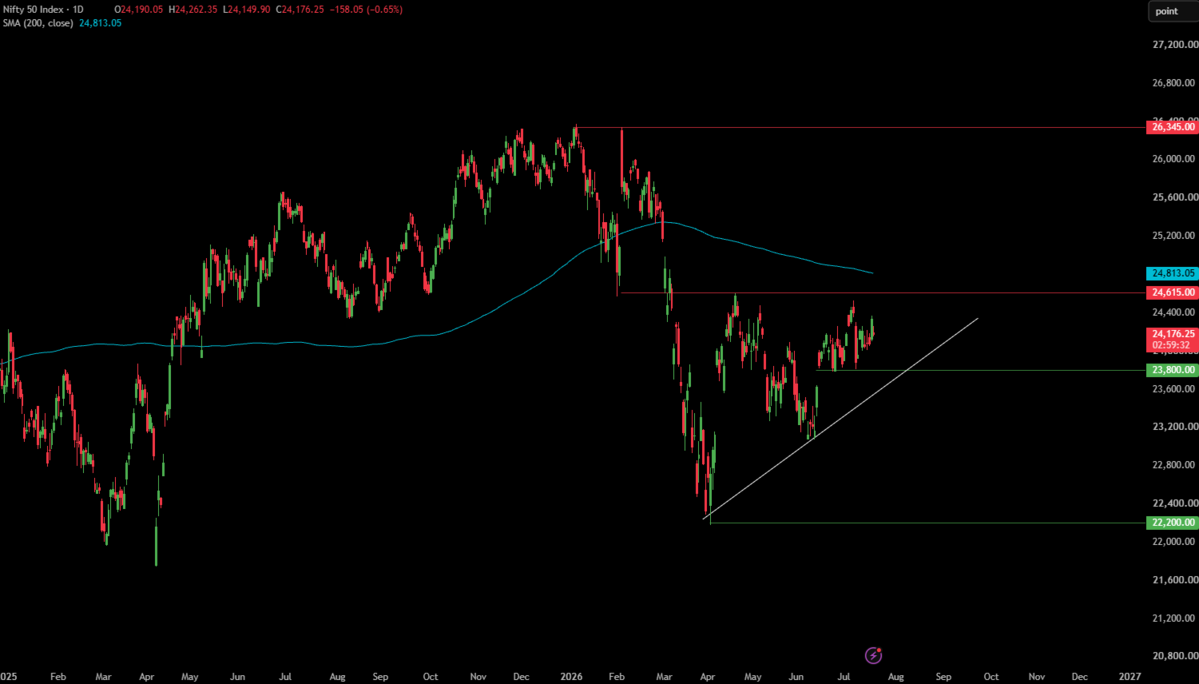
The price continues to be squeezed between the 24.615 level and the ascending trendline. A breakout above this resistance will open the way to the ATH at 26.345.
Pakistan markets: KSE-100 slides 3.5% as the war rattles sentiment
The KSE-100 dropped 3.53% for the week, closing at 175,802.78 after volatility driven by the US-Iran conflict. On Friday, the index lost about 2,320 points, or 1.30%, as escalating strikes and fears of a wider regional war triggered heavy selling and pulled Asian markets lower. South Korea’s KOSPI fell 6.3%, and Japan’s Nikkei declined 3% amid the global chip rout.
The week was mixed. The index recovered for two days mid-week on hopes of renewed US-Iran dialogue, but those gains reversed on Friday as hostilities intensified and oil prices surged. Higher energy costs pose a significant challenge to Pakistan’s import-dependent external account, undermining the improved macro outlook that had recently supported the market.
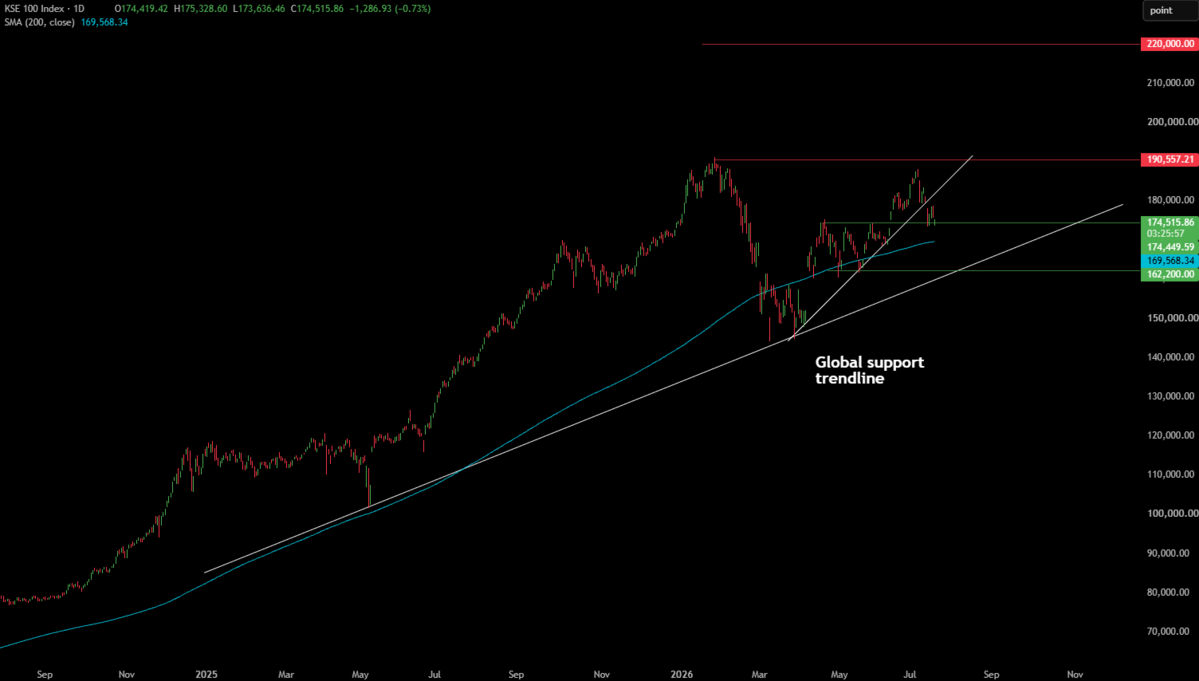
With the State Bank’s policy meeting on 27 July, the KSE-100’s direction this week will depend largely on the external environment, including the conflict’s trajectory and UK Brent prices.
KSE-100 lost its local support trendline and may face the global trendline during this week, breaking below the 174,500 support level.
Week Ahead
ECB Rate Decision — Thursday, 23 July, 12:15 UTC
The European Central Bank will announce its latest decision on Thursday, followed by President Christine Lagarde’s press conference at 12:45 UTC. After raising the deposit rate to 2.25% in June, its first increase since September 2023 due to the Middle East energy shock that pushed euro-area inflation to 3.2% in May, the ECB is expected to hold rates, with markets pricing an 88% probability of no change.
With a pause expected, attention shifts to Lagarde’s guidance. Markets previously anticipated another hike by September, but the easing of euro-area inflation to 2.8% in June has reduced that likelihood, despite renewed oil price increases. Investors will analyze her assessment of the energy shock, growth, and risks, along with July flash PMIs, for signals on the future of the tightening cycle.
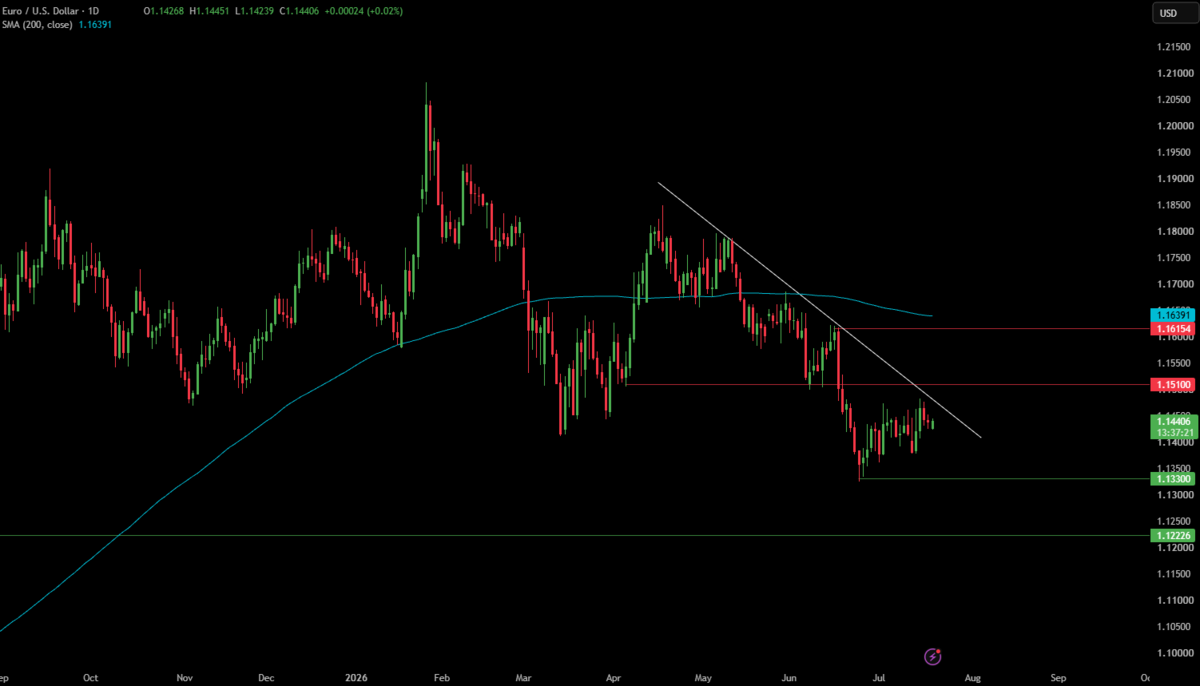
EUR/USD starts the week near 1.144. The major level to watch is 1.1510, as a breakout above it may open the way to 1.1615. A hawkish Lagarde maintaining a September hike could push EUR/USD higher; signaling the ECB is finished would likely pull it lower.
UK Inflation (June) — Wednesday, 22 July, 06:00 UTC
The UK will release June CPI on Wednesday, a crucial indicator for a divided Bank of England. Inflation remained at 2.8% in May, unchanged from April and down from 3.3% in March, but June’s figure is expected to rise as the Iran war’s energy shock impacts household bills and fuel prices.
The data arrives amid a hawkish backdrop. The BoE held the Bank Rate at 3.75% in June by a 7–2 vote, with two members, including Chief Economist Huw Pill, favoring a hike to 4%. The Bank projects inflation rising to about 3% in the third quarter and above 3.25% in the fourth, with some forecasts peaking near 3.6% in September. Policymakers focus on service inflation, which was 3.7% in May. The next rate decision is on 30 July.
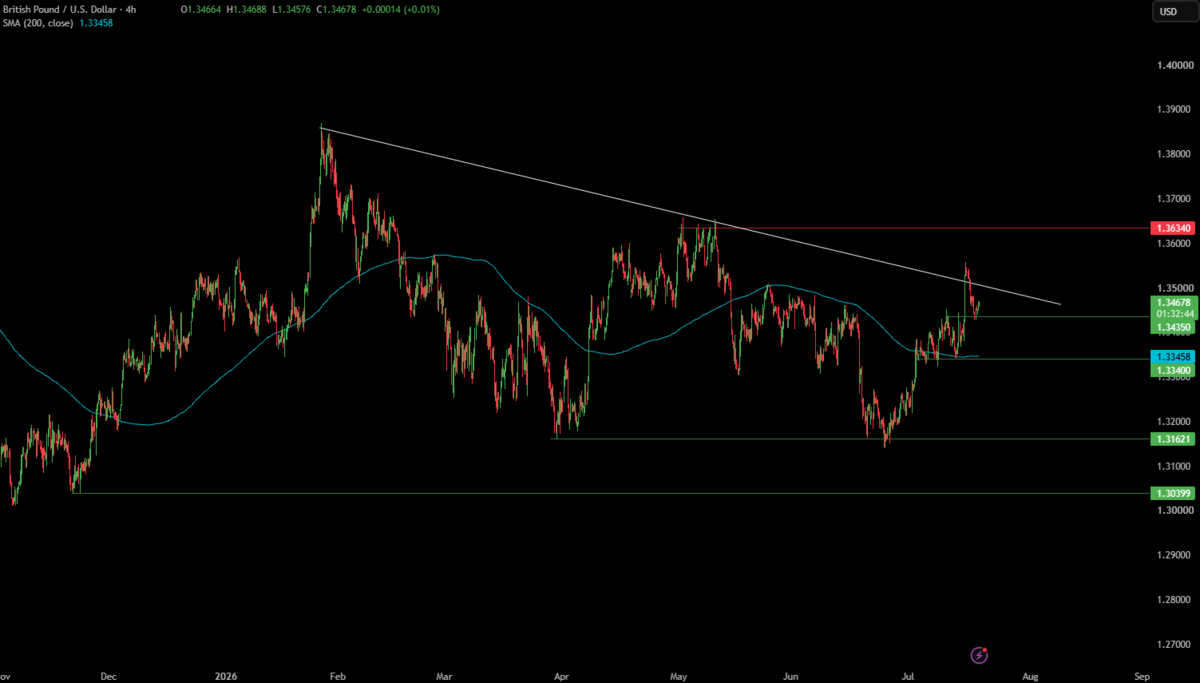
GBP/USD trades near 1.347, with sterling supported by the Bank’s 150-basis-point rate advantage over the ECB and the resolution of domestic political uncertainty. A higher-than-expected June CPI would strengthen the hawkish minority and could lift GBP/USD; a softer reading favoring patience or renewed easing would likely weigh on GBP/USD.
Bottom line
The main driver is the renewed US-Iran oil shock, combined with a sharp derating of the AI trade, which has revived inflation fears and pulled markets away from last week’s relief on the soft CPI. Central banks are now in focus: the ECB and BoE must determine if the energy spike is temporary or signals broader inflation, and their guidance will influence EUR/USD and GBP/USD.
Trading involves risk.
Author



 Risk Disclaimer
The content provided here is for informational purposes only. It is not intended as personal investment advice and does not constitute a solicitation or invitation to engage in any financial transactions, investments, or related activities. Past performance is not a reliable indicator of future results.
The financial products offered by the Company are complex and come with a high risk of losing money rapidly due to leverage. These products may not be suitable for all investors. Before engaging, you should consider whether you understand how these leveraged products work and whether you can afford the high risk of losing your money.
The Company does not accept clients from the Restricted Jurisdictions as indicated in our website/ T&C. Some services or products may not be available in your jurisdiction.
The applicable legal entity and its respective products and services depend on the client’s country of residence and the entity with which the client has established a contractual relationship during registration.