10 min read
 Weekly recap
Iran-US peace deal, Hormuz reopening & Brent
The week’s most significant development was Sunday’s announcement of the US-Iran peace deal. Trump stated on Truth Social: “The Deal with the Islamic Republic of Iran is now complete,” authorizing the immediate removal of the US naval blockade and the “toll-free opening” of the Strait of Hormuz. Pakistan, which mediated the negotiations, confirmed the agreement earlier that day. The official signing ceremony is scheduled for Friday, 19 June, in Switzerland.
The 14-point memorandum ends the conflict, withdraws US forces from Iran’s vicinity, releases $25 billion in Iranian frozen assets, lifts oil and financial sanctions, and commits Tehran to non-proliferation under the NPT. A 60-day window addresses remaining nuclear and UN Security Council issues. Israel is not a party to the deal. Netanyahu called it a “deep disappointment” for the Israeli government, and ongoing strikes on Hezbollah in Beirut nearly derailed the announcement.
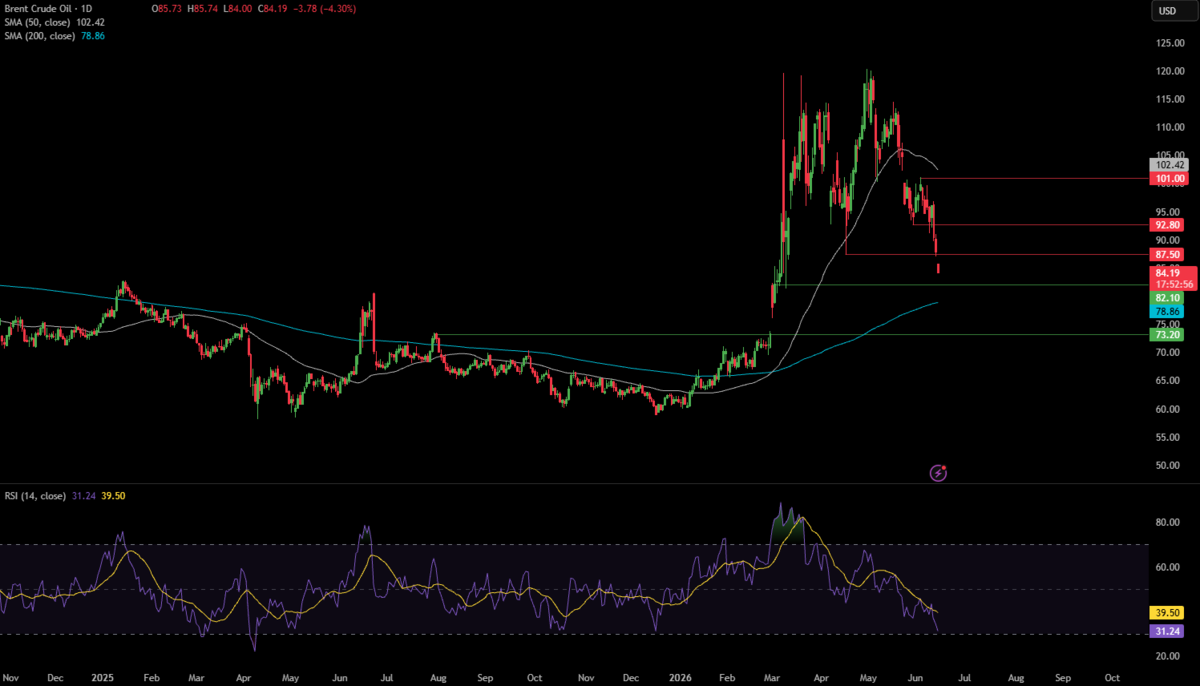
Brent opened the week with 4% decline. With the blockade lifted, Hormuz reopened, and sanctions on Iranian crude removed, the supply-side risk premium that has anchored Brent through Q1 and Q2 collapses. The energy shock that drove the ECB hike, US CPI to 4.2%, and RBA tightening was supply-driven; if the deal holds through the 60-day window, that pressure unwinds across global rates and inflation paths.
Hot CPI, ECB hike, SpaceX IPO
US indices fluctuated throughout the week due to Wednesday’s CPI report, which showed a headline rate of 4.2% year-on-year, the highest since April 2023, driven by a 23.5% increase in energy prices (+3.9% month-on-month). Core CPI rose 2.9% year-on-year and 0.2% month-on-month, below the expected 0.3%. On the same day, the Dow Jones fell 900 points after Trump warned Iran “will pay the price” for rejecting the deal.
On Thursday, the ECB implemented its first rate hike since September 2023, raising the deposit rate by 25 basis points to 2.25%. Lagarde rejected the “insurance hike” characterization during the press conference and noted a second hike is now more likely.
Friday’s SpaceX IPO was the exclamation mark. Listed on Nasdaq at $135, the stock opened at $150 and closed at $161.11, up 19.34%. MSCI added it to the Standard and Large-Cap indices immediately, with inclusion in the Nasdaq-100 to follow. The Dow Jones closed at 51,202.26 (+0.7% on the day), the S&P 500 at 7,394.30 (+0.5%), and the Nasdaq at 29,650, driven by combined optimism over SpaceX and growing expectations for a deal with Iran.
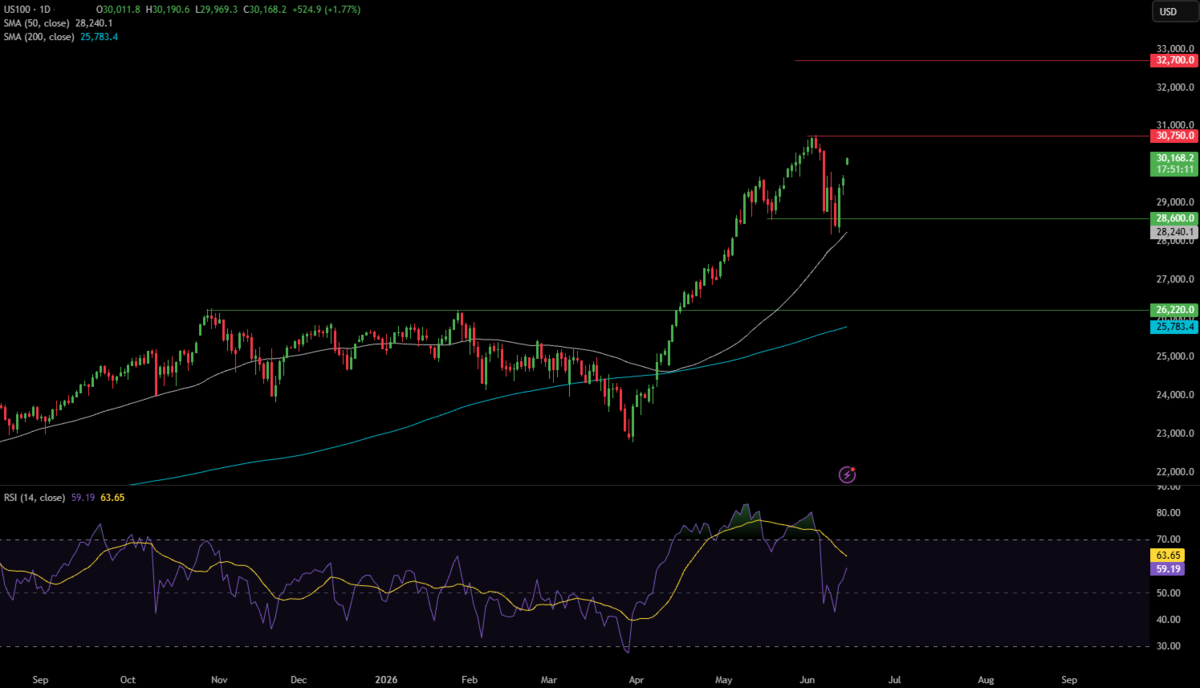
As central banks prepare for a busy week, the US 100 index faces two opposing forces: elevated inflation, which prevents Fed rate cuts, and the Iran deal, which could ease supply-driven inflation and allow policymakers to look beyond the current spike.
Week Ahead
RBA rate decision (Tuesday, 04:30 UTC+0)
The Reserve Bank of Australia is expected to maintain the cash rate at 4.35% on Tuesday, following three consecutive hikes earlier in 2026. Markets’ forecast is more hawkish than consensus, with 55% probability for a hawkish hold, 22.5% for a balanced hold, and 7.5% for an actual hike.
Q1 GDP grew only 0.3% quarter-on-quarter as of 3 June, below expectations, with productivity declining 0.6%. April CPI was 4.2% year-on-year, and the labor market remains tight. Domestic slowdown signals support a pause, while energy-driven inflation pressures argue for further tightening; however, the Iran deal announced Sunday significantly weakens the energy case.
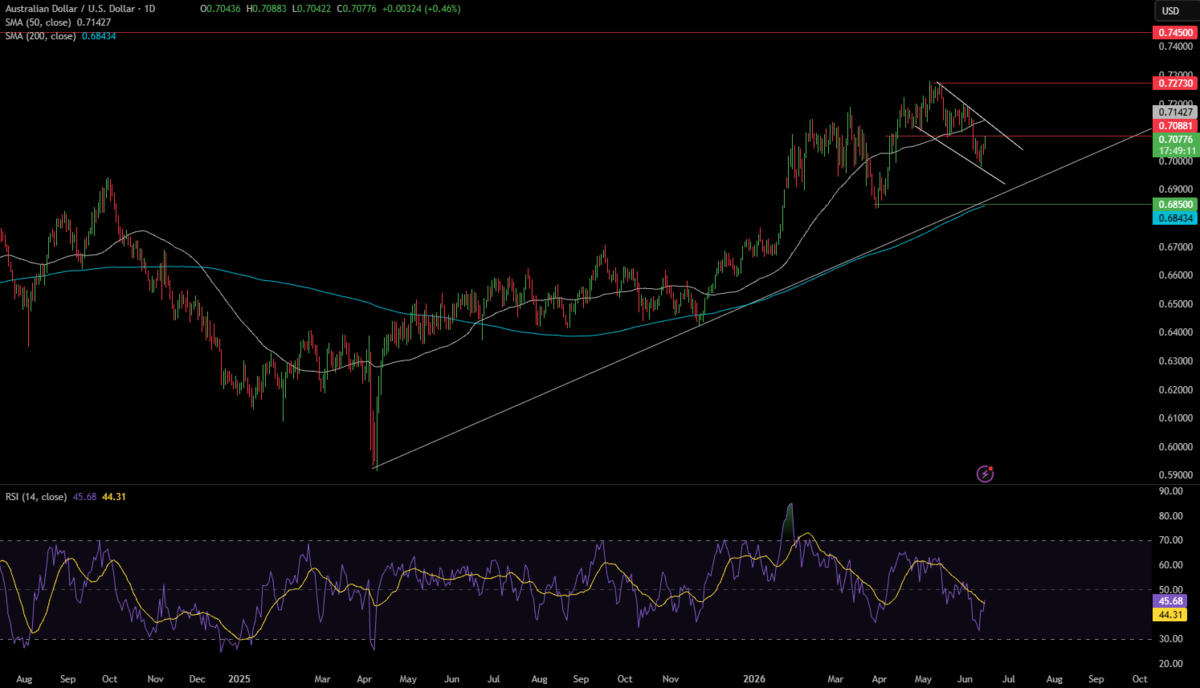
Forward guidance will drive market response. A hawkish hold, indicating readiness to hike if second-round inflation emerges, would support AUD/USD. Conversely, signaling that the rate cycle has peaked and the next move is downward would put pressure on the pair.
US Retail Sales May (Tuesday, 12:30 UTC+0)
US Retail Sales for May will be released at 12:30 UTC+0 on Tuesday, marking the first major US data release following Friday’s NFP surprise and Wednesday’s hot CPI. April Retail Sales increased 0.1% month-on-month, with the control group up 0.2%. Consensus expects May headline growth to be flat or slightly positive, as higher gasoline prices support nominal sales while volumes soften.
The report will be published less than 36 hours before the FOMC decision. With 2026 rate cuts already priced out and support for hikes increasing, a strong result, especially in the control group that contributes to GDP, would reinforce expectations for higher rates. A weak report could renew growth concerns, even as optimism about the Iran deal supports risk appetite.
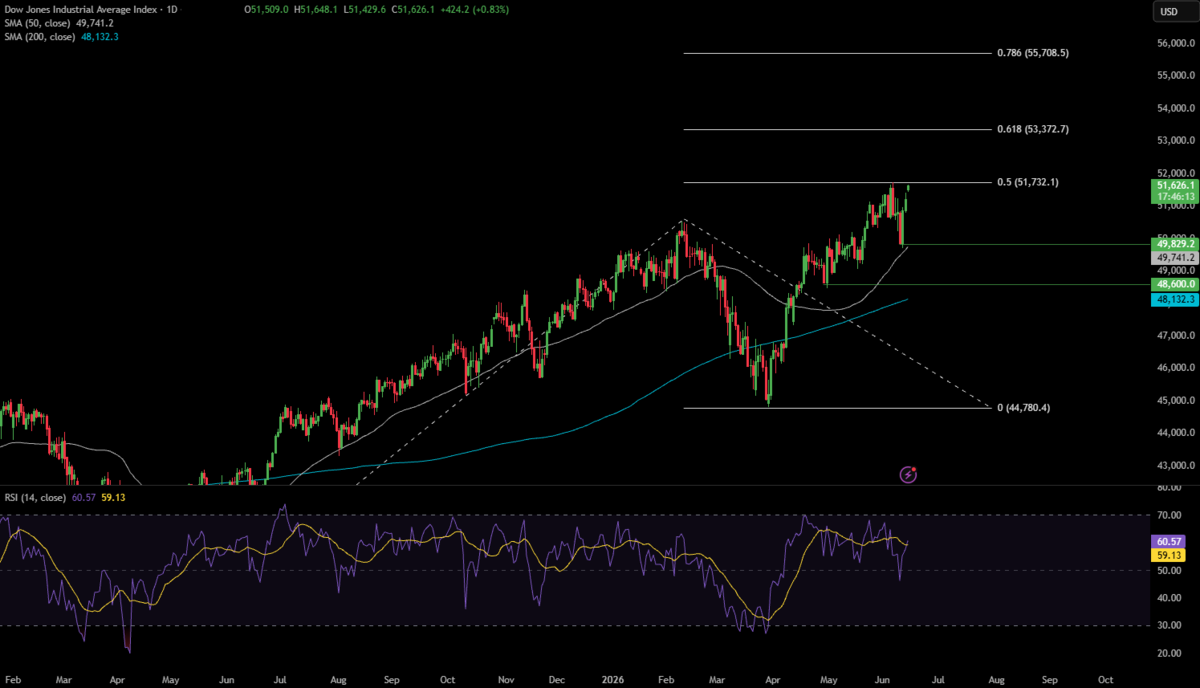
The Dow Jones best reflects retail sales performance due to its consumer staples and financials weighting. A strong report, combined with positive sentiment from the Iran deal, would support the index. A weak report would challenge its recovery from last week’s NFP-driven selloff.
UK CPI May (Wednesday, 06:00 UTC+0)
UK CPI for May will be released at 06:00 UTC+0 on Wednesday, the final major UK data before the Bank of England decision. April’s CPI was softer at 2.8% year-on-year, down from 3.3% in March, with services inflation easing to 3.2% from 4.5% and core CPI at 2.5%. The Bank’s April Monetary Policy Report projected headline CPI to rise to 3.1% in Q2 and “somewhat further” into Q4 due to the Iran energy shock.
Most economists expect inflation to approach 4% by year-end, but May is unlikely to reflect the full energy passthrough. The Iran deal announced this weekend materially alters the longer-term outlook; without ongoing disruption to the Strait of Hormuz, the energy impact will diminish through Q3. The May report still reflects pre-deal conditions and is likely to show some renewed acceleration from April’s 2.8%.
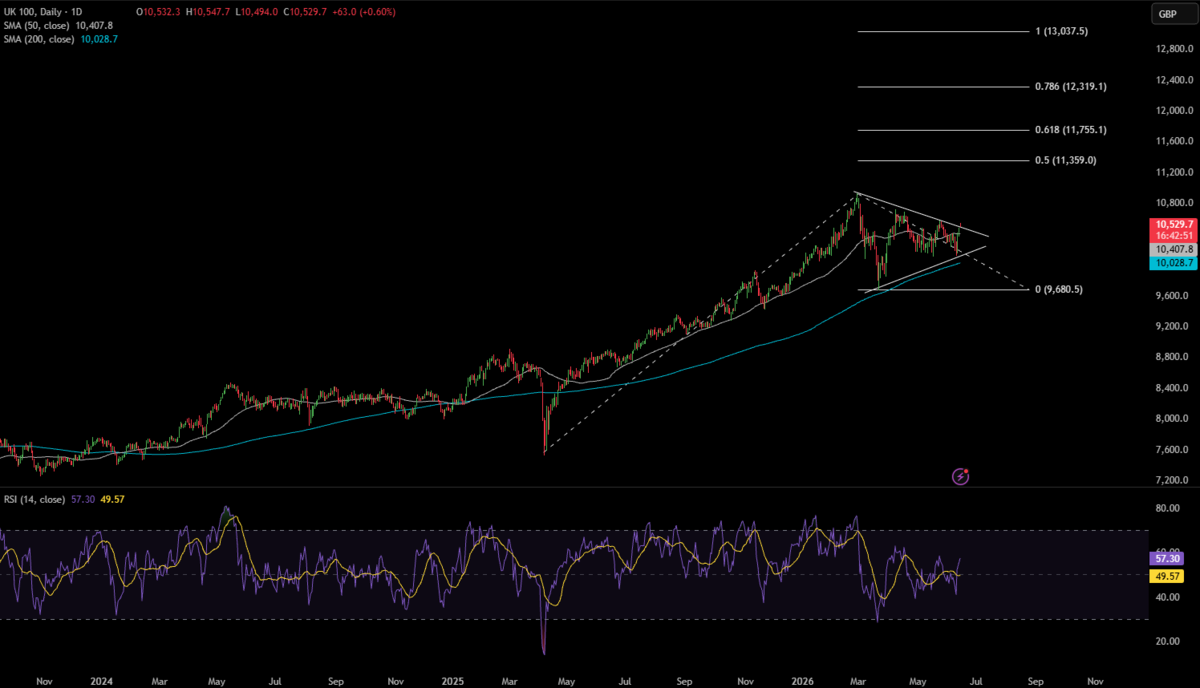
The UK100 has been consolidating for a while and has finally broken above the upper border of the symmetrical triangle. Low CPI would support the index.
BoJ rate decision (Wednesday, 03:00 UTC+0)
The Bank of Japan is expected to raise its policy rate to 1% for the first time since 1995, up 25 basis points from 0.75%, on Wednesday. Bloomberg estimates a 96% market-implied probability. Governor Kazuo Ueda is hospitalized for treatment of a hepatic cyst infection and will miss the meeting; Deputy Governor Shinichi Uchida will chair the post-meeting press conference.
Japanese wholesale prices increased 6.3% year-on-year in May, driven by higher import costs from the Iran energy shock and a weaker yen. A Reuters poll projects the BoJ will reach 1.25% by Q4 after this hike, with about two-thirds of economists expecting semi-annual moves. This decision aligns Japan with the ECB’s recent hawkish shift and marks the first BoJ hike since December.
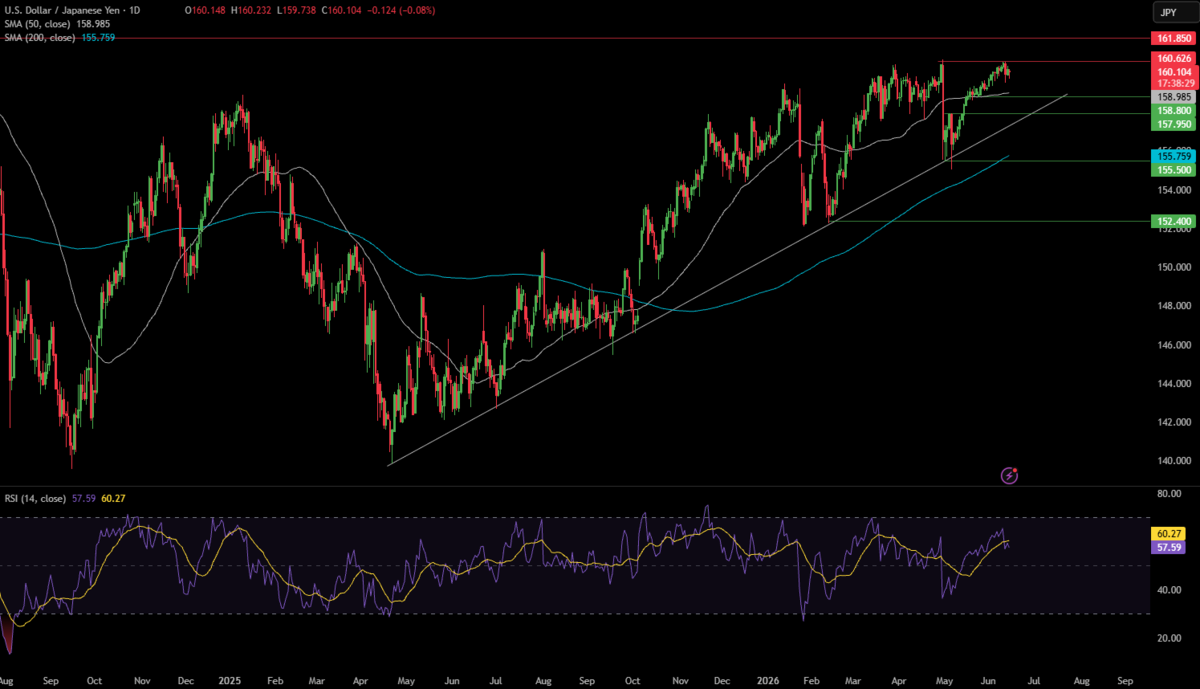
USD/JPY is the most direct indicator of the rate move. The market has already priced in the hike, so the reaction will depend on Uchida’s forward guidance. Clear signals of further tightening would push USD/JPY lower as the rate spread narrows, while a one-time hike would support the pair. The Iran deal further strengthens the JPY outlook by gradually reducing import price pressures.
FOMC decision (Wednesday, 18:00 UTC+0)
The Federal Reserve will conclude its June meeting at 18:00 UTC+0 on Wednesday, marking Kevin Warsh’s first session as Chair since succeeding Powell on 22 May. Markets assign a 94% probability to holding rates at 3.50–3.75%. Updated economic projections and the new dot plot will be released, followed by Warsh’s first press conference at 18:30 UTC+0.
The context is particularly complex. An elevated CPI of 4.2% argues against an easing bias. JPMorgan, BNP Paribas, and Goldman have removed 2026 rate cuts from their forecasts, with BNP now expecting three hikes starting in December. Polymarket assigns a 35% probability to a 2026 hike and 63% to a hike before July 2027. April FOMC minutes indicated most members favored dropping the easing bias.
The dot plot will provide a clear signal. A median projection with no cuts in 2026 and one or two hikes in 2027 would confirm the hawkish shift expected under Warsh. The Iran deal complicates the outlook by removing the energy-shock rationale for further rate hikes, though labor market and shelter inflation remain concerns.
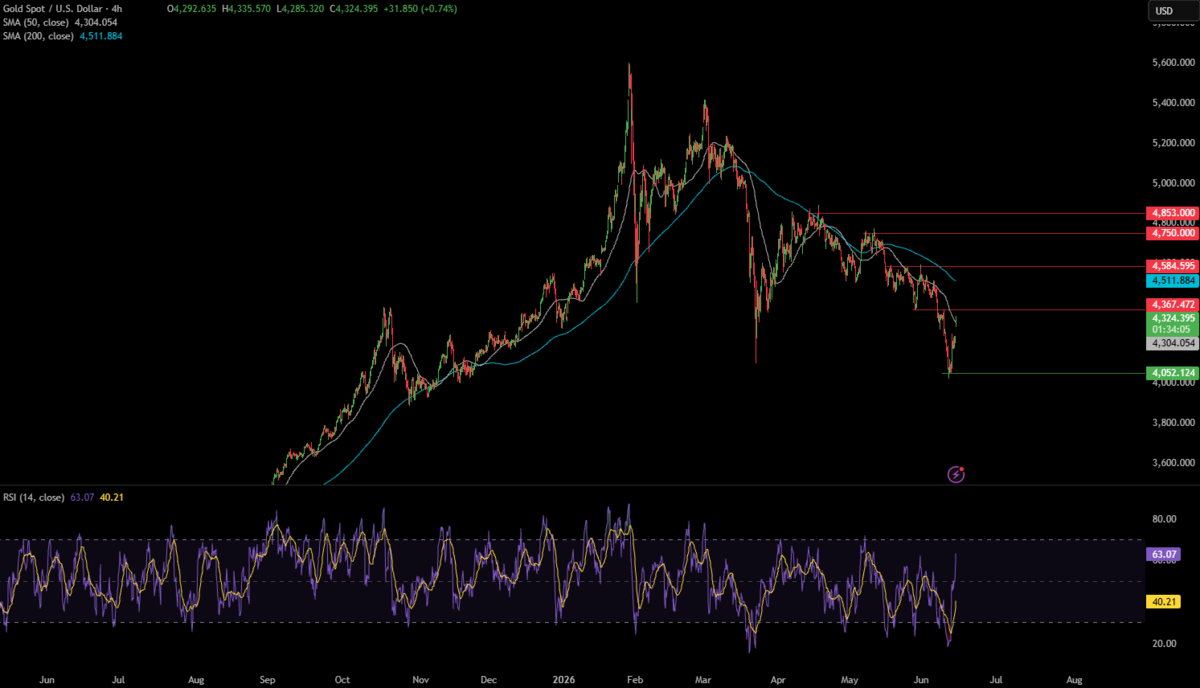
Gold is about to change its short-term trend as central banks may become less hawkish due to the USA-Iran deal.
BoE rate decision (Thursday, 11:00 UTC+0)
The Bank of England is expected to hold the Bank Rate at 3.75% on Thursday, with markets pricing in a probability of around 4% for a hike. The 30 April meeting delivered a hawkish 8–1 hold with Chief Economist Huw Pill dissenting in favor of a 25bp hike. The committee dropped the easing bias and flagged the need to “lean against” second-round inflation effects. Markets currently price in 50 bp of further tightening over 12 months.
Wednesday’s UK CPI report will inform the vote. April’s softer-than-expected CPI at 2.8% reduced near-term hike risk, but the Iran-related energy passthrough was expected to push inflation toward 4% later in the year. The Iran deal announced Sunday undermines the main argument for further tightening; if Brent falls below $70, the BoE’s stagflation narrative weakens significantly.
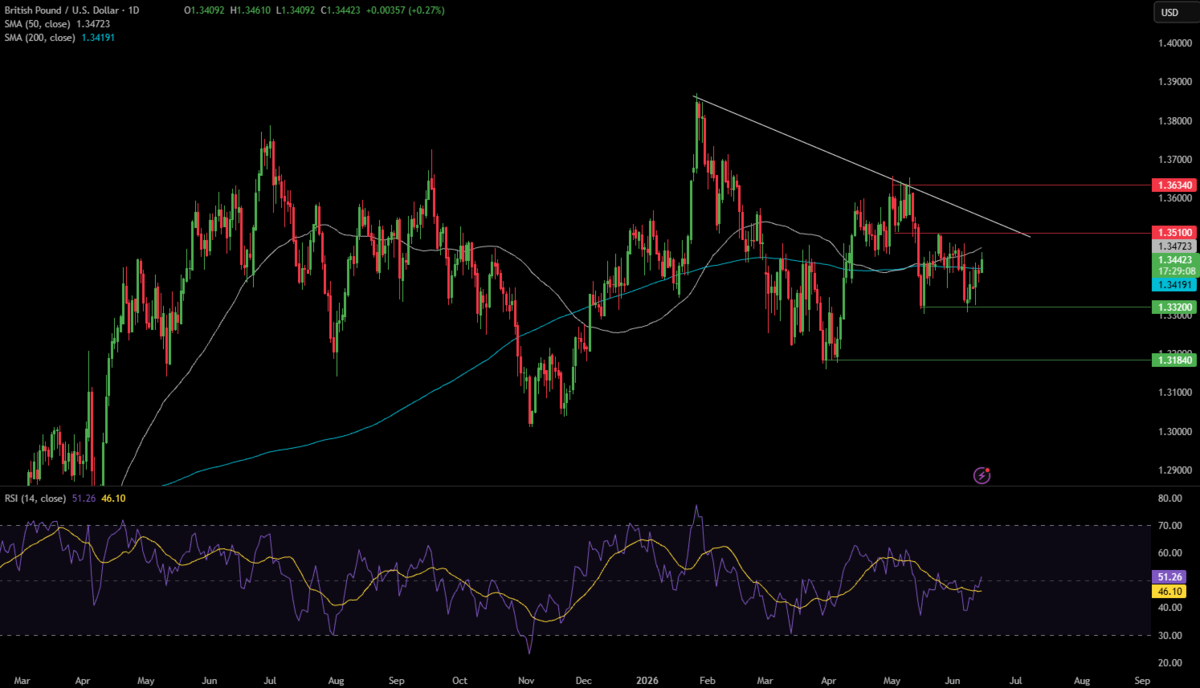
The vote split will be the main signal. A broader hawkish dissent (7–2 or 6–3 for a hike) would support GBP/USD, while a unanimous hold would pressure sterling. Bailey’s press conference at 11:30 UTC+0 will be closely watched for any change in tone, especially regarding whether the committee maintains focus on second-round effects or shifts to recognize the easing supply impulse from the Iran deal.
Bottom line
The US-Iran peace deal announced Sunday is the primary driver this week. The BoJ will deliver its first 1% rate since 1995 on Wednesday, the FOMC will release Warsh’s first dot plot the same evening, and the BoE will conclude the week on Thursday, with the RBA decision on Tuesday. Elevated US CPI at 4.2% supports hawkish messaging, but the Iran deal removes the main justification for further tightening, leaving central banks to weigh persistent inflation against a diminishing energy impulse.
Trading involves risk.
Author



 Risk Disclaimer
The content provided here is for informational purposes only. It is not intended as personal investment advice and does not constitute a solicitation or invitation to engage in any financial transactions, investments, or related activities. Past performance is not a reliable indicator of future results.
The financial products offered by the Company are complex and come with a high risk of losing money rapidly due to leverage. These products may not be suitable for all investors. Before engaging, you should consider whether you understand how these leveraged products work and whether you can afford the high risk of losing your money.
The Company does not accept clients from the Restricted Jurisdictions as indicated in our website/ T&C. Some services or products may not be available in your jurisdiction.
The applicable legal entity and its respective products and services depend on the client’s country of residence and the entity with which the client has established a contractual relationship during registration.