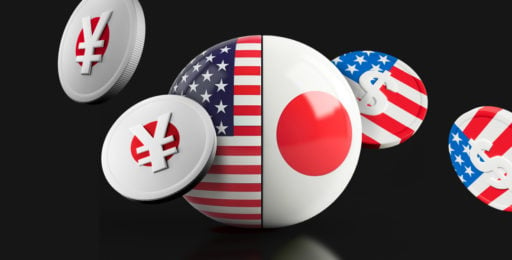

Japan's Ministry of Finance has spent close to $96 billion defending the yen in 2026, yet the currency keeps sliding back toward the levels that triggered the intervention. The interest rate gap between Japan and the United States remains the core driver, and the Bank of Japan's next policy move will decide whether Tokyo has to spend again.
Japan's Ministry of Finance spent 11.7 trillion yen, roughly $73 billion to $73.5 billion, defending the currency between April and May 2026, the largest single-month intervention on record. The spending followed the yen touching 160.725 per dollar on April 30, a near two-year low.
A further operation on July 30 cost an estimated $53 billion, pushing Japan's total 2026 intervention bill toward $96 billion.
How Japan got here
The yen's weakness flows from the interest rate gap between Japan and the United States. When US rates run meaningfully higher than Japanese rates, global investors move capital toward dollar assets, and that steady demand keeps pressuring the yen lower.
Japan imports nearly all its oil and natural gas in dollars, so a weaker yen raises the local cost of those purchases and feeds inflation. Finance Minister Satsuki Katayama has publicly committed to acting against what officials describe as excessive volatility, and the 160-per-dollar level has functioned as an informal line since interventions began in 2024.
A record single day
Japan's single-day intervention on April 30 exceeded 6.2 trillion yen, approximately $40 billion, a record for one trading session. The yen rebounded to the mid-155 range afterward but drifted back toward 160 by early June, and some market participants have since seen it test levels near 164.
The July 30 action added a new element: Japan and the United States conducted what is believed to be a coordinated intervention around July 31 and August 1, the first joint currency operation between the two countries in decades. The last comparable effort dates back to 1998 and 2011.
What sustained weakness means next
A weak yen initially helps exporters like Toyota and Sony, which earn revenue abroad and translate it back into yen at a favorable rate. But imported goods, from fuel to electronics components, cost more when the yen is soft, squeezing household budgets.
The Bank of Japan's policy path is the variable that matters most. If it moves toward higher rates and narrows the gap with the US, the yen could stabilize without further intervention. If it holds its loose stance, the Ministry of Finance could find itself spending another $96 billion next year to hold the same line.
Source: Crypto Briefing
Trading involves risk.





 Risk Disclaimer