14 min read
 Arbitrum (ARB) trades around $0.10 in late August 2026, roughly 96% below the $2.40 record it set in January 2024. ARB is the governance token of Arbitrum, the largest optimistic-rollup Layer 2 built on top of Ethereum: it lets holders vote in the Arbitrum DAO on treasury spending and protocol changes, but it does not, on its own, collect the network’s transaction fees. That gap between usage and token value sits underneath every number on this page. What follows is PrimeXBT’s price outlook for ARB through 2030 and out to 2050, the levels traders are watching now, and the catalysts, including a steady stream of token unlocks, most likely to move it. Figures are shown as ranges, and where the evidence runs thin, the text says so rather than inventing precision.
Arbitrum outlook at a glance
- 2026 base case: $0.091–$0.118, a year of basing near current levels rather than a fresh trend.
- Main bullish catalyst: Fed rate cuts pulling capital back into risk, paired with rising Arbitrum activity from Stylus, Orbit chains, and the Robinhood L2.
- Biggest downside risk: relentless monthly ARB unlocks to team and investors diluting holders, with a break below the $0.07 support opening more room down.
- Long-term view: a slow, dilution-capped recovery is the base case, and any figure past 2030 reads as a direction, not a dated target.
Live Arbitrum price chart
The chart below tracks ARB/USD in real time; the levels that matter right now are set out in the technical section further down.
Trading involves risk.
Arbitrum price prediction 2026–2030 (yearly forecast)
The table below sets PrimeXBT’s expected range for each year. The far-apart institutional and algorithmic targets that inform it, some flat, some calling for a multiple of today’s price, are kept in the analyst section rather than blended into a single misleading average here.
| Year | Minimum | Average | Maximum |
|---|---|---|---|
| 2026 | $0.091 | $0.103 | $0.118 |
| 2027 | $0.101 | $0.138 | $0.193 |
| 2028 | $0.148 | $0.190 | $0.235 |
| 2029 | $0.123 | $0.167 | $0.210 |
| 2030 | $0.110 | $0.152 | $0.192 |
Arbitrum price prediction 2026
PrimeXBT’s 2026 outlook keeps ARB close to its late-August level near $0.10, a full-year range of $0.091–$0.118 averaging about $0.103. The token is basing, not trending: recent strength has lifted it off local lows, but every rally still runs into fresh supply as locked tokens vest. A quiet year is the honest base case.
Across the remaining months of 2026, the month-by-month path stays in a narrow, faintly rising band, opening near a $0.099 average in August and drifting toward the top of that range by December:
| Month (2026) | Minimum | Average | Maximum |
|---|---|---|---|
| August | $0.091 | $0.099 | $0.107 |
| September | $0.093 | $0.101 | $0.109 |
| October | $0.094 | $0.103 | $0.112 |
| November | $0.096 | $0.105 | $0.115 |
| December | $0.098 | $0.108 | $0.118 |
Arbitrum price prediction 2027
2027 is where the outlook starts to lift, provided Layer-2 usage keeps compounding: the path climbs off the 2026 base toward a full-year range of $0.101–$0.193, averaging near $0.135. The move rests on network traction, not a single announcement, and it stays modest because new ARB keeps entering circulation the whole way up.
| Month (2027) | Minimum | Average | Maximum |
|---|---|---|---|
| January | $0.101 | $0.112 | $0.123 |
| February | $0.105 | $0.116 | $0.128 |
| March | $0.108 | $0.120 | $0.133 |
| April | $0.111 | $0.125 | $0.138 |
| May | $0.114 | $0.129 | $0.143 |
| June | $0.118 | $0.133 | $0.148 |
| July | $0.122 | $0.138 | $0.154 |
| August | $0.127 | $0.145 | $0.162 |
| September | $0.132 | $0.151 | $0.170 |
| October | $0.137 | $0.157 | $0.177 |
| November | $0.142 | $0.164 | $0.185 |
| December | $0.147 | $0.170 | $0.193 |
Arbitrum price prediction 2028
2028 carries the cycle high in this forecast. The path peaks around mid-year before giving back ground into December, producing a range of $0.148–$0.235 and an average near $0.185. That top sits well under $0.25 by design: a governance token diluting toward its 10 billion cap has a heavier ceiling than a fixed-supply asset, so the modeled peak is deliberately restrained.
| Month (2028) | Minimum | Average | Maximum |
|---|---|---|---|
| January | $0.151 | $0.175 | $0.200 |
| February | $0.155 | $0.181 | $0.206 |
| March | $0.159 | $0.186 | $0.213 |
| April | $0.163 | $0.192 | $0.220 |
| May | $0.167 | $0.197 | $0.227 |
| June | $0.171 | $0.202 | $0.234 |
| July | $0.170 | $0.203 | $0.235 |
| August | $0.166 | $0.198 | $0.231 |
| September | $0.161 | $0.194 | $0.226 |
| October | $0.157 | $0.189 | $0.221 |
| November | $0.153 | $0.185 | $0.217 |
| December | $0.148 | $0.180 | $0.212 |
Arbitrum price prediction 2029
2029 cools after the peak, easing lower through the year within a range of $0.123–$0.210 and an average near $0.166. By this point the bulk of team and investor tokens have unlocked, which thins the supply overhang but does not reverse it.
| Month (2029) | Minimum | Average | Maximum |
|---|---|---|---|
| January | $0.146 | $0.178 | $0.210 |
| February | $0.143 | $0.176 | $0.208 |
| March | $0.141 | $0.174 | $0.206 |
| April | $0.139 | $0.171 | $0.204 |
| May | $0.136 | $0.169 | $0.202 |
| June | $0.134 | $0.167 | $0.200 |
| July | $0.132 | $0.165 | $0.199 |
| August | $0.130 | $0.164 | $0.197 |
| September | $0.129 | $0.162 | $0.196 |
| October | $0.127 | $0.161 | $0.195 |
| November | $0.125 | $0.159 | $0.194 |
| December | $0.123 | $0.158 | $0.193 |
Arbitrum price prediction 2030
PrimeXBT’s 2030 view spans $0.110–$0.192, averaging about $0.152. Read the month-by-month figures below as the shape of a trajectory rather than dated prices: at four years out, the direction is the useful part, and the plausible band around it is wide.
| Month (2030) | Minimum | Average | Maximum |
|---|---|---|---|
| January | $0.122 | $0.157 | $0.192 |
| February | $0.121 | $0.156 | $0.191 |
| March | $0.120 | $0.155 | $0.191 |
| April | $0.118 | $0.154 | $0.190 |
| May | $0.117 | $0.153 | $0.190 |
| June | $0.116 | $0.152 | $0.189 |
| July | $0.115 | $0.152 | $0.188 |
| August | $0.114 | $0.151 | $0.188 |
| September | $0.113 | $0.150 | $0.188 |
| October | $0.112 | $0.149 | $0.187 |
| November | $0.111 | $0.149 | $0.187 |
| December | $0.110 | $0.148 | $0.186 |
Arbitrum long-term price prediction: 2035, 2040–2050
Numbers this far out describe a hope, not a schedule. No model can account for a decade of Ethereum roadmap changes, L2 competition, and macro regimes that have not happened yet, so treat the long-range table as a rough slope with error bars that grow every year. On that basis, PrimeXBT’s path grinds higher without ever going vertical, which fits an asset whose supply keeps expanding:
| Year | Minimum | Average | Maximum |
|---|---|---|---|
| 2035 | $0.147 | $0.210 | $0.273 |
| 2040 | $0.192 | $0.300 | $0.408 |
| 2050 | $0.269 | $0.480 | $0.691 |
What analysts and models say (compared)
Forecasts for ARB scatter more than they agree. Algorithmic models sit low, clustering under $0.10 for 2026, while editorial forecasters project a climb past $1 by 2030 on the assumption that Arbitrum’s DeFi lead converts into token demand. Because those views rest on incompatible premises, averaging them would produce a number no one actually holds, so they are laid out side by side.
| Source | Method | Arbitrum view |
|---|---|---|
| Changelly | Algorithmic | 2026 avg ~$0.087; 2030 avg ~$0.164; 2050 avg ~$1.22 |
| CoinDataFlow | Algorithmic | 2026 avg ~$0.071; 2030 avg ~$0.355 |
| Binance (community model) | Algorithmic | 2026 ~$0.098, roughly flat; longer horizons “too low to predict” |
| Cryptopolitan | Editorial/model | 2026 avg ~$0.212; 2030 avg ~$1.28 |
| CoinCodex | Algorithmic | No forecast published at the time of writing |
The gap is the signal. Cryptopolitan expects ARB above $1 by 2030, more than ten times today’s price, while Binance’s community model can barely justify a move off $0.10 and stops projecting past 2027. The bullish case leans on Arbitrum’s DeFi depth and the Robinhood Orbit chain; the bearish one leans on the token’s weak fee capture and its expanding float. Anyone looking for a single agreed target will not find one in this data.
Track record of this forecast
This is PrimeXBT’s first published price forecast for Arbitrum. Starting with the next monthly review, this section will hold the previous forecast against ARB’s actual price on the update date and explain any gap plainly, without rounding the miss away.
Arbitrum technical analysis
ARB trades right on top of its two most-watched moving averages, an unusually tight setup. Price, the 50-day simple moving average, and the 200-day average all sit near $0.10, so the long trend reads as flat-to-down rather than clearly turned. A late-summer bounce of roughly 29% over seven days pushed the RSI into overbought territory around 75, which often precedes a pause after a fast move.
The support and resistance levels in play at the time of writing: support near $0.07, with resistance around $0.15. Reclaiming and holding above $0.15 would be the first real evidence the downtrend has broken; losing $0.07 would confirm sellers still control the tape. Composite signals leaned bearish in late August even as momentum spiked, a common tension when a sharp bounce meets a heavy longer trend. The broader market read “Greed” on the Fear and Greed Index at 73, a crowd-sentiment gauge rather than an ARB-specific one. For the mechanics behind these readings, see PrimeXBT’s guide to crypto technical analysis.
Correlation with other assets
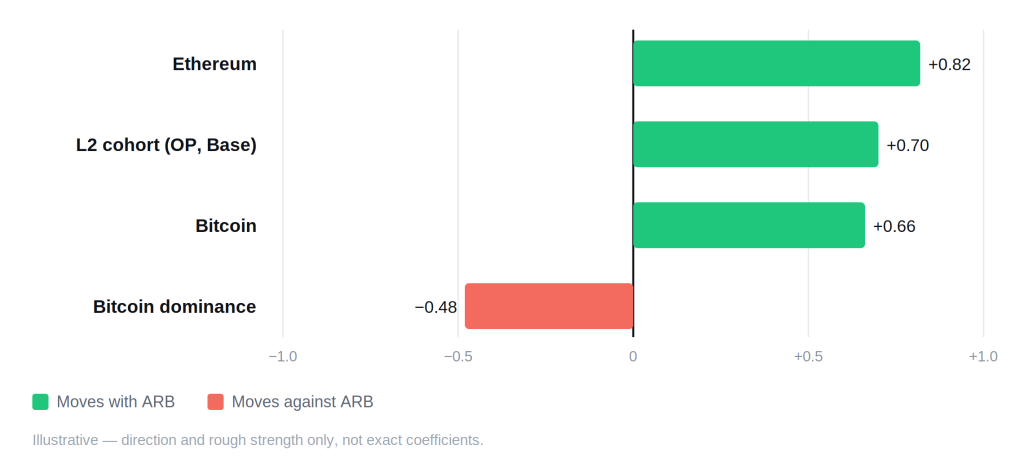
Arbitrum trades as a leveraged bet on Ethereum. Because ARB settles its economics on Ethereum and rises or falls with the health of the L2 sector, it moves most tightly with ETH and with the rest of the rollup cohort, Optimism and the Base ecosystem, and tends to overshoot Ethereum in both directions, the classic high-beta pattern of a smaller-cap altcoin. It still tracks Bitcoin, but less closely, and it works against Bitcoin dominance: when money crowds into Bitcoin, thinner alt-L2 tokens like ARB are usually the first to bleed. The quirk worth remembering is that Arbitrum’s fortunes are chained to Ethereum’s roadmap more directly than most alts, so an Ethereum scaling upgrade can matter more to ARB than anything on Arbitrum’s own calendar. None of these links are fixed, and they loosen or tighten as the market’s focus shifts.
Fundamental factors
Arbitrum is one of the deepest DeFi ecosystems in the Layer-2 field, and by several measures the leader in total value locked, though Base now rivals or beats it on daily transactions and active users. The stack has three pillars: Arbitrum One, the main general-purpose rollup; Arbitrum Nova, tuned for cheaper, high-throughput apps like gaming and social; and the Orbit program, which lets projects launch their own L2s and L3s settling back to Arbitrum. Robinhood is building an Orbit chain, one of the clearer signs that the model is pulling in institutions.
Stylus is the technical differentiator. It lets developers write smart contracts in Rust, C, and C++ alongside Solidity, with benchmarks showing large gas savings and much faster execution for compute-heavy tasks. The Arbitrum DAO has also put real money behind adoption, including a gaming incentive fund in the hundreds of millions of ARB. The catch is what all of this does, and does not, do for the token. ARB is a governance token: it steers the treasury and votes on upgrades, but network fees do not flow to holders, so activity on Arbitrum does not mechanically bid up ARB the way staking demand supports some Layer-1 coins. Layer that weak value accrual over a supply schedule still releasing tokens toward a 10 billion cap, with roughly a third of supply yet to unlock at the time of writing, and the fundamental picture is a strong network attached to a token that struggles to capture its success.
Upcoming catalysts
Only confirmed, dated events are listed. With ARB so sensitive to risk appetite, Federal Reserve policy is the clearest near-term driver, and the token’s own unlock schedule is the clearest recurring drag.
| Date | Event | Potential impact |
|---|---|---|
| September 15–16, 2026 | FOMC meeting (with economic projections) | Bull if the Fed signals cuts; bear if it holds rates higher for longer |
| September 16, 2026 | Scheduled ARB token unlock (ongoing linear vesting to team, investors, and DAO treasury) | Bearish to neutral: adds sell-side supply as locked tokens vest |
| October 27–28, 2026 | FOMC meeting | Rate path steers risk appetite across altcoins |
| December 8–9, 2026 | FOMC meeting (with economic projections) | Year-end policy signal for 2027 positioning |
FOMC dates follow the Federal Reserve’s published 2026 schedule. ARB unlocks release on a monthly cadence through 2027; the September tranche is dated here, and the wider vesting overhang is treated in the fundamentals section rather than as a single event.
Bull case vs bear case
Bull case:
- The Fed cuts rates, risk appetite returns, and high-beta alt-L2 tokens like ARB rally hardest.
- Stylus and the Orbit program pull more builders and institutions, including the Robinhood chain, onto Arbitrum.
- The Arbitrum DAO ties fee revenue or buybacks to ARB, finally giving the token direct value accrual.
- Most team and investor tokens finish unlocking, lifting the supply overhang that has capped rallies.
Bear case:
- Rates stay higher for longer, and speculative alts stay out of favor.
- Base keeps taking transaction share, and the “largest L2” narrative slips away from Arbitrum.
- Monthly unlocks keep pressuring price while ARB still captures none of the network’s fees.
- Momentum fades after the summer bounce and support gives way.
Invalidation levels. The bull case weakens on a sustained close below $0.07, the support named in the technical section. The bear case is invalidated on a decisive reclaim of $0.15 that holds, roughly 50% above the late-August price and the line that would mark the downtrend as broken. Those are the same two levels from the chart read above, not new ones.
Historical performance
Arbitrum’s price history is short and mostly downhill. ARB launched via airdrop in March 2023, spiked to its $2.40 record in January 2024, and has spent the time since grinding lower against a constant tide of newly unlocked tokens. The network kept growing through that decline, which is the whole tension in the asset: adoption up, token down. Past drawdowns set no floor, and a young token with an expanding supply has less history to lean on than the majors.
Is Arbitrum a good investment in 2026?
It comes down to one question: do you expect ARB to start capturing the value its network creates? Today it does not, and PrimeXBT’s outlook sees the price basing near $0.10 into year-end rather than breaking out, with a 2026 average around $0.103. The bull thesis is real, Arbitrum leads in DeFi depth, ships genuine technology in Stylus, and is winning institutional Orbit deployments, but the token only rewards that if governance eventually routes fees or buybacks to holders, and the unlock schedule works against price until it does. Strong network, weak token mechanics, live dilution: whether that reads as a discount or a trap is the reader’s call.
How to trade Arbitrum on PrimeXBT
PrimeXBT lets you take a position on a market in either direction, so a view on ARB can be expressed long or short rather than only by buying and holding. CFDs track price movement without owning the underlying token, and a long or short can be sized to your own plan. Leverage cuts both ways, magnifying losses as readily as gains, so a stop-loss and sensible position size matter on every trade. Trade your own analysis and risk tolerance, and never risk more than you can afford to lose.
Trading involves risk.
How we build this forecast
PrimeXBT’s analysts assemble this outlook rather than pull it from one feed. We begin at ARB’s current price, read it against the 50- and 200-day moving averages and the $0.07–$0.15 range that frames the chart, then weigh the fundamentals that actually govern this token, its governance-only design, the Stylus and Orbit adoption story, and above all the unlock schedule, before setting the whole picture against the macro backdrop of U.S. interest-rate policy. The yearly ranges fuse that technical read with the fundamental and macro view; the long-range figures follow trajectory rather than pretending to precision.
Nothing here is a promise. ARB is volatile, its float is still expanding, and one macro or governance surprise can move it faster than any model expects. Read every figure as a considered estimate, not a guarantee, and note that we revisit this outlook each month as the data changes.
How much will Arbitrum be worth in 2026?
PrimeXBT's outlook is roughly $0.091–$0.118 for 2026, averaging near $0.103, a year of basing rather than a breakout.
How much will Arbitrum be worth in 2030?
The 2030 view is about $0.110–$0.192, averaging near $0.152. At four years out, treat the figure as a direction rather than a fixed price.
What will Arbitrum be worth in five years?
See 2030 above. On this horizon a single number means little, since the plausible range spans several times the current price and depends heavily on whether ARB ever captures network fees.
Can Arbitrum reach $1?
Not on PrimeXBT's base case within this window: the top of the modeled range is about $0.23 in 2028. Some editorial forecasters see $1-plus by 2030, but reaching it would take a far stronger cycle and a token redesign that routes value to holders.
Does holding ARB earn network fees?
No. ARB is a governance token: it votes on the Arbitrum DAO's treasury and upgrades but does not collect the network's transaction fees, which is a key reason its price has lagged Arbitrum's growth in usage.
Author



 Risk Disclaimer
The content provided here is for informational purposes only. It is not intended as personal investment advice and does not constitute a solicitation or invitation to engage in any financial transactions, investments, or related activities. Past performance is not a reliable indicator of future results.
The financial products offered by the Company are complex and come with a high risk of losing money rapidly due to leverage. These products may not be suitable for all investors. Before engaging, you should consider whether you understand how these leveraged products work and whether you can afford the high risk of losing your money.
The Company does not accept clients from the Restricted Jurisdictions as indicated in our website/ T&C. Some services or products may not be available in your jurisdiction.
The applicable legal entity and its respective products and services depend on the client’s country of residence and the entity with which the client has established a contractual relationship during registration.