9 min read
 Key takeaways
- Oil has climbed more than 25% in a month, with a gain of around 7% on Thursday alone, putting the $100 level back in view for the first time since May
- Iran-aligned Houthis have declared a naval blockade on Saudi Arabia and struck two Saudi tankers, putting the Red Sea route Riyadh has relied on to bypass Hormuz under direct threat
- At least seven tankers have already turned back rather than transit Bab el-Mandeb, though enforcement so far appears to depend on who owns a vessel rather than what it carries
- Brent is rejecting resistance around 95, with daily EMA support down at 85 and $100 in view if the situation escalates further
Oil has found a second chokepoint
Crude has surged this week. Prices climbed around 7% on Thursday and are on course for a weekly gain of more than 13%, extending a rally of over 25% across the past month. That has brought the $100 level back into view for the first time since May.
The trigger wasn’t Hormuz. Iran-aligned Houthis said they had struck two Saudi oil tankers in the Red Sea, days after declaring a naval blockade on Saudi Arabia on Monday. What’s driving prices is the fear of a closure of Bab el-Mandeb, which controls access from the Red Sea to the Indian Ocean and is the second most important oil channel after the Strait of Hormuz. It appears to be the first time since the war began that attacks on shipping have spread beyond the vicinity of Hormuz.
Why this route matters more than it used to
Saudi Arabia’s answer to a disrupted Hormuz has been to send its crude west overland instead. The East-West pipeline, known as the Petroline, runs more than 1,000 kilometres from the eastern oil fields to the Red Sea port of Yanbu, and was pushed to its full capacity of 7 million barrels a day earlier this year, with exports through Yanbu reaching around 5 million barrels a day. That only partly offsets the loss of Hormuz, through which roughly 15 million barrels a day of crude passed before the war, but it’s one of the reasons prices hadn’t reached the crisis levels seen in previous supply shocks. The strait briefly reopened under the memorandum signed in June, before that arrangement broke down and traffic was disrupted again this month.
That bypass now sits at the northern end of a waterway the Houthis say they’re blockading. Tehran had been pressing the group to close the Bab el-Mandeb gateway if the US continued to attack Iranian power infrastructure. The Houthis themselves have framed the blockade as retaliation for Saudi strikes on a major airport in Sanaa, which they accuse the kingdom of hitting while an Iranian official was travelling through it this month.
The disruption is showing up in shipping first
Barrels haven’t stopped moving, but voyages have changed. At least seven oil tankers have turned around in the Red Sea, with four rerouting away from Bab el-Mandeb on Wednesday after three bound for India and China turned back on Tuesday, heading for the far more indirect Suez route instead. Shipbrokers report that the threat has begun to affect tanker activity more broadly, with several vessels that loaded at Yanbu shifting course towards the Suez Canal rather than sailing south, while others hold position awaiting instructions.
How far this goes is still unclear. Vessel tracking showed that cargo passing through Bab el-Mandeb on 20 July was Saudi in origin but Chinese in crew and destination, and drew no interference, suggesting enforcement is being calibrated to who owns and operates a vessel rather than what it’s carrying. On that reading, the blockade is shaping who moves Saudi crude rather than whether it moves at all. Against that, the US Navy-led maritime coalition has warned that the Houthis are ready to attack ships in the southern Red Sea, having deployed missiles and drones near the strait.
A third supply hit, outside the Middle East
Kazakhstan has reduced crude output after drone strikes on tankers at the Caspian Pipeline Consortium terminal on Russia’s Black Sea coast. Officials described the cut as a purely technical decision to stop storage tanks overflowing after the consortium restricted incoming shipments. The route accounts for about 80% of Kazakh oil exports, and at least five tankers have been attacked at the terminal so far this month. Russia has accused Ukraine of carrying out the strikes, and Kyiv hasn’t commented.
Washington isn’t signalling a way down
Trump wrote that from now on, every time Iran fires on a ship in the Strait of Hormuz, the US will destroy one bridge or power plant, including those in or next to Tehran. He later said he’s considering a massive attack on Iran that would be bigger than anything so far, and that he’s close to a decision. He also indicated he isn’t ready to negotiate a new ceasefire. A senior Iranian military adviser responded that attacks on Iranian infrastructure would draw a severe and escalatory response, while the UN Secretary-General warned the situation is getting out of control.
The Fed meets next week with oil at these levels
The rates picture has moved with the barrel. Futures markets have repriced sharply towards a hike since oil began climbing, though estimates of how far vary widely, and the Fed is still broadly expected to hold at 3.50% to 3.75% when it announces on 29 July. The dollar has been riding Treasury yields higher and is hovering near a 40-year peak. For a committee that has kept a higher-for-longer stance and taken cuts off the table, an energy shock of this size heading into the meeting narrows the room to sound dovish.
We now head over to the charts.
Brent daily chart
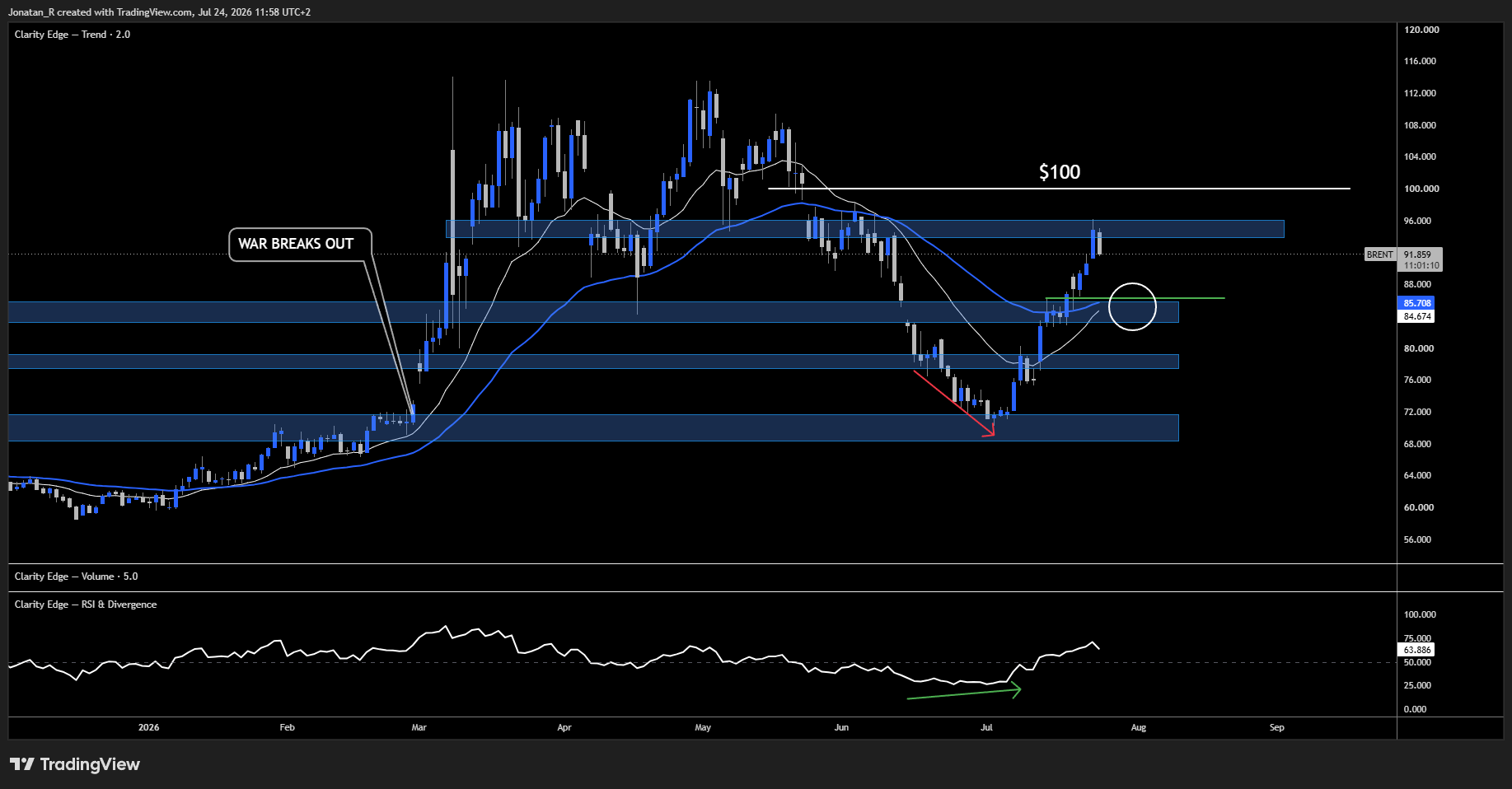
Brent rejecting a high timeframe resistance zone below $100, with the daily 20 and 50 EMA sitting at the support zone underneath.
When we last covered Brent in our previous coverage of Brent, price was testing 85 as resistance with 90 above it. Both have since been cleared. Today we are seeing a rejection at a high timeframe resistance zone at around 95, and below that the daily 20 and 50 EMA sit down around 85, confluent with the high timeframe support zone. If we do see a move down into that region, we could potentially see some support there and buyers coming in to defend the level.
To the upside, if the current situation escalates we could see a break above that 95 resistance zone, and potentially Brent trading above 100 if the situation in Hormuz and with the Houthis escalates further and brings even more uncertainty around the supply of oil.
Brent 4-hour chart
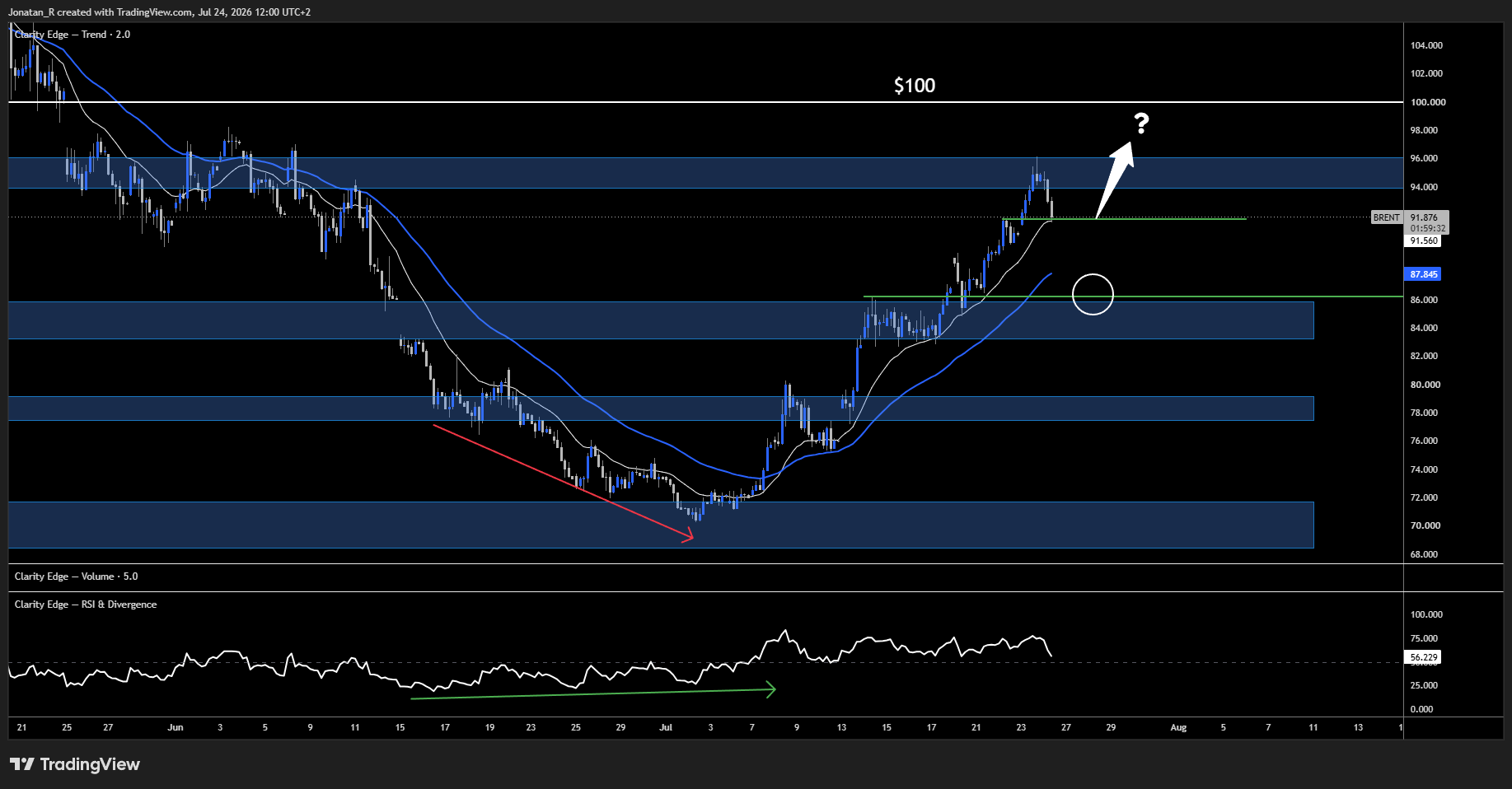
Price testing the 4-hour 20 EMA as local support after a sustained bounce off it through July.
On the 4H we can see a clear trend, with price bouncing off the 20 EMA and a nice uptrend in place. We are currently testing that 20 EMA once again as local support.
If we break this area it would be the first time breaking below the 20 EMA since reclaiming it back at the beginning of July. That might be the first signal of seeing a retrace lower, into potentially hitting that 86 level below, marked with the white circle on the chart.
If we continue the pattern we have seen over the last couple of weeks, bouncing here and then breaking above the resistance zone at around 95, it could potentially take us higher into the $100 area, depending on what catalyst we might see based on the situation in the Middle East.
Trading involves risk.
Author



 Risk Disclaimer
The content provided here is for informational purposes only. It is not intended as personal investment advice and does not constitute a solicitation or invitation to engage in any financial transactions, investments, or related activities. Past performance is not a reliable indicator of future results.
The financial products offered by the Company are complex and come with a high risk of losing money rapidly due to leverage. These products may not be suitable for all investors. Before engaging, you should consider whether you understand how these leveraged products work and whether you can afford the high risk of losing your money.
The Company does not accept clients from the Restricted Jurisdictions as indicated in our website/ T&C. Some services or products may not be available in your jurisdiction.
The applicable legal entity and its respective products and services depend on the client’s country of residence and the entity with which the client has established a contractual relationship during registration.