9 min read
 Key takeaways
- The Federal Reserve announces on Wednesday with the market split, roughly 62% priced for a hold and 38% for a hike, and nothing priced for a larger move.
- Dollar volatility has compressed toward levels last seen in late 2021, a condition that has historically come before large moves without saying anything about direction.
- The dollar index has broken above the zone that capped it through 2025, but an equal-weighted version of the same currency basket has been rejected at its equivalent level, so the breakout may be narrower than it appears.
- EUR/USD is sitting near its lows, with 1.12800 the first level of interest below and the high timeframe support area near 1.12 beneath that.
The Fed decides on Wednesday, and the market is genuinely split
The Federal Reserve announces its decision on Wednesday at 2pm ET, with Chair Kevin Warsh’s press conference half an hour later, and the target range is widely expected to stay at 3.50% to 3.75%. There is no update to the committee’s economic projections at this meeting, so the statement language and the press conference carry the entire signal.
Pricing has moved a long way in a short time. Futures currently put roughly 62% on a hold and 38% on a quarter-point increase, against about 26% for a hike a week ago and 30% a month ago. Worth noting what isn’t priced at all: a move larger than a quarter point carries no probability whatsoever. With the market split close to two to one, some portion of it is likely to be caught out whichever way the committee goes, and that alone could be enough to produce an outsized reaction.
The euro side is no longer the softer of the two, though it is more passive than it first appears. The ECB held its three key rates on 23 July, leaving the deposit facility at 2.25%, and signalled that a September increase is becoming more likely while warning that the full inflationary impact of the Middle East energy shock has yet to feed through. That is a forward-looking call rather than a reaction to current prices. Eurozone inflation has actually been falling, easing to 2.8% in June from 3.2% in May, the lowest reading since February, with the core rate down to 2.4%. President Lagarde also cautioned that policymakers could not overinterpret fast-moving swings in oil prices while the conflict remained unresolved.
That leaves the dollar leg doing most of the work, as it has all month. Crude fell more than 6% at the start of the week as the US and Iran stepped back, pulling the US 10-year yield down from close to 4.70% toward 4.63% and handing the euro a bounce driven by the dollar rather than by anything on the euro side. The dollar then recovered to a one-month high on Monday and that bounce faded. US second-quarter GDP and the June PCE inflation report both land on 30 July, the day after the decision, with the eurozone flash inflation estimate following on Friday 31 July.
The dollar has gone very quiet ahead of the decision
The dollar index is trading around 101.50, roughly in the middle of the range it has held since the spring. What stands out is not the level but how little it has been moving. Bollinger BandWidth, which measures the distance between the upper and lower bands as a percentage of price, has compressed back toward the lows it last reached in late 2021. Periods of unusually low volatility have tended to precede large moves, though they say nothing at all about which way the move goes.
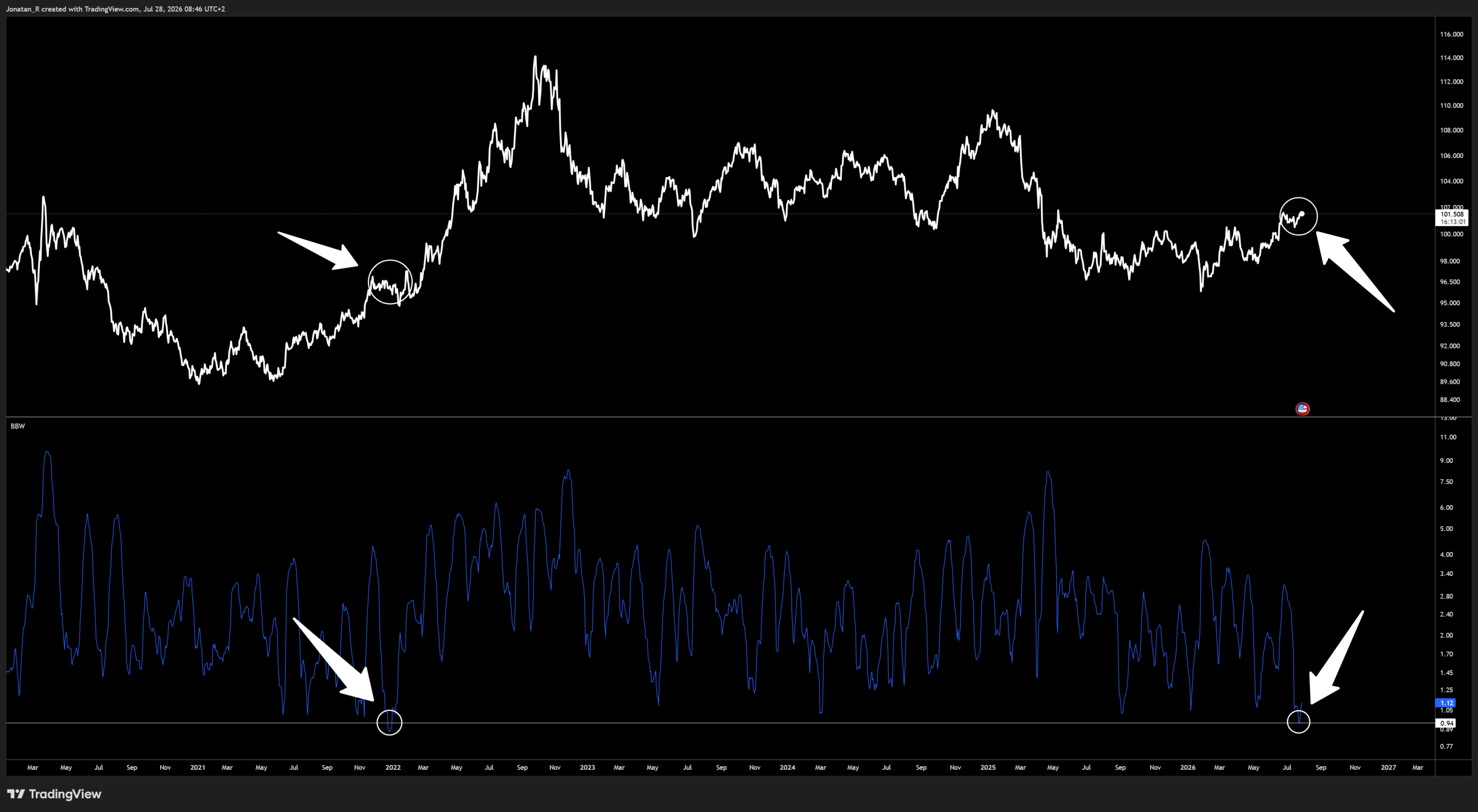
Original ide by Dean Christians at Turning Point Market Research.
Participation across the dollar’s major crosses is broad. Measuring the percentage of G-10 currencies against which the dollar trades above its 200-day moving average puts the current reading at close to 78%, or seven of nine. That is a headcount rather than a measure of force, so it tells us the dollar is trending higher against most of its crosses without telling us how far it has travelled against any of them.
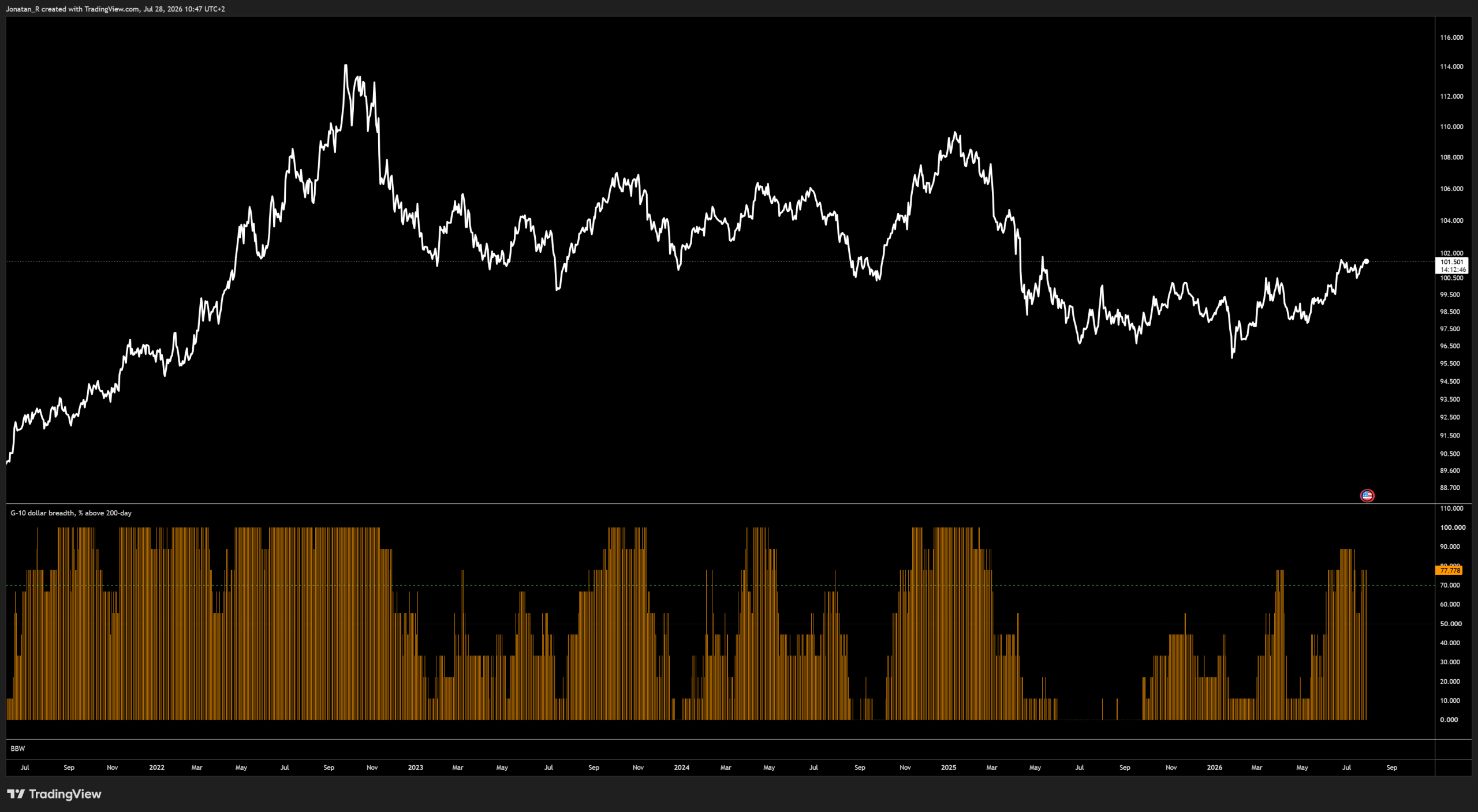
The dollar index with the percentage of G-10 pairs trading above their 200-day moving average beneath.
Breadth alone doesn’t tell us how far the dollar has travelled, and there is a way to test that. The dollar index is dominated by a single currency, with the euro accounting for 57.6% of it and European currencies making up roughly 77% in total. That means a weak euro on its own could carry the index through resistance while the dollar has moved very little against the yen, the Australian dollar or the Norwegian krone. Rebuilding the same basket with every currency weighted equally removes that effect, because no single pair can then move the index by itself.
The two are not currently telling the same story. The dollar index has broken above the zone that capped it through 2025 and is holding above it. The equal-weighted version reached its equivalent zone in early July and has since slipped back below it. That could suggest the breakout is being carried by its largest component rather than by broad dollar demand, and moves built on one leg have tended to be more fragile than moves where most of the crosses are participating. This comparison follows an observation originally made by Alfonso de Pablos, CMT.
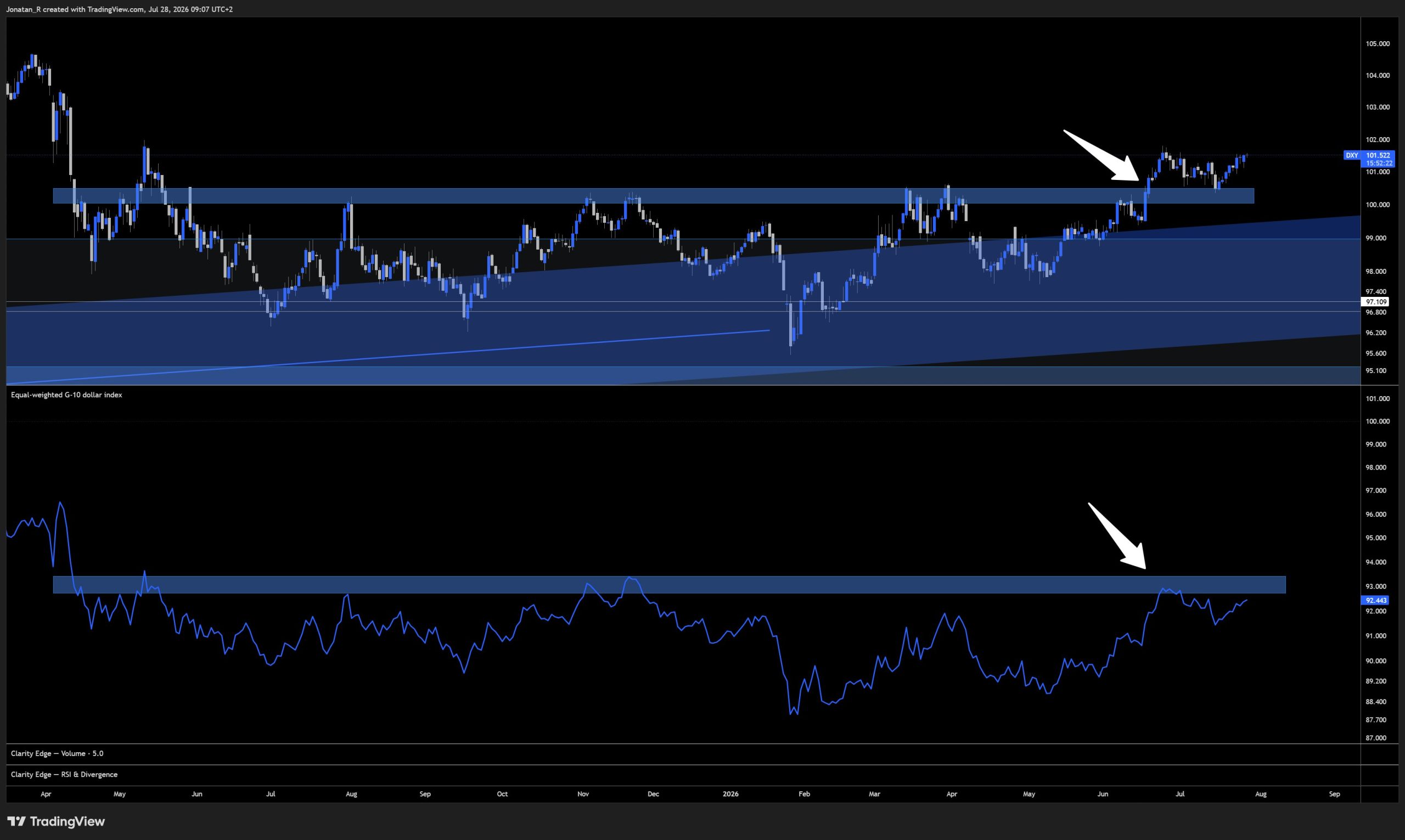
The dollar index trading above its resistance zone with an equal-weighted version of the same currency basket below, still beneath its own.
The case for the dollar having found a base still holds. The Fed is the only major central bank with a live move this week, hike pricing has climbed steadily through the month, September carries a materially higher probability than July, and participation across the crosses is broad rather than concentrated. A larger increase is not priced anywhere, so a surprise on that front could hit the dollar’s upside with nothing to cushion it.
The case against has more behind it now. Compression indicates a move may be coming, not which way it resolves. Much of the oil impulse that drove the repricing has already reversed. Breadth pushed to similar levels around March and April this year and the dollar did not sustain a rally from it, fading back through May. The equal-weighted basket has not confirmed the breakout. And a hold accompanied by a soft statement could unwind close to 40 points of priced probability in a single afternoon, with growth and inflation data landing the following day.
EUR/USD daily chart
In our previous coverage of EUR/USD at the end of June, the pair had just broken below its range and was retesting the broken support from beneath. That retest has since resolved lower, and the pair has spent the month grinding along beneath the zone rather than reclaiming it.
What we are watching now is a potential move to the downside on dollar strength. The first level of interest below sits at 1.12800. If we see a larger move lower, price could potentially come down and test the high timeframe support area at around 1.12, and that scenario would likely require the dollar to be genuinely breaking out rather than simply firming into the decision.
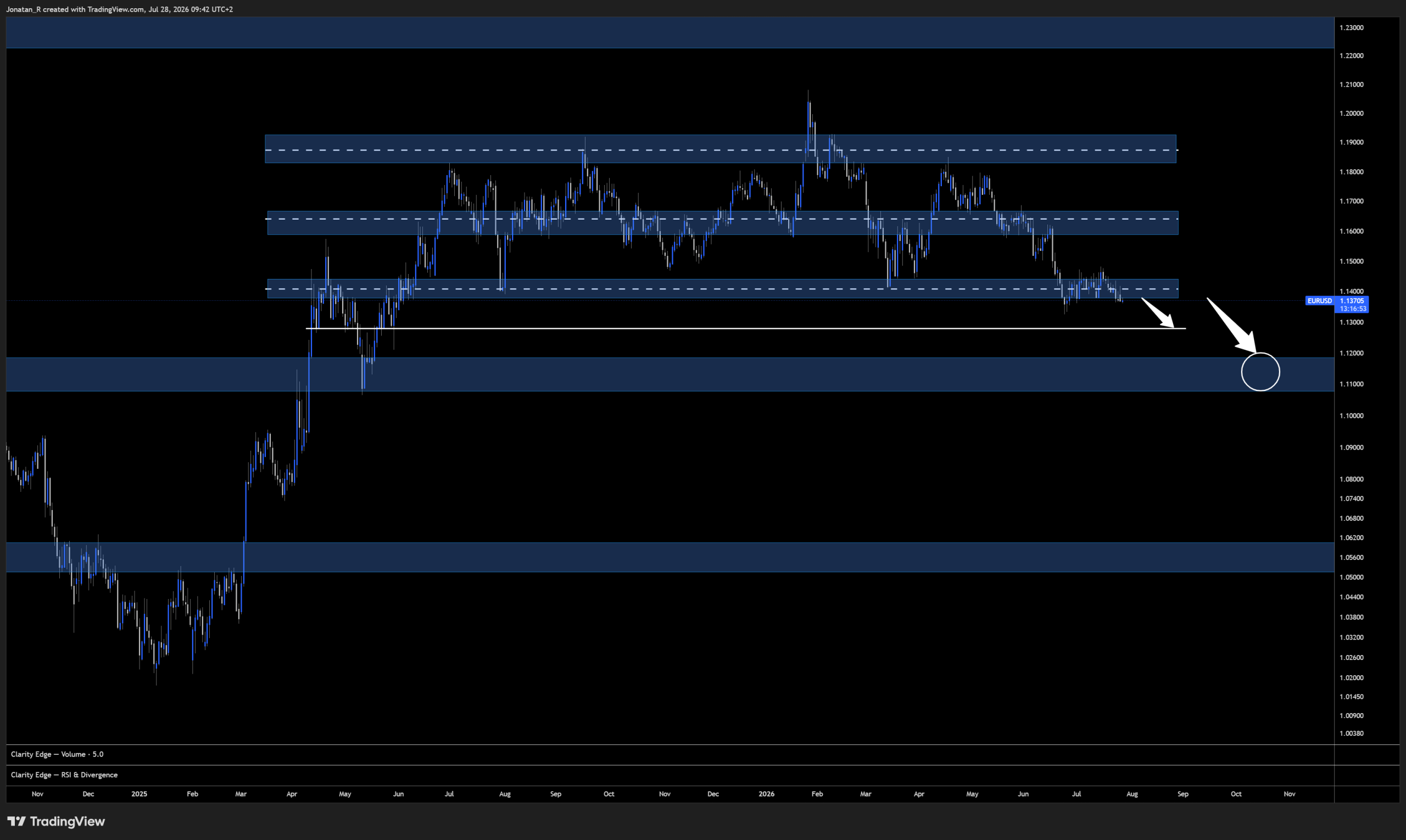
Key levels to watch
- 1.12800 first level of interest to the downside
- 1.12 high timeframe support area, in play on a larger move lower
- 1.14 the zone the pair broke below in June, now overhead
Trading involves risk.
Author



 Risk Disclaimer
The content provided here is for informational purposes only. It is not intended as personal investment advice and does not constitute a solicitation or invitation to engage in any financial transactions, investments, or related activities. Past performance is not a reliable indicator of future results.
The financial products offered by the Company are complex and come with a high risk of losing money rapidly due to leverage. These products may not be suitable for all investors. Before engaging, you should consider whether you understand how these leveraged products work and whether you can afford the high risk of losing your money.
The Company does not accept clients from the Restricted Jurisdictions as indicated in our website/ T&C. Some services or products may not be available in your jurisdiction.
The applicable legal entity and its respective products and services depend on the client’s country of residence and the entity with which the client has established a contractual relationship during registration.