7 min read
The US Federal Reserve (the Fed) raised interest rates in September for the first time since 2023. Since then, prices in the US have kept rising faster than the Fed would like. On Wednesday, 28 October, the Fed announces its next decision at 18:00 UTC. Fed Chair Kevin Warsh then speaks to reporters at 18:30 UTC.
What the Fed does, in plain words
The Fed is the central bank of the United States. Its main tool is an interest rate called the federal funds rate. This rate affects how much it costs to borrow money across the US economy.
- Higher rates make loans more expensive. People and companies tend to spend less, which can slow down price rises.
- Lower rates make loans cheaper, which can encourage spending.
The Fed wants prices to rise by about 2% a year. That’s its target.
Where interest rates are now
After September’s hike, the rate sits at 3.75% to 4.00%. The Fed raised rates to fight inflation that was pushed up by the war involving Iran and higher energy prices.
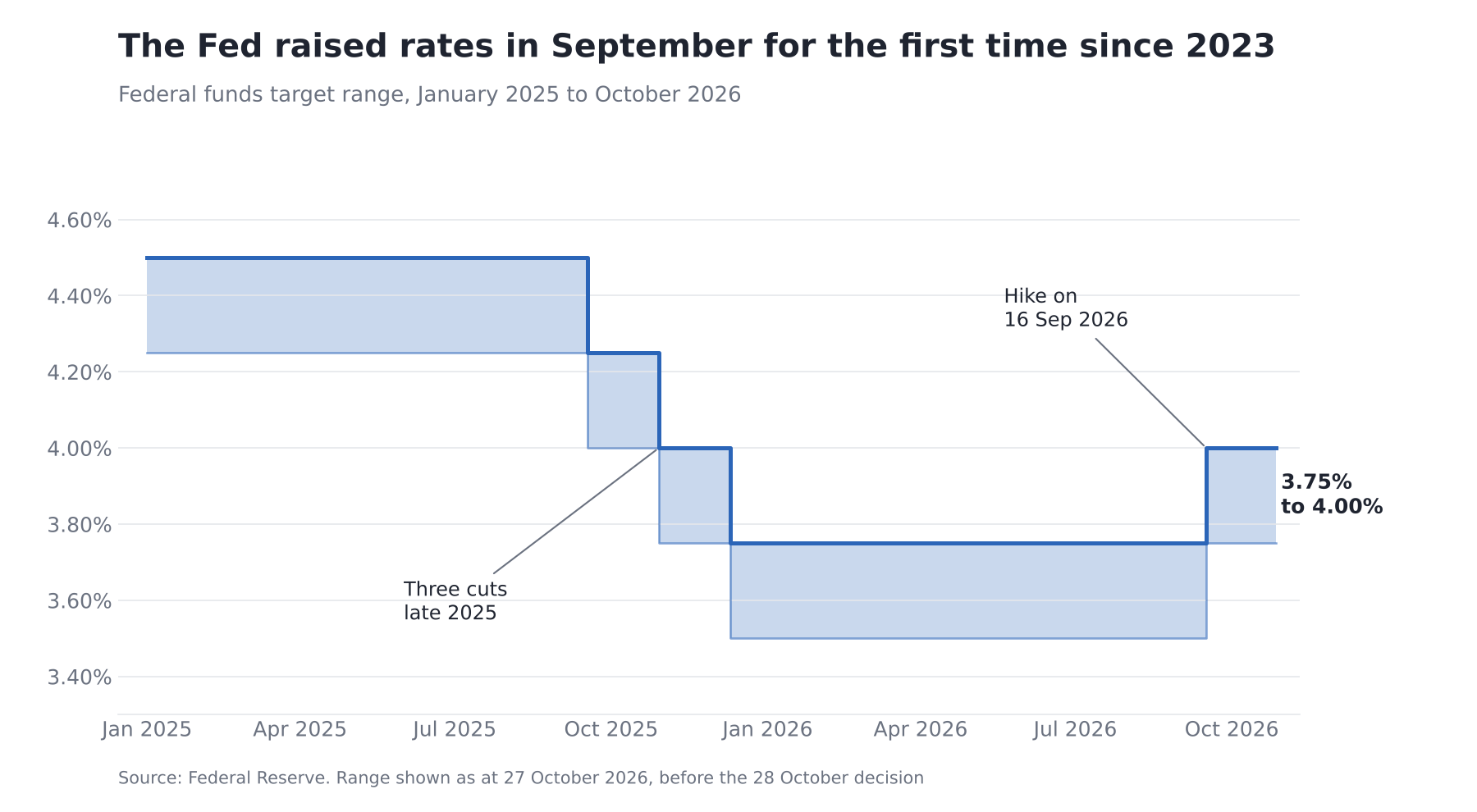
The Fed cut rates three times in late 2025, then kept them unchanged until September 2026. The hike took the rate back to the level it was at in late 2025.
Why inflation is the problem
Inflation simply means prices going up. The most watched measure is the Consumer Price Index (CPI), which tracks the cost of everyday things like food, petrol and rent.
- In September, prices were 3.7% higher than a year earlier, up from 3.4% in August. Economists had expected 3.6%.
- Petrol was the main reason. Its price jumped 9.1% in one month and caused more than half of the increase.
- Core inflation, which leaves out food and energy because their prices jump around a lot, rose to 2.6% from 2.4%.
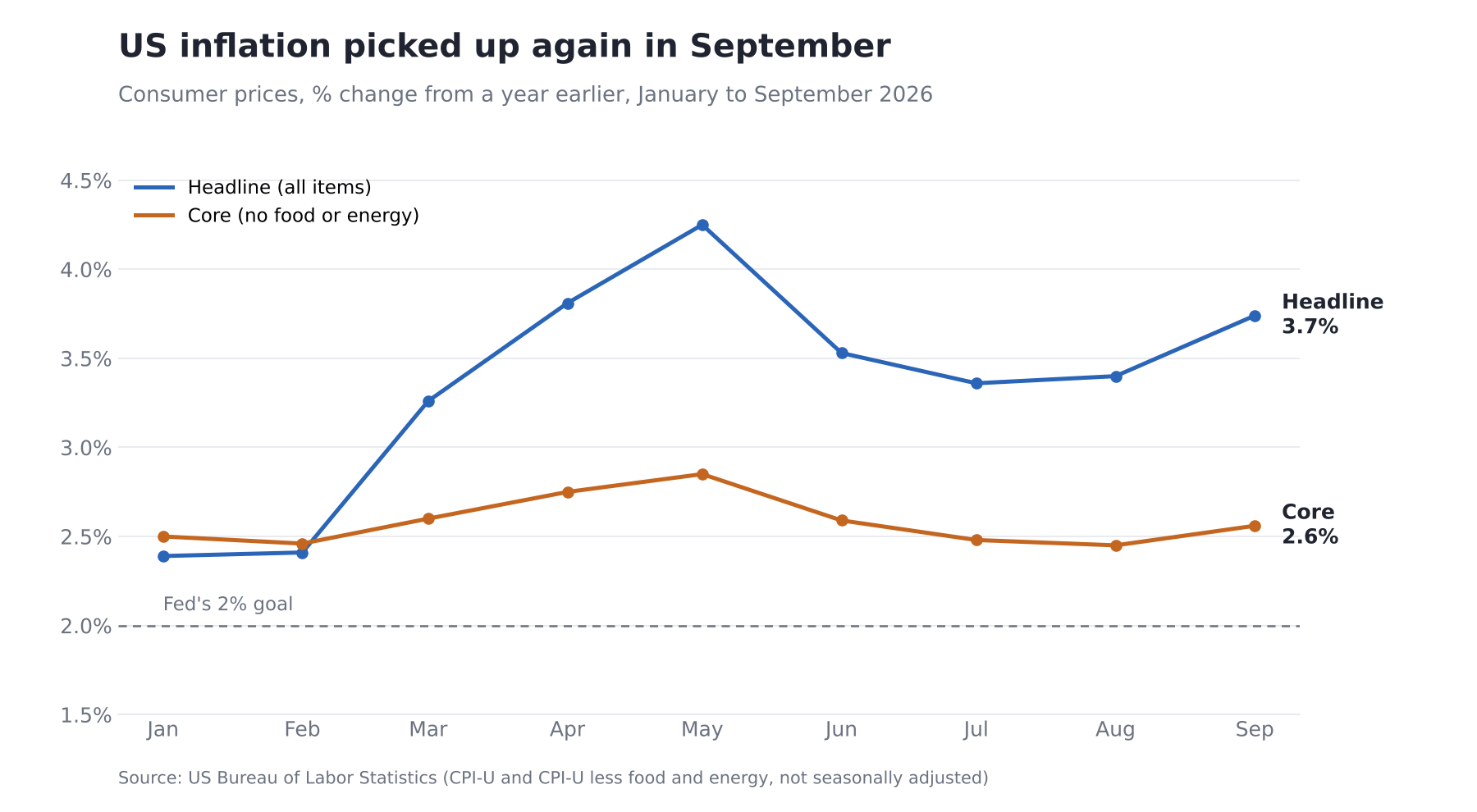
Headline inflation has been pushed up by energy prices this year, while core inflation has been steadier. Both are still above the Fed’s 2% target.
Why most people expect the Fed to wait
- Some Fed officials have said they can wait. Vice Chair Philip Jefferson, New York Fed President John Williams and Governor Christopher Waller have hinted that the Fed could hold off this month. Waller said rate hikes don’t need to happen at back to back meetings.
- The last hike needs time to work. A change in interest rates takes months to reach the economy. The September hike came too late to affect September’s prices.
- Warsh sounded calm. He said the economy had largely behaved as expected since the hike.
Why a hike is still possible
- Inflation went the wrong way after the September hike, as the numbers above show.
- Most Fed officials expect another hike this year. In September, 16 of 18 officials expected at least one more rate rise before the end of 2026.
- Warsh doesn’t like giving hints. He has said that signalling future moves in advance ties the Fed’s hands. That makes a surprise harder to rule out than usual.
What to watch on Wednesday
Even if rates stay the same, what the Fed says could still move markets.
- How Warsh talks about inflation. If he says again that inflation is too high and needs to come down faster, many would see that as a sign of a hike in December.
- How many officials disagree. If more of them vote for a hike, a December hike could look more likely.
- The written statement. It’s usually short, so even a small change in the wording could matter.
How markets could react
- Pause with a tough tone: the US dollar could rise, while tech stocks and Bitcoin (BTC) could come under pressure.
- Pause with a softer tone: this could take some pressure off and help tech stocks and other riskier assets recover.
- Surprise hike: this could lead to sharp moves in the dollar, stocks and crypto.
The Fed decides without the latest reading of its favourite inflation measure, the PCE price index. That comes out on Thursday at 12:30 UTC.
US Tech 100: stuck between a floor and a ceiling
The US Tech 100 tracks 100 of the biggest non financial companies on the Nasdaq stock exchange, many of them tech firms. Higher interest rates often weigh on these stocks.
The index reached a record close of 31,224 on 6 October. Since then, worries about how much companies are spending on AI have pulled it down by about 6%. It closed Monday at 29,273.
- The floor, around 28,950: the index stopped falling near this level in mid September and again on 22 and 23 October. Traders call a level like this support, because buyers have stepped in there before.
- The ceiling, 29,800 to 30,000: the 50 day average sits here, and the bounce on 21 October stopped just below it. Traders call a level like this resistance, because sellers have shown up there before.
- The 200 day average, around 27,850: this longer term average of closing prices is still rising, which suggests the bigger uptrend is still in place for now.
Bullish scenario: a close above the 30,000 area could open the way back toward 30,600 to 30,900, where the index traded in early October.
Bearish scenario: a close below 28,950 could expose the early August level around 28,780, and then the 200 day average near 27,850.
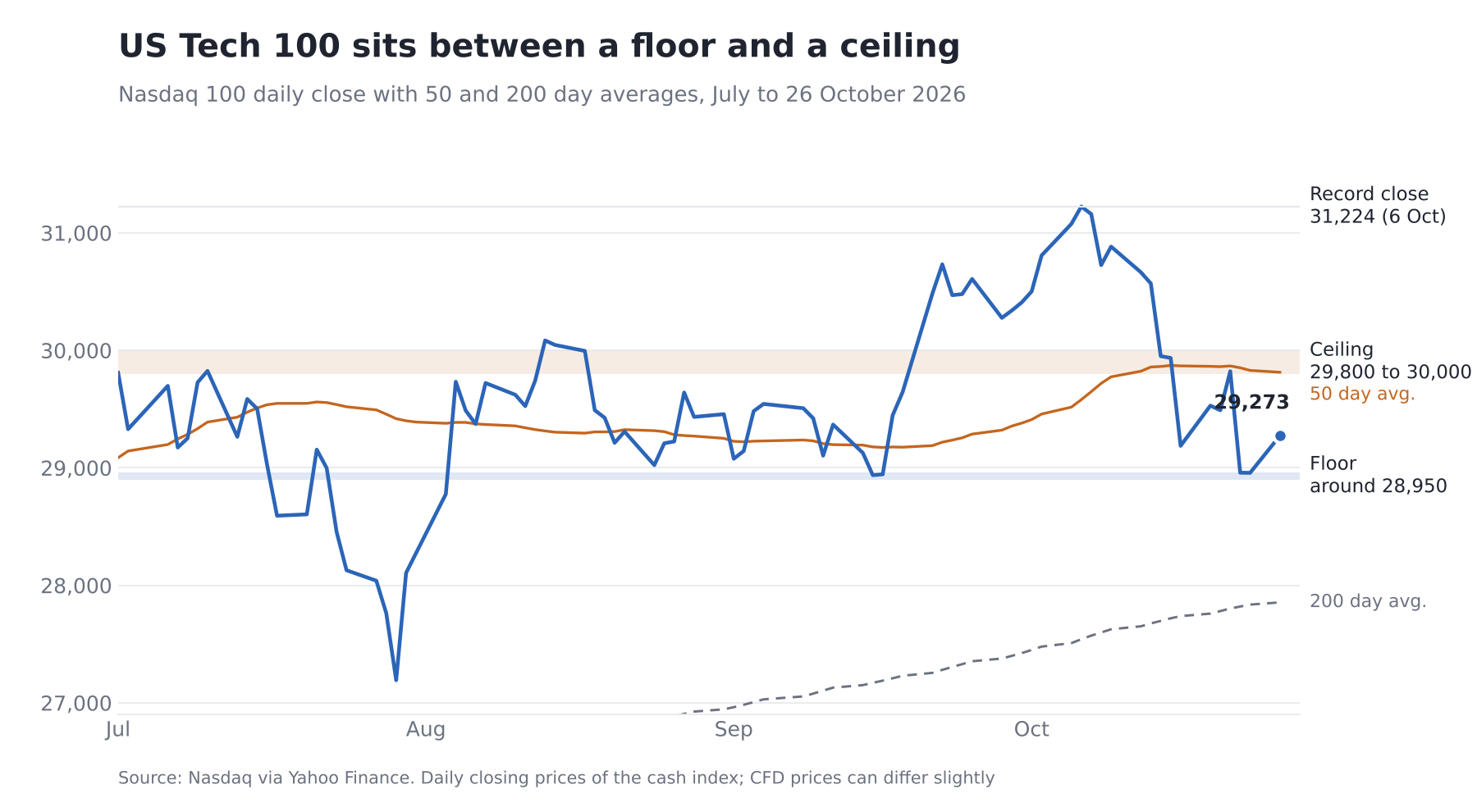
The index has bounced off the same floor twice since September. The Fed decision could help decide which way it breaks next.
Trading involves risk.
Author



 Risk Disclaimer
The content provided here is for informational purposes only. It is not intended as personal investment advice and does not constitute a solicitation or invitation to engage in any financial transactions, investments, or related activities. Past performance is not a reliable indicator of future results.
The financial products offered by the Company are complex and come with a high risk of losing money rapidly due to leverage. These products may not be suitable for all investors. Before engaging, you should consider whether you understand how these leveraged products work and whether you can afford the high risk of losing your money.
The Company does not accept clients from the Restricted Jurisdictions as indicated in our website/ T&C. Some services or products may not be available in your jurisdiction.
The applicable legal entity and its respective products and services depend on the client’s country of residence and the entity with which the client has established a contractual relationship during registration.