14 min read
 Filecoin (FIL) trades near $0.70 in early August 2026, within a few cents of the lowest price it has ever recorded and roughly 99% below its April 2021 peak. Filecoin is the token of a decentralized storage network: users pay FIL to store data across a global market of independent storage providers, who lock up FIL as collateral and earn it as block rewards for keeping that data safe. This page lays out PrimeXBT’s price outlook for FIL through 2030 and out to 2050, the levels traders are watching now, and the catalysts and headwinds that shape where it goes next. Figures are our own estimates, given as ranges rather than false-precise targets; where the picture is genuinely uncertain, the text says so.
Filecoin outlook at a glance
- Current price: $1.051 per FIL.
- 2026 base case: $0.644–$0.818, a year spent basing near multi-year lows rather than staging a recovery.
- Main bullish catalyst: a broad crypto upcycle plus real demand for the DePIN and AI-data storage narrative, if paying usage on the network finally outpaces token issuance.
- Biggest downside risk: Filecoin’s heavy ongoing emissions keep diluting holders, and a sustained break below the $0.66 support opens fresh record lows.
- Long-term view: a slow grind higher is plausible into the 2030s, but forecasts that far out describe a direction, not a price.
Live Filecoin price chart
Today (7 October 2026) Filecoin (FIL/USD) is trading at $1.051 per FIL, with a market cap of $885,922,930 USD. The 24-hour trading volume amounts to $157,064,530 USD. FIL price has changed by -10.09% in the last 24 hours. Filecoin’s circulating supply is 834,431,055 FIL.
Trading involves risk.
Filecoin price prediction 2026–2030 (yearly forecast)
The table below sets PrimeXBT’s expected range for each year from 2026 through 2030. The wildly divergent institutional and algorithmic targets, which rest on incompatible assumptions, are kept in the analyst section rather than averaged into this view.
| Year | Minimum | Average | Maximum |
|---|---|---|---|
| 2026 | $0.644 | $0.723 | $0.818 |
| 2027 | $0.698 | $0.872 | $1.078 |
| 2028 | $0.858 | $1.054 | $1.251 |
| 2029 | $0.715 | $0.954 | $1.198 |
| 2030 | $0.616 | $0.826 | $1.037 |
Filecoin price prediction 2026
Our 2026 outlook keeps FIL close to where it starts the year, a range of $0.644–$0.818 averaging near $0.72. That is a coin building a floor near its record lows, not one turning a corner. With paying storage demand still small next to the flow of newly minted FIL, the base case is patience rather than reversal.
| Month (2026) | Minimum | Average | Maximum |
|---|---|---|---|
| August | $0.644 | $0.700 | $0.756 |
| September | $0.651 | $0.710 | $0.769 |
| October | $0.659 | $0.720 | $0.781 |
| November | $0.670 | $0.735 | $0.800 |
| December | $0.682 | $0.750 | $0.818 |
Filecoin price prediction 2027
2027 is where our forecast allows the first real lift, to a range of $0.698–$1.078 and an average near $0.88. The move leans on the broader market rather than anything unique to Filecoin: the next crypto upcycle tends to pull high-beta altcoins off their lows, and FIL has plenty of ground to recover.
| Month (2027) | Minimum | Average | Maximum |
|---|---|---|---|
| January | $0.698 | $0.770 | $0.842 |
| February | $0.714 | $0.790 | $0.866 |
| March | $0.730 | $0.810 | $0.890 |
| April | $0.746 | $0.830 | $0.914 |
| May | $0.761 | $0.850 | $0.939 |
| June | $0.777 | $0.870 | $0.963 |
| July | $0.790 | $0.887 | $0.985 |
| August | $0.801 | $0.902 | $1.003 |
| September | $0.811 | $0.916 | $1.022 |
| October | $0.821 | $0.931 | $1.040 |
| November | $0.832 | $0.945 | $1.059 |
| December | $0.842 | $0.960 | $1.078 |
Filecoin price prediction 2028
2028 holds the cycle high in our model, a range of $0.858–$1.251 averaging near $1.05. The forecast places FIL’s next local top in this window, timed to the post-halving liquidity that historically peaks a year or so after Bitcoin’s supply cut. Even at the top, the number sits far below prior cycle highs, because token issuance keeps working against price.
| Month (2028) | Minimum | Average | Maximum |
|---|---|---|---|
| January | $0.858 | $0.982 | $1.105 |
| February | $0.874 | $1.003 | $1.132 |
| March | $0.890 | $1.025 | $1.159 |
| April | $0.906 | $1.046 | $1.186 |
| May | $0.922 | $1.068 | $1.213 |
| June | $0.938 | $1.089 | $1.241 |
| July | $0.940 | $1.095 | $1.251 |
| August | $0.929 | $1.086 | $1.243 |
| September | $0.919 | $1.077 | $1.236 |
| October | $0.908 | $1.068 | $1.228 |
| November | $0.897 | $1.059 | $1.221 |
| December | $0.887 | $1.050 | $1.213 |
Filecoin price prediction 2029
2029 cools from the peak, a range of $0.715–$1.198 with an average near $0.95. The path eases rather than collapses, the typical shape after a cyclical top when speculative flows drain out but the network keeps running.
| Month (2029) | Minimum | Average | Maximum |
|---|---|---|---|
| January | $0.871 | $1.035 | $1.198 |
| February | $0.855 | $1.019 | $1.183 |
| March | $0.840 | $1.004 | $1.168 |
| April | $0.824 | $0.988 | $1.153 |
| May | $0.809 | $0.973 | $1.137 |
| June | $0.793 | $0.958 | $1.122 |
| July | $0.779 | $0.944 | $1.108 |
| August | $0.766 | $0.931 | $1.096 |
| September | $0.753 | $0.918 | $1.083 |
| October | $0.740 | $0.905 | $1.071 |
| November | $0.728 | $0.893 | $1.058 |
| December | $0.715 | $0.880 | $1.045 |
Filecoin price prediction 2030
Our 2030 view spans $0.616–$1.037, averaging near $0.82. Four years out, the monthly path below is a shape rather than a schedule of dated prices, so read it for trajectory. The steady drift reflects a coin whose fundamentals improve slowly while its supply keeps expanding.
| Month (2030) | Minimum | Average | Maximum |
|---|---|---|---|
| January | $0.705 | $0.871 | $1.037 |
| February | $0.695 | $0.862 | $1.028 |
| March | $0.685 | $0.852 | $1.019 |
| April | $0.676 | $0.843 | $1.010 |
| May | $0.666 | $0.834 | $1.002 |
| June | $0.657 | $0.825 | $0.993 |
| July | $0.648 | $0.817 | $0.986 |
| August | $0.642 | $0.812 | $0.982 |
| September | $0.635 | $0.806 | $0.977 |
| October | $0.629 | $0.801 | $0.973 |
| November | $0.623 | $0.795 | $0.968 |
| December | $0.616 | $0.790 | $0.964 |
Filecoin long-term price prediction: 2035, 2040–2050
Push the horizon past 2030 and precision stops meaning anything. Nobody can price a decade of storage-market adoption, protocol changes, and macro regimes that have not happened yet, so treat every figure below as a rough path with error bars that widen each year. On that basis our long-range view drifts higher without ever going vertical: an average near $1.10 in 2035, near $1.60 in 2040, and near $2.80 in 2050. Even the 2050 figure stays a fraction of the 2021 record, which is the honest consequence of a supply that keeps growing.
| Year | Minimum | Average | Maximum |
|---|---|---|---|
| 2035 | $0.814 | $1.100 | $1.386 |
| 2040 | $1.088 | $1.600 | $2.112 |
| 2050 | $1.680 | $2.800 | $3.920 |
What analysts and models say (compared)
Few coins split forecasters as sharply as Filecoin does right now. Algorithmic models that extrapolate the recent downtrend see FIL drifting toward $0.30 by 2030, while editorial and higher-base models put it several times higher. Averaging views built on opposite assumptions would only hide the disagreement, so they sit side by side here.
| Source | Method | Filecoin view |
|---|---|---|
| CoinCodex | Algorithmic | 2026 avg ~$0.68; declining to ~$0.33 by 2030 (bearish extrapolation) |
| Changelly | Algorithmic | 2026 avg ~$0.66; ~$0.35 by 2030, then recovery to ~$3.29 by 2050 |
| BeInCrypto | Technical model | 2026 avg ~$0.99 rising to ~$1.32 by 2029; flags a bearish 2026 setup |
| Cryptopolitan | Editorial model | Much higher path: ~$2.41 (2026) to ~$3.31 (2030) |
The spread is the signal. The bearish algorithmic models and the constructive editorial ones disagree by a factor of five on the same year, and neither camp can point to a settled catalyst that resolves it. Anyone looking for a single agreed Filecoin number will not find one, and a page that manufactured consensus here would be misleading rather than helpful.
Track record of this forecast
This is the first published PrimeXBT price forecast for Filecoin. Starting with the next monthly review, this section will hold the previous forecast up against FIL’s actual price on the update date and explain any miss plainly rather than quietly revising it away.
Filecoin technical analysis
FIL trades below both of its most-watched moving averages, the mark of a downtrend that has not yet turned. As of publication it sits under the 50-day simple moving average near $0.75 and well under the 200-day average near $0.91, so even a bounce to the 50-day would only be a move within a falling structure. The 14-day RSI reads about 43, just below the midline and short of oversold, while the Fear & Greed Index sits at 29 in “Fear.”
The support and resistance levels that matter now: support at $0.68, then $0.66, with the record-low zone near $0.63 below that; resistance at $0.73, then $0.75, and a heavier band around $0.77. Reclaiming the 200-day average near $0.91 is the line that would signal the year-long downtrend has actually broken, and nothing on the chart argues that has happened yet. For a primer on reading these signals, see PrimeXBT’s guide to crypto technical analysis.
Correlation with other assets
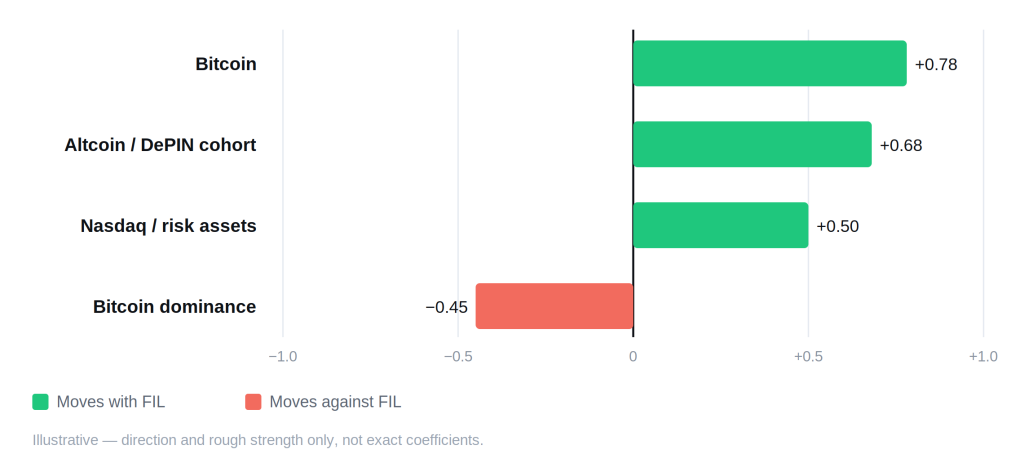
Filecoin trades as a high-beta altcoin, so its first driver is Bitcoin: when BTC rises FIL tends to rise harder, and when BTC falls FIL usually falls further. Its second driver is Bitcoin dominance — when capital concentrates in Bitcoin, small-cap tokens like FIL bleed, and they only outperform once dominance rolls over and money rotates down the risk curve. Beyond the crypto majors, FIL increasingly moves with the DePIN and AI-data theme, rising and falling with sentiment around decentralized infrastructure and demand for data storage, and it tracks risk assets such as the Nasdaq closely enough that Federal Reserve policy shows up in its price. Unlike Bitcoin, FIL carries no safe-haven story, so it has no dependable link to gold and only a loose, inconsistent one to the dollar. These are tendencies that shift with the market, not fixed numbers to trade off.
Fundamental factors
Filecoin is a decentralized storage network built by Protocol Labs, the team led by Juan Benet that also created IPFS, the content-addressing protocol Filecoin sits on top of. The project raised more than $200 million in its 2017 token sale, one of the largest of that era, and launched mainnet in October 2020. The design is straightforward: clients pay FIL to store data, storage providers pledge FIL as collateral to guarantee they will keep it, and the protocol pays them block rewards for proving they still hold it. Collateral and rewards are both denominated in FIL, which ties the network’s security directly to the token.
The 2023 launch of the Filecoin Virtual Machine (FVM) added smart contracts and programmable compute on top of storage, opening the door to lending against storage deals, tokenized data, and other on-chain applications. Filecoin Plus and DataCap steer subsidized rewards toward genuinely useful data rather than filler, and the network’s pitch has increasingly attached itself to two bigger themes: DePIN, the idea of coordinating physical infrastructure through tokens, and the demand for verifiable storage of AI training datasets.
Supply is the counterweight, and it is the single most important fact for the price. FIL is capped at 2 billion tokens, but only about 817 million are in circulation, roughly 41% of the maximum. The rest unlocks gradually through block rewards to storage providers and vesting to early backers and Protocol Labs, on a schedule that runs into the 2050s. That steady issuance is a structural headwind: unless paid usage of the network grows faster than new FIL enters the market, the extra supply weighs on market value regardless of how the technology develops. Any durable Filecoin thesis has to clear that bar first.
Upcoming catalysts
Only confirmed, dated events are listed. With FIL tracking risk assets, U.S. monetary policy is the clearest near-term driver; the network’s own upgrade cadence matters too, but no 2026 mainnet upgrade date has been confirmed at the time of writing.
| Date | Event | Potential impact |
|---|---|---|
| September 15–16, 2026 | FOMC meeting (with economic projections) | Bull if the Fed signals cuts; bear if it holds rates higher for longer |
| October 27–28, 2026 | FOMC meeting | Rate path steers risk appetite across altcoins, FIL among them |
| December 8–9, 2026 | FOMC meeting (with economic projections) | Year-end policy signal that frames 2027 positioning |
FOMC dates follow the Federal Reserve’s published 2026 schedule. A Filecoin network upgrade is not listed because none has a confirmed mainnet date; an invented date would be a guess, not information.
Bull case vs bear case
Bull case:
- A broad crypto upcycle lifts high-beta altcoins, and FIL recovers from a very low base.
- Paid storage and FVM activity grow fast enough to absorb new issuance, turning the supply story from headwind to tailwind.
- The DePIN and AI-data narrative attracts real demand for verifiable decentralized storage.
- Bitcoin dominance rolls over and capital rotates into smaller tokens.
Bear case:
- Emissions keep outpacing usage, and holders stay diluted year after year.
- FIL keeps trading below its 200-day average with “Fear” sentiment and no fresh demand.
- Bitcoin dominance stays high, starving altcoins of flows.
- Selling pressure builds and the $0.66 support cracks, exposing new record lows.
Invalidation levels. The bull case weakens if FIL closes below $0.66, the support that has capped the downside so far; lose it and the record-low zone near $0.63 comes into play. The bear case starts to break on a sustained move back above $0.75, and it is properly invalidated only when FIL reclaims the 200-day average near $0.91, roughly 30% above the current price and the level that would mark the downtrend as over. These are the same levels named in the technical section.
Historical performance
Filecoin’s chart is a story of one spike and a long descent. FIL jumped more than 100% within hours of its October 2020 mainnet launch, ran to an all-time high of about $237 on April 1, 2021, and has spent the years since grinding lower through the 2022 downturn and the cycles that followed. In early August 2026 it trades near record lows, below both its 50- and 200-day averages. The pattern to take from it is not a promise of recovery but a reminder of how far issuance and fading speculation can carry a token away from a former peak.
Is Filecoin a good investment in 2026?
Whether Filecoin fits a portfolio comes down to horizon and risk appetite. Our outlook sees FIL basing near current levels through 2026, averaging around $0.72, with no breakout in the base case. The bullish reading is that a coin near record lows with a working network and a live DePIN and AI-data narrative has room to recover in the next upcycle. The bearish reading is that relentless token issuance keeps diluting holders until paid usage catches up, and that catch-up is not visible yet. Both readings are defensible from the same facts, which is exactly why this is a high-risk, high-conviction position rather than a passive hold.
How to trade Filecoin on PrimeXBT
On PrimeXBT you can take a position on Filecoin in either direction. CFDs on FIL can be traded long or short, so a bearish view on emissions is as tradable as a bullish one on a recovery, and short selling lets you position for further downside without owning the token. Leverage magnifies gains and losses alike, and FIL’s volatility makes position sizing and a stop-loss matter on every trade. Trade on your own analysis and risk tolerance, and never stake more than you can afford to lose.
Trading involves risk.
How we build this forecast
This outlook is assembled by PrimeXBT’s analysts, not copied from one price feed. We start from where FIL trades today, read its position against the 50- and 200-day moving averages and the support and resistance levels that matter, weigh the fundamentals that are specific to Filecoin — paid storage demand, FVM adoption, and above all the token issuance schedule — and set the whole picture against the macro backdrop, chiefly the path of U.S. interest rates and Bitcoin dominance. The yearly ranges combine that technical read with the fundamental and macro view; the long-range figures lean on trajectory rather than precision.
None of this is a guarantee. Crypto is volatile, the inputs move, and a single macro or protocol surprise can shift FIL faster than any model expects. Treat every figure here as a considered estimate rather than a promise, and note that we revisit and update this outlook monthly as the data changes.
How much will Filecoin be worth in 2026?
PrimeXBT's outlook puts FIL in the $0.644–$0.818 range for 2026, averaging near $0.72 — a year of basing near multi-year lows rather than a recovery.
How much will Filecoin be worth in 2030?
Our 2030 view is roughly $0.616–$1.037, averaging near $0.82. A call this far out carries wide error bars and leans heavily on where the broader market cycle lands.
Can Filecoin reach $10?
Not on our numbers within this decade. The top of our modeled range through 2030 stays near $1, and our 2050 average is under $3. Reaching $10 would require paid network usage to grow much faster than FIL's ongoing issuance.
Is Filecoin a good investment in 2026?
It is a high-risk position. FIL trades near record lows with a working network but faces steady token dilution, so the case runs both ways and depends on your time horizon.
Why does Filecoin keep falling?
The main structural reason is supply. Only about 41% of Filecoin's 2 billion cap is in circulation, and new FIL keeps entering the market through block rewards and vesting into the 2050s. Until paid storage demand grows faster than that issuance, the extra supply weighs on the price.
Author



 Risk Disclaimer
The content provided here is for informational purposes only. It is not intended as personal investment advice and does not constitute a solicitation or invitation to engage in any financial transactions, investments, or related activities. Past performance is not a reliable indicator of future results.
The financial products offered by the Company are complex and come with a high risk of losing money rapidly due to leverage. These products may not be suitable for all investors. Before engaging, you should consider whether you understand how these leveraged products work and whether you can afford the high risk of losing your money.
The Company does not accept clients from the Restricted Jurisdictions as indicated in our website/ T&C. Some services or products may not be available in your jurisdiction.
The applicable legal entity and its respective products and services depend on the client’s country of residence and the entity with which the client has established a contractual relationship during registration.