14 min read
 MultiversX (EGLD), the layer-1 blockchain that traded as Elrond until its late-2022 rebrand, changes hands near $2.70 in early August 2026 — more than 99% below its 2021 record. EGLD is the native token of the MultiversX network: it pays gas, secures the chain through staking, and carries governance votes. This page lays out PrimeXBT’s price outlook for EGLD through 2030 and out to 2050, the levels traders are watching now, and the catalysts that could move it. Numbers appear as bands rather than single points, and where the evidence runs thin, the text says as much instead of guessing.
MultiversX outlook at a glance
- Current price: $3.912 per EGLD.
- 2026 base case: $2.48–$3.05, an average near $2.75 — a year of basing out, not a breakout.
- Main bullish catalyst: a broad alt-market recovery into the next Bitcoin halving cycle, amplified by MultiversX’s agentic-AI and on-chain payments pivot.
- Biggest downside risk: fading relevance and thin liquidity, with a loss of the $2.60 support opening the door toward $2.00.
- Long-term view: a slow, uneven climb is the base case, though anything past 2030 is a direction of travel rather than a dated target.
Live MultiversX price chart
Today (7 October 2026) MultiversX (EGLD/USD) is trading at $3.912 per EGLD, with a market cap of $122,843,388 USD. The 24-hour trading volume amounts to $11,394,679 USD. EGLD price has changed by -12.15% in the last 24 hours. MultiversX’s circulating supply is 30,907,221 EGLD.
Trading involves risk.
MultiversX price prediction 2026–2030 (yearly forecast)
The table below gives PrimeXBT’s expected range for each year. The wide, far-higher targets that some algorithmic models still publish are kept out of it and parked in the analyst section, because most of them have not repriced to EGLD’s post-collapse level and blending them in would flatter the outlook.
| Year | Minimum | Average | Maximum |
|---|---|---|---|
| 2026 | $2.48 | $2.74 | $3.05 |
| 2027 | $2.59 | $3.20 | $3.99 |
| 2028 | $3.20 | $4.21 | $5.43 |
| 2029 | $4.07 | $5.23 | $6.47 |
| 2030 | $3.39 | $4.65 | $5.98 |
MultiversX price prediction 2026
The 2026 outlook keeps EGLD close to its early-August level near $2.70 — a range of $2.48–$3.05 with an average near $2.75, and no return toward prior highs. That is the profile of a token trying to find a floor after a long decline, not one turning a corner.
For the remaining months of 2026, the month-by-month path holds EGLD in a narrow band that drifts only slightly higher into December:
| Month (2026) | Minimum | Average | Maximum |
|---|---|---|---|
| August | $2.48 | $2.70 | $2.92 |
| September | $2.49 | $2.71 | $2.93 |
| October | $2.49 | $2.72 | $2.95 |
| November | $2.52 | $2.76 | $3.00 |
| December | $2.55 | $2.80 | $3.05 |
MultiversX price prediction 2027
2027 is where a tentative recovery begins: the path lifts off the 2026 base toward a full-year range of $2.59–$3.99, averaging near $3.20. The move leans on a warming broad market rather than anything unique to MultiversX, since EGLD tends to follow the alt cohort more than it leads it.
| Month (2027) | Minimum | Average | Maximum |
|---|---|---|---|
| January | $2.59 | $2.86 | $3.13 |
| February | $2.64 | $2.92 | $3.20 |
| March | $2.69 | $2.98 | $3.28 |
| April | $2.74 | $3.05 | $3.36 |
| May | $2.78 | $3.11 | $3.43 |
| June | $2.83 | $3.17 | $3.51 |
| July | $2.88 | $3.23 | $3.59 |
| August | $2.93 | $3.30 | $3.67 |
| September | $2.97 | $3.36 | $3.75 |
| October | $3.02 | $3.42 | $3.83 |
| November | $3.07 | $3.49 | $3.91 |
| December | $3.11 | $3.55 | $3.99 |
MultiversX price prediction 2028
2028 carries the Bitcoin halving, historically the trigger for the risk-on phase that lifts smaller layer-1s. The year runs to a range of $3.20–$5.43 with an average near $4.20, with most of the gain arriving in the second half as the cycle turns.
| Month (2028) | Minimum | Average | Maximum |
|---|---|---|---|
| January | $3.20 | $3.66 | $4.12 |
| February | $3.28 | $3.77 | $4.25 |
| March | $3.37 | $3.87 | $4.38 |
| April | $3.45 | $3.98 | $4.51 |
| May | $3.53 | $4.09 | $4.65 |
| June | $3.61 | $4.20 | $4.78 |
| July | $3.68 | $4.29 | $4.90 |
| August | $3.74 | $4.37 | $5.01 |
| September | $3.80 | $4.45 | $5.11 |
| October | $3.86 | $4.54 | $5.22 |
| November | $3.91 | $4.62 | $5.32 |
| December | $3.97 | $4.70 | $5.43 |
MultiversX price prediction 2029
2029 is the peak year in this window. Post-halving cycles have tended to top out roughly a year after the halving, and the outlook places EGLD’s local high here — a range of $4.07–$6.47 averaging near $5.25. Thin liquidity cuts both ways at a top: it can exaggerate the upside spike as easily as it deepens the drawdown that follows.
| Month (2029) | Minimum | Average | Maximum |
|---|---|---|---|
| January | $4.07 | $4.83 | $5.59 |
| February | $4.16 | $4.96 | $5.76 |
| March | $4.26 | $5.09 | $5.92 |
| April | $4.36 | $5.22 | $6.09 |
| May | $4.45 | $5.35 | $6.26 |
| June | $4.54 | $5.48 | $6.43 |
| July | $4.55 | $5.51 | $6.47 |
| August | $4.47 | $5.43 | $6.39 |
| September | $4.39 | $5.35 | $6.31 |
| October | $4.30 | $5.26 | $6.22 |
| November | $4.22 | $5.18 | $6.14 |
| December | $4.14 | $5.10 | $6.06 |
MultiversX price prediction 2030
2030 cools off the 2029 high rather than extending it, settling into a range of $3.39–$5.98 with an average near $4.60. Five years out the outlook rests on the shape of the cycle more than on any single month, so read the path below as a trajectory, not a set of appointments.
| Month (2030) | Minimum | Average | Maximum |
|---|---|---|---|
| January | $4.07 | $5.02 | $5.98 |
| February | $3.99 | $4.95 | $5.90 |
| March | $3.92 | $4.87 | $5.82 |
| April | $3.84 | $4.79 | $5.74 |
| May | $3.77 | $4.72 | $5.66 |
| June | $3.69 | $4.64 | $5.58 |
| July | $3.63 | $4.58 | $5.52 |
| August | $3.58 | $4.53 | $5.48 |
| September | $3.54 | $4.49 | $5.44 |
| October | $3.49 | $4.44 | $5.39 |
| November | $3.44 | $4.40 | $5.35 |
| December | $3.39 | $4.35 | $5.31 |
MultiversX long-term price prediction: 2035, 2040–2050
Put a number on 2050 and you are really describing a mood, not a price. A decade of halvings, technology resets, and macro regimes that do not exist yet sit between here and there, and EGLD carries an extra unknown few large caps do: whether MultiversX stays relevant at all. Treat the figures below as a low-confidence trend line whose error bars swallow the numbers themselves — a gentle rise that assumes the network survives and grows, without pretending to know how far.
| Year | Minimum | Average | Maximum |
|---|---|---|---|
| 2035 | $4.81 | $6.50 | $8.19 |
| 2040 | $6.12 | $9.00 | $11.88 |
| 2050 | $8.40 | $14.00 | $19.60 |
What analysts and models say (compared)
Forecasts for EGLD are not so much divided as living in different eras. Several widely quoted models still carry 2026 averages many times the live price, apparently anchored to figures set before the token fell under $3. Rather than average across incompatible starting points, the main sources sit side by side below.
| Source | Method | MultiversX view |
|---|---|---|
| MEXC | Algorithmic (fixed-growth) | ~$2.70 in 2026 rising to ~$3.28 by 2030, ~$5.34 by 2040 |
| Changelly | Algorithmic | Avg ~$8.90 in 2026, ~$39.85 by 2030, ~$57.75 by 2040 |
| DigitalCoinPrice | Algorithmic | Avg ~$76 in 2026, ~$172 by 2030 |
| PrimeXBT | Synthesis (technical + fundamental + macro) | Avg ~$2.75 in 2026, ~$4.60 by 2030 |
The gap is the point. MEXC’s model, which simply compounds the current price at a fixed rate, lands closest to where EGLD actually trades; Changelly and DigitalCoinPrice sit far above it, on assumptions their own price feeds have already overtaken. PrimeXBT’s read is deliberately closer to the market in front of us — a modest recovery, not a return to Elrond-era valuations. Anyone shopping for a single agreed number will leave empty-handed.
Track record of this forecast
This is the first EGLD forecast PrimeXBT has published, so there is no prior call to grade yet. Each monthly revision from here will print the previous month’s numbers against EGLD’s actual price and account for the difference plainly, misses included.
MultiversX technical analysis
EGLD trades below both of its most-watched moving averages, which frames the current picture as a downtrend that has slowed rather than reversed. Price near $2.70 sits under the 50-day simple moving average around $2.84 and well under the 200-day average near $3.81, the gap between the two averages measuring how far the token still has to climb to repair its longer trend. The RSI has hovered around 40 — soft, but short of the oversold zone that often precedes a bounce.
The support and resistance that matter now: support at $2.60, then the round $2.00 level below it; resistance first at the 50-day average near $2.85, then $3.00, with the 200-day average near $3.81 the line that would signal the downtrend has genuinely broken. On the Fear & Greed Index, the wider market has sat in fear-to-neutral territory, with recent readings near 30. For the mechanics behind these signals, see PrimeXBT’s guide to crypto technical analysis.
Correlation with other assets
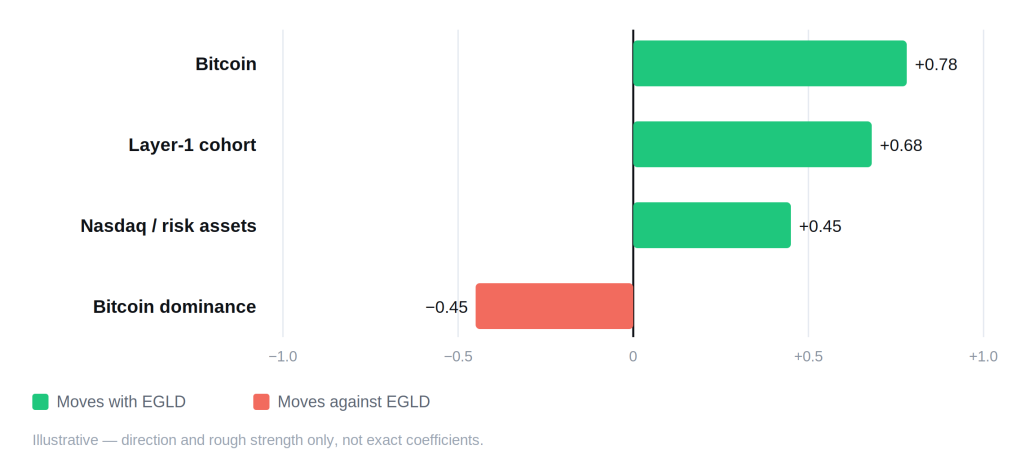
MultiversX trades as a high-beta follower of Bitcoin. When Bitcoin rallies, EGLD tends to rally harder; when Bitcoin sells off, EGLD usually falls further, a pattern typical of a smaller layer-1 with thin order books. Its fortunes track Bitcoin dominance closely: capital rotating toward Bitcoin tends to drain the alt cohort EGLD belongs to, and with the coin far off the market’s radar, it is among the names left behind when dominance climbs. Because institutions now treat crypto as a risk asset, EGLD also leans on the Nasdaq’s direction and on Federal Reserve policy, though its own catalysts — ecosystem adoption, the AI push, a listing or a governance vote — can jolt it out of step with the majors, up or down, on days when its slim liquidity magnifies the move. Unlike Bitcoin, it carries no safe-haven or store-of-value narrative, so gold and the dollar index barely register in its price. None of these links are fixed; they loosen and tighten as sentiment turns.
Fundamental factors
MultiversX is a high-throughput layer-1 built on adaptive state sharding and a Secure Proof of Stake consensus, a design meant to raise transactions per second and keep fees low by splitting the network’s state, transactions, and validators across parallel shards. Launched as Elrond in 2020, the project rebranded to MultiversX in late 2022 with a metaverse and Web3 pitch, and through 2026 has leaned hard into artificial intelligence — becoming, by its own account, the first chain to integrate Google’s agent-payments protocol, adding support for the Coinbase-incubated x402 standard, and shipping an Agent Hub with gasless tooling for on-chain AI agents. EGLD is the fuel for all of it: gas for transactions, the stake that secures the chain, and the ballot in governance, held for most users through the xPortal app and wallet.
Staking pays roughly 8% a year at current rates and locks up a large share of supply, which thins the float available to sell. The supply story itself has changed, and traders should weigh the shift. From launch, MultiversX marketed EGLD as scarce — a genesis of 20 million tokens and a theoretical ceiling around 31.4 million, framed publicly as “only ever” about 30 million. In October 2025 the MultiversX Foundation proposed scrapping that hard cap, replacing it with roughly 9.47% annual tail inflation offset by a 10% burn on validator fees. Circulating supply now stands near 30.5 million. If the change stands, EGLD’s long-touted Bitcoin-style scarcity gives way to a managed-inflation model, and any long-term valuation has to assume the token count keeps rising rather than stopping at a fixed line.
Upcoming catalysts
Only confirmed, dated events appear here. With EGLD trading as a risk asset, US monetary policy is the clearest scheduled driver; MultiversX’s own AI and network rollouts have no fixed mainnet dates, so they are covered in the fundamentals above rather than pinned to a day the project has not announced.
| Date | Event | Potential impact |
|---|---|---|
| September 15–16, 2026 | FOMC meeting (with economic projections) | Bull if the Fed signals cuts; bear if it holds rates higher for longer |
| October 27–28, 2026 | FOMC meeting | Rate path steers risk appetite across the alt market |
| December 8–9, 2026 | FOMC meeting (with economic projections) | Year-end policy signal that sets the tone for 2027 |
These dates follow the Federal Reserve’s published 2026 calendar. No MultiversX protocol upgrade or token event has a confirmed date at the time of writing, so none is listed — an invented date would be noise, not information.
Bull case vs bear case
Bull case:
- The Fed cuts rates and capital rotates back into higher-risk alts, where EGLD’s high beta works in its favour.
- The agentic-AI and on-chain payments pivot lands real usage, giving MultiversX a reason to be quoted again.
- Staking keeps a large slice of supply locked, thinning the float that can hit the market.
- A Bitcoin halving cycle into 2028–2029 drags the whole alt cohort higher.
Bear case:
- MultiversX stays a footnote, and attention and liquidity keep draining toward larger layer-1s.
- Removing the supply cap sours holders who bought the scarcity story, adding sell pressure.
- Rates stay higher for longer and risk assets stay under a lid.
- EGLD slips below the $2.60 support and the $2.00 floor gives way, extending the multi-year decline.
Invalidation levels. The bullish case loses its footing if EGLD closes convincingly below $2.60, and breaks down outright on a sustained move under $2.00. The bearish case is the one in force today; it starts to unwind on a clean push above $3.00 and is properly overturned only when EGLD reclaims the 200-day average near $3.81 — roughly 40% above the current price, and the marker that would flag the long downtrend as broken.
Historical performance
EGLD’s chart is a single spectacular boom followed by a long give-back. As Elrond, the token ran to an all-time high of $545.64 on November 23, 2021, riding the last bull market’s appetite for fast, cheap layer-1s. The 2022 downturn erased most of that, and unlike the majors it never staged a durable recovery — the rebrand, the metaverse pitch, and now the AI push have not returned it anywhere near those levels. Near $2.70 in August 2026, EGLD sits more than 99% below its record and below its own 200-day average. The lesson in that shape is about survival before price: the question is whether the network stays relevant, and only then how far it re-rates.
Is MultiversX a good investment in 2026?
Whether EGLD fits a portfolio comes down to how much risk and patience a buyer brings. PrimeXBT’s outlook sees the token roughly basing through 2026 — an average near $2.75 — rather than rebounding, with any real recovery pushed out toward the next halving cycle. The facts are plain enough to weigh: EGLD trades far below its highs and below its long-term average, sentiment sits in fear, staking still pays around 8%, and the scarcity narrative that once anchored the bull thesis is being unwound. Those cut for and against in roughly equal measure, and the call belongs to the reader.
How to trade MultiversX on PrimeXBT
On PrimeXBT you can take a position on MultiversX in either direction. CFDs on EGLD can be traded long or short, so a view that the token keeps sliding is as tradable as a view that it recovers — see the primer on short selling. Leverage cuts both ways, magnifying losses as readily as gains, which makes position sizing and a stop-loss matter more on a thin, volatile name like EGLD than on a large cap. Trade on your own analysis and risk tolerance, and never stake more than you can afford to lose.
Trading involves risk.
How we build this forecast
This outlook is assembled by PrimeXBT’s analysts rather than copied from one price feed. We start from where EGLD trades today, read its position against the 50- and 200-day moving averages and the support and resistance levels around it, weigh the fundamentals — staking, the supply-cap change, the network’s AI pivot and adoption — and set all of it against the macro backdrop, chiefly the path of US interest rates and Bitcoin’s cycle. The yearly ranges fuse that technical read with the fundamental and macro picture; the long-range figures lean on trajectory over precision.
None of it is a promise. EGLD is thinly traded and volatile, the inputs shift, and a single macro or project-specific surprise can move it faster than any model expects. Read every figure here as a considered estimate, not a guarantee, and note that we revisit and update this outlook monthly as the data changes.
How much will MultiversX be worth in 2026?
PrimeXBT's outlook puts EGLD in a range of roughly $2.60–$2.95 for 2026, averaging near $2.75 — a year of basing out rather than recovering.
How much will MultiversX be worth in 2030?
Our base case is an average near $4.60 in 2030, up from current levels but far below EGLD's former highs. Any five-year crypto figure should be read as a rough direction, not a target.
Can MultiversX reach $100?
Not on our numbers. The top of the modeled range through 2030 sits in the single digits, and $100 is far above even the optimistic aggregator forecasts. Reaching it would take a full return to relevance and a bull market stronger than anything currently in view.
Is EGLD still capped like Bitcoin?
No longer, if the latest proposal stands. MultiversX long marketed a hard ceiling near 31 million EGLD, but in October 2025 its Foundation proposed removing that cap and moving to about 9.47% annual tail inflation offset by a fee burn. Circulating supply is currently near 30.5 million.
Author



 Risk Disclaimer
The content provided here is for informational purposes only. It is not intended as personal investment advice and does not constitute a solicitation or invitation to engage in any financial transactions, investments, or related activities. Past performance is not a reliable indicator of future results.
The financial products offered by the Company are complex and come with a high risk of losing money rapidly due to leverage. These products may not be suitable for all investors. Before engaging, you should consider whether you understand how these leveraged products work and whether you can afford the high risk of losing your money.
The Company does not accept clients from the Restricted Jurisdictions as indicated in our website/ T&C. Some services or products may not be available in your jurisdiction.
The applicable legal entity and its respective products and services depend on the client’s country of residence and the entity with which the client has established a contractual relationship during registration.