13 min read
 Ondo (ONDO) trades near $0.38 in late August 2026, roughly 82% below the record it set in December 2024. ONDO is the governance token of Ondo Finance, the largest real-world-asset (RWA) protocol in crypto — it tokenizes US Treasuries, money-market funds, and a fast-growing catalog of US stocks and ETFs so they settle on public blockchains. This page sets out PrimeXBT’s price outlook for ONDO through 2030 and out to 2050, the levels traders are watching now, and the catalysts most likely to move it. The numbers below are ranges rather than point targets, and each section flags where the evidence runs thin.
Ondo outlook at a glance
- 2026 base case: $0.350–$0.479, a stabilization year rather than a return to the old highs.
- Main bullish catalyst: institutional RWA demand — tokenized-equity growth on Ondo Global Markets and Treasury inflows into USDY and OUSG, reinforced if the Fed keeps cutting rates.
- Biggest downside risk: the unlock overhang, with about 5.1 billion ONDO still locked and the next large release scheduled for January 18, 2027, compounded by any break below the $0.30 support.
- Long-term view: Ondo leads a real, expanding market, yet any figure past 2030 marks a direction of travel, not a dated price.
Live Ondo price chart
The chart below follows ONDO in real time; the levels worth acting on right now sit in the technical section further down this page.
Trading involves risk.
Ondo price prediction 2026–2030 (yearly forecast)
The table gives our expected range for each year. Longer-horizon targets from third-party models, which rest on very different assumptions and scatter widely, are kept out of this table and handled separately in the analyst section.
| Year | Minimum | Average | Maximum |
|---|---|---|---|
| 2026 | $0.350 | $0.410 | $0.479 |
| 2027 | $0.407 | $0.569 | $0.795 |
| 2028 | $0.620 | $0.786 | $0.955 |
| 2029 | $0.564 | $0.741 | $0.908 |
| 2030 | $0.502 | $0.681 | $0.852 |
Ondo price prediction 2026
Our 2026 outlook holds ONDO close to its late-August level of $0.38, in a range of $0.350–$0.479 and averaging near $0.41. That is a recovery off the 2025 lows, not a breakout — the token is repairing a downtrend, and heavy locked supply still caps how far it can run this year.
For the remaining months of 2026, the month-by-month path drifts gently higher, from a late-summer average near current levels toward the low-$0.40s by December:
| Month (2026) | Minimum | Average | Maximum |
|---|---|---|---|
| August | $0.350 | $0.385 | $0.420 |
| September | $0.361 | $0.397 | $0.434 |
| October | $0.371 | $0.410 | $0.449 |
| November | $0.381 | $0.422 | $0.464 |
| December | $0.391 | $0.435 | $0.479 |
Ondo price prediction 2027
2027 is the first genuine step up: our path lifts from the low $0.40s early in the year toward the high $0.60s by December, a full-year range of $0.407–$0.795 averaging near $0.56. The January 18 token unlock is an early headwind, so the gains cluster in the second half as adoption catches up with the enlarged float.
| Month (2027) | Minimum | Average | Maximum |
|---|---|---|---|
| January | $0.407 | $0.454 | $0.502 |
| February | $0.423 | $0.473 | $0.524 |
| March | $0.438 | $0.493 | $0.547 |
| April | $0.454 | $0.512 | $0.570 |
| May | $0.470 | $0.531 | $0.593 |
| June | $0.485 | $0.550 | $0.616 |
| July | $0.503 | $0.573 | $0.642 |
| August | $0.524 | $0.598 | $0.673 |
| September | $0.544 | $0.624 | $0.703 |
| October | $0.564 | $0.649 | $0.734 |
| November | $0.585 | $0.675 | $0.764 |
| December | $0.605 | $0.700 | $0.795 |
Ondo price prediction 2028
2028 holds the cycle high in our model: the path peaks around the middle of the year before easing back, for a range of $0.620–$0.955 and an average near $0.79. We place the next cyclical top in this window, driven by RWA flows rather than a single event — and still short of the December 2024 record.
| Month (2028) | Minimum | Average | Maximum |
|---|---|---|---|
| January | $0.620 | $0.720 | $0.820 |
| February | $0.635 | $0.740 | $0.845 |
| March | $0.650 | $0.760 | $0.870 |
| April | $0.665 | $0.780 | $0.895 |
| May | $0.680 | $0.800 | $0.920 |
| June | $0.694 | $0.820 | $0.946 |
| July | $0.696 | $0.825 | $0.955 |
| August | $0.686 | $0.816 | $0.946 |
| September | $0.676 | $0.807 | $0.938 |
| October | $0.666 | $0.798 | $0.930 |
| November | $0.657 | $0.789 | $0.922 |
| December | $0.647 | $0.780 | $0.913 |
Ondo price prediction 2029
2029 cools off after the peak. Our path eases through the year in a range of $0.564–$0.908, averaging near $0.74 — a controlled give-back rather than a fresh bear market, the kind of digestion that usually follows a cycle top.
| Month (2029) | Minimum | Average | Maximum |
|---|---|---|---|
| January | $0.639 | $0.774 | $0.908 |
| February | $0.632 | $0.768 | $0.903 |
| March | $0.625 | $0.762 | $0.898 |
| April | $0.618 | $0.755 | $0.893 |
| May | $0.610 | $0.749 | $0.888 |
| June | $0.603 | $0.743 | $0.883 |
| July | $0.596 | $0.737 | $0.878 |
| August | $0.590 | $0.732 | $0.874 |
| September | $0.583 | $0.726 | $0.869 |
| October | $0.577 | $0.721 | $0.865 |
| November | $0.571 | $0.715 | $0.860 |
| December | $0.564 | $0.710 | $0.856 |
Ondo price prediction 2030
Our 2030 view spans $0.502–$0.852, averaging near $0.68. Five years out, the model leans on trajectory over precision, so treat the month-by-month figures below as the shape of a path, not appointments on a calendar.
| Month (2030) | Minimum | Average | Maximum |
|---|---|---|---|
| January | $0.558 | $0.705 | $0.852 |
| February | $0.553 | $0.701 | $0.849 |
| March | $0.547 | $0.696 | $0.845 |
| April | $0.542 | $0.692 | $0.842 |
| May | $0.536 | $0.687 | $0.838 |
| June | $0.530 | $0.682 | $0.834 |
| July | $0.525 | $0.678 | $0.831 |
| August | $0.520 | $0.675 | $0.829 |
| September | $0.516 | $0.671 | $0.826 |
| October | $0.511 | $0.667 | $0.824 |
| November | $0.506 | $0.664 | $0.821 |
| December | $0.502 | $0.660 | $0.818 |
Ondo long-term price prediction: 2035, 2040–2050
Push a forecast a decade out and it stops being analysis and starts being arithmetic on top of a guess. No model can price ten years of market cycles, rule changes, and technology that hasn’t shipped yet, so the figures below are a slope, not a promise, and the uncertainty widens with every year added. On that basis, our long-range path grinds higher steadily, without the vertical spikes some models pencil in:
| Year | Minimum | Average | Maximum |
|---|---|---|---|
| 2035 | $0.648 | $0.900 | $1.152 |
| 2040 | $0.792 | $1.200 | $1.608 |
| 2050 | $1.015 | $1.750 | $2.485 |
What analysts and models say (compared)
Few tokens split forecasters as sharply as ONDO. Algorithmic models sit low — CoinCodex’s 2026 average lands near $0.28, below the current price — while editorial and scenario-based views stretch to $1 and beyond. Averaging figures built on incompatible assumptions would flatter the low end and bury the debate, so they are laid out side by side instead.
| Source | Method | Ondo view (2026 unless noted) |
|---|---|---|
| CoinCodex | Algorithmic | Avg ~$0.28 (range ~$0.26–$0.37) |
| Coinbase | Trend model (5%/yr) | ~$0.38, rising to ~$0.46 by 2030 |
| crypto.news | Scenario model | Base $0.40–$0.65; bull case to ~$1.40 |
| Changelly | Algorithmic | Avg ~$0.64 (range ~$0.62–$0.74) |
| Bitcoin Foundation | Editorial scenarios | Base $0.60–$1.20; bull $2–$3 |
The spread is the message. The pessimistic and optimistic camps are pricing the same tension differently: models weight the diluting token unlocks, while the bullish scenarios weight adoption — record TVL, tokenized stocks, and institutional partners. One trader quoted by Bitcoin Foundation framed the gap bluntly, noting that a move back to $1 would now imply a larger market cap than the December 2024 peak, because the circulating supply has roughly tripled since then. Anyone hunting a single consensus number will not find one here.
Track record of this forecast
This is the first ONDO price forecast PrimeXBT has published. From the next monthly review onward, this section will hold the previous forecast against ONDO’s actual price on the update date, and explain any miss instead of quietly moving on.
Ondo technical analysis
ONDO trades above both of its most-watched moving averages, a shift from the 2025 downtrend. It sits over the 50-day simple moving average near $0.36 and the 200-day average near $0.32 — the longer trend has flattened and turned up. The RSI reads in the mid-50s, neutral with a mild upward lean, and the Fear & Greed Index sits in Greed territory.
The support and resistance that matter now: support at $0.30, with a deeper demand zone toward $0.26; resistance at $0.42, then a heavier band around $0.50 that has capped every rally this year. A daily close and hold above $0.50 would be the clearest sign the recovery has legs. For readers new to these signals, PrimeXBT’s guide to crypto technical analysis covers how to read them.
Correlation with other assets
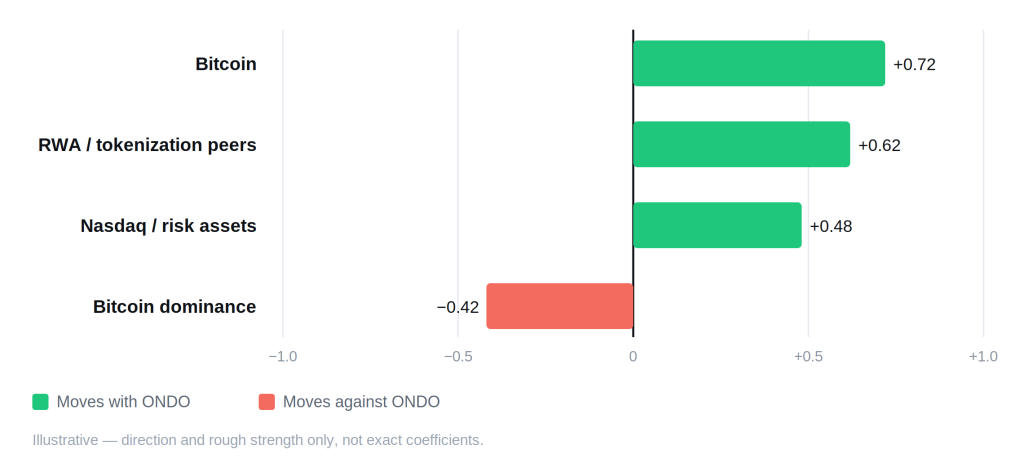
ONDO moves with broad crypto beta, but it carries a sensitivity most altcoins don’t. Its flagship products hold short-term US Treasuries, so the same interest-rate path that sets Treasury yields also shapes demand for USDY and OUSG — a rate cut that lifts risk appetite can, at the margin, trim the yield that makes those products attractive. Day to day, ONDO still tracks Bitcoin, and it tends to strengthen when Bitcoin dominance falls and capital rotates into alts. It also trades as part of a distinct RWA-and-tokenization cohort, rising and falling with peers on that narrative rather than the meme or DeFi trades. Since institutions arrived, its link to the Nasdaq has firmed too, which is why Fed policy shows up quickly in the chart. Read these as tendencies that drift with the market, not fixed numbers.
Fundamental factors
Ondo Finance runs the largest RWA business in crypto, and the token sits on top of real revenue-generating products. OUSG is an institutional Treasury fund backed directly by BlackRock’s BUIDL, where Ondo is among the largest holders; USDY is a yield-bearing token backed by short-term Treasuries, paying around 4.65% with roughly $740 million in supply in mid-2026. Total protocol value locked reached about $3.48 billion by July 2026.
The growth engine now is Ondo Global Markets, which tokenizes US stocks and ETFs and crossed $1 billion in value locked in May 2026 — the first tokenized-equities platform to do so — with hundreds of assets live across Ethereum, Solana, and BNB Chain. Partnerships give the effort weight: Franklin Templeton, a BlackRock ETF as a tokenized underlying, and a 2025 tie-up with the Trump-linked World Liberty Financial to bring USDY and OUSG on-chain. In July 2026, Ondo shelved its planned standalone Ondo Chain layer-1 and launched Ondo Network instead, an execution layer that keeps trading logic in secure hardware and settles on public chains — a pivot toward exchange-speed performance rather than running its own blockchain.
The catch is the token itself. ONDO has a 10 billion maximum supply, of which about 4.87 billion (49%) circulates, leaving more than half still to unlock. The token does not yet capture protocol revenue directly, so its price leans on demand and narrative more than on cash flows — a value-capture gap that the market has priced into the low models above. Regulation is the tailwind: clearer US rules for tokenized securities in 2025–2026 have moved RWAs from experiment to product, and Ondo is positioned at the center of that shift. PrimeXBT’s primer on real-world assets in crypto covers the sector in more depth.
Upcoming catalysts
Only confirmed, dated events are listed. For ONDO, the calendar splits between macro policy and its own supply schedule.
| Date | Event | Potential impact |
|---|---|---|
| September 15–16, 2026 | FOMC meeting (with economic projections) | Bull if the Fed signals more cuts; bear if it holds higher for longer. Rates cut both ways for ONDO, through risk appetite and Treasury yields |
| October 27–28, 2026 | FOMC meeting | Rate path steers risk appetite across crypto |
| December 8–9, 2026 | FOMC meeting (with economic projections) | Year-end policy signal that frames 2027 positioning |
| January 18, 2027 | Scheduled ONDO token unlock (next major release) | Bear/supply overhang; added float can pressure price if demand does not absorb it |
FOMC dates follow the Federal Reserve’s published 2026 schedule. The January 18, 2027 unlock is on Ondo’s confirmed vesting calendar; further unlock tranches exist but are listed here only where the date is fixed.
Bull case vs bear case
Bull case:
- Tokenized-equity volume on Ondo Global Markets keeps compounding, and TVL sets new highs.
- The Fed keeps cutting, capital rotates back into risk assets, and RWA becomes the cycle’s lead narrative.
- Institutional partners deepen — more Treasury and ETF inflows into USDY and OUSG.
- A token value-capture mechanism ties ONDO more directly to protocol revenue.
Bear case:
- Unlock tranches add supply faster than demand absorbs it, extending the dilution that drove the 2025 selloff.
- Rates stay higher for longer and risk appetite thins across crypto.
- ONDO’s price stays disconnected from strong platform metrics while the token captures none of the revenue.
- Competition in RWA tokenization compresses Ondo’s lead and its narrative premium.
Invalidation levels. The bull case weakens on a daily close below $0.30, the level that has held as support this year; lose it and the next demand zone is near $0.26. The bear case is invalidated on a sustained break above $0.42 and, more convincingly, a weekly close that holds over $0.50 — the band that has stopped every 2026 rally.
Historical performance
ONDO’s short life has been a boom and a long hangover. The token launched in January 2024 near $0.08, ran past $2 by December that year as the RWA trade caught fire, then gave back more than 80% through 2025 and into 2026 as unlock after unlock hit the market and the narrative cooled. What stands out is the gap between token and business: through the drawdown, Ondo’s TVL and product suite kept expanding while the price fell. Past cycles set the range of what’s possible, not what’s owed.
Is Ondo a good investment in 2026?
ONDO is a bet on one specific thesis: that tokenized real-world assets keep migrating on-chain and that Ondo stays the venue where much of it happens. The business case is the strongest part — record TVL, a $1 billion tokenized-equities platform, and blue-chip partners. The token case is weaker, because ONDO does not yet capture that revenue and more than five billion coins remain locked. Our outlook has it recovering gradually, averaging near $0.41 in 2026, with the real move deferred to the 2027–2028 window. Whether that trade-off appeals depends on how much unlock risk a buyer will tolerate for exposure to the sector leader.
How to trade Ondo on PrimeXBT
On PrimeXBT you can take a position in either direction using CFDs, going long if you expect a recovery or short if you expect the unlock overhang to win. Leverage enlarges gains and losses together, so position size and a stop-loss carry more weight the more volatile the asset. Trade on your own analysis and risk tolerance, and never risk more than you can afford to lose.
Trading involves risk.
How we build this forecast
PrimeXBT’s analysts assemble this outlook rather than pull it from one price feed. We start with where ONDO trades today, place it against the 50- and 200-day moving averages and the support and resistance that matter, then weigh the fundamentals — TVL, tokenized-asset growth, unlock schedule, institutional flows — against the macro backdrop, above all the path of US interest rates, which touches ONDO twice through risk appetite and Treasury yields. The yearly ranges blend that technical read with the fundamental and macro picture; the long-range figures lean on trajectory rather than precision.
None of this is a guarantee. Crypto is volatile, ONDO carries a heavy unlock schedule on top of that, and one macro surprise can move it faster than any model expects. Treat every figure here as a considered estimate, not a promise — we revisit and update the outlook monthly as the data changes.
How much will Ondo be worth in 2026?
Our outlook is roughly $0.350–$0.479 for 2026, averaging near $0.41 — a recovery year rather than a breakout.
How much will Ondo be worth in 2030?
Our long-range view is roughly $0.502–$0.852, averaging near $0.68. A figure this far out hinges on how RWA adoption and the remaining token unlocks play out, so read it as a direction rather than a fixed target.
What will Ondo be worth in five years?
See 2030 above. On this horizon, read any single figure as a direction rather than a target — the plausible range is wide.
Can Ondo reach $1?
Not as a base case on our numbers — the top of our modeled range peaks under $1 in 2028. A move to $1 would need adoption to outrun the unlock schedule, and it would imply a larger market cap than the December 2024 record because supply has roughly tripled since then.
Is Ondo a good investment in 2026?
Mixed. The underlying business leads the RWA sector, but the token does not yet capture its revenue and more than half the supply is still locked. The case runs both ways.
When is the next Ondo token unlock?
The next major scheduled release is January 18, 2027. Unlocks have been the main source of selling pressure on ONDO since the large January 2025 release, so the vesting calendar matters as much as any chart level.
Author



 Risk Disclaimer
The content provided here is for informational purposes only. It is not intended as personal investment advice and does not constitute a solicitation or invitation to engage in any financial transactions, investments, or related activities. Past performance is not a reliable indicator of future results.
The financial products offered by the Company are complex and come with a high risk of losing money rapidly due to leverage. These products may not be suitable for all investors. Before engaging, you should consider whether you understand how these leveraged products work and whether you can afford the high risk of losing your money.
The Company does not accept clients from the Restricted Jurisdictions as indicated in our website/ T&C. Some services or products may not be available in your jurisdiction.
The applicable legal entity and its respective products and services depend on the client’s country of residence and the entity with which the client has established a contractual relationship during registration.