14 min read
 Pi Network (PI) trades near $0.09 in late August 2026, roughly 97% below the $2.99 peak it hit within days of opening its mainnet in February 2025. PI is the token of a mobile-first project that let users “mine” coins by tapping a phone app once a day, a scheme running since 2019 that claims more than 60 million sign-ups. This page lays out PrimeXBT’s price outlook for PI through 2030 and out to 2050, the levels traders are watching now, and the catalysts, most of them supply-related, that could move it. Figures are given as ranges, and where the picture is genuinely thin, the text says so rather than inventing precision the data can’t support.
Pi Network outlook at a glance
- 2026 base case: $0.085–$0.105, a coin pinned near its lows by steady token unlocks rather than trending.
- Main bullish catalyst: a top-tier exchange listing or genuine ecosystem usage that finally gives migrated tokens somewhere to go.
- Biggest downside risk: monthly unlocks keep flooding supply into thin demand, breaking the $0.085 support and dragging PI toward new lows.
- Long-term view: a slow grind higher is the base case, with an average near $0.17 by 2030 — nowhere near the launch spike, and everything past 2030 reads as direction, not a target.
Live Pi Network price chart
The chart below tracks Pi Network in real time; the levels that matter right now are broken down in the technical section further down. Note that PI is not currently listed on PrimeXBT, so the figures here draw on third-party market data.
Trading involves risk.
Pi Network price prediction 2026–2030 (yearly forecast)
The table sets PrimeXBT’s expected range for each year. It is a sober path by design: PI carries a structural supply overhang that most coins don’t, so the outlook assumes a slow recovery, not a rerun of the 2025 launch spike. Wider-ranging third-party targets are kept in the analyst section rather than blended in here.
| Year | Minimum | Average | Maximum |
|---|---|---|---|
| 2026 | $0.081 | $0.095 | $0.112 |
| 2027 | $0.092 | $0.131 | $0.184 |
| 2028 | $0.130 | $0.169 | $0.209 |
| 2029 | $0.119 | $0.162 | $0.207 |
| 2030 | $0.118 | $0.169 | $0.228 |
Pi Network price prediction 2026
PrimeXBT’s 2026 outlook holds PI close to its late-August level near $0.09 — a range of roughly $0.085–$0.105, averaging about $0.095, with no recovery toward its old highs. The ceiling on the year is supply, not sentiment: fresh tokens unlock every month and meet a market whose daily volume rarely clears a few million dollars.
For the rest of 2026, the month-by-month view keeps PI in a narrow band, drifting slightly higher into year-end as the pace of new unlocks is already priced in:
| Month (2026) | Minimum | Average | Maximum |
|---|---|---|---|
| August | $0.081 | $0.090 | $0.099 |
| September | $0.083 | $0.092 | $0.102 |
| October | $0.085 | $0.095 | $0.105 |
| November | $0.087 | $0.098 | $0.108 |
| December | $0.088 | $0.100 | $0.112 |
Pi Network price prediction 2027
2027 is where the outlook allows a modest step up, to a full-year average near $0.13 and a range of about $0.11–$0.15. The move rests on the migration backlog clearing and at least one credible listing or ecosystem use case emerging, not on a broad market melt-up. Absent either, PI stays pinned near 2026 levels.
| Month (2027) | Minimum | Average | Maximum |
|---|---|---|---|
| January | $0.092 | $0.105 | $0.117 |
| February | $0.096 | $0.109 | $0.123 |
| March | $0.099 | $0.114 | $0.129 |
| April | $0.103 | $0.118 | $0.134 |
| May | $0.106 | $0.123 | $0.140 |
| June | $0.110 | $0.128 | $0.146 |
| July | $0.113 | $0.133 | $0.152 |
| August | $0.117 | $0.138 | $0.158 |
| September | $0.121 | $0.143 | $0.165 |
| October | $0.124 | $0.148 | $0.171 |
| November | $0.128 | $0.153 | $0.178 |
| December | $0.132 | $0.158 | $0.184 |
Pi Network price prediction 2028
2028 holds the modest peak in this outlook: an average near $0.170 and a range of about $0.13–$0.21, with the top of the band around mid-year. The projection places whatever cyclical high PI reaches in this window well short of its launch price, because by then the bulk of the 100 billion supply is either circulating or close to it.
| Month (2028) | Minimum | Average | Maximum |
|---|---|---|---|
| January | $0.133 | $0.161 | $0.188 |
| February | $0.134 | $0.163 | $0.192 |
| March | $0.136 | $0.166 | $0.196 |
| April | $0.137 | $0.168 | $0.200 |
| May | $0.139 | $0.171 | $0.203 |
| June | $0.140 | $0.174 | $0.207 |
| July | $0.140 | $0.174 | $0.209 |
| August | $0.138 | $0.173 | $0.207 |
| September | $0.136 | $0.171 | $0.206 |
| October | $0.134 | $0.169 | $0.205 |
| November | $0.132 | $0.168 | $0.204 |
| December | $0.130 | $0.166 | $0.202 |
Pi Network price prediction 2029
2029 cools off after the 2028 high, easing to an average near $0.16 across a range of roughly $0.12–$0.20. Nothing dramatic, just the give-back that tends to follow a local top when there is no fresh catalyst to sustain it.
| Month (2029) | Minimum | Average | Maximum |
|---|---|---|---|
| January | $0.128 | $0.165 | $0.202 |
| February | $0.127 | $0.164 | $0.201 |
| March | $0.125 | $0.163 | $0.201 |
| April | $0.124 | $0.162 | $0.201 |
| May | $0.123 | $0.161 | $0.200 |
| June | $0.121 | $0.160 | $0.200 |
| July | $0.121 | $0.160 | $0.200 |
| August | $0.120 | $0.161 | $0.201 |
| September | $0.120 | $0.161 | $0.203 |
| October | $0.120 | $0.162 | $0.204 |
| November | $0.119 | $0.162 | $0.206 |
| December | $0.119 | $0.163 | $0.207 |
Pi Network price prediction 2030
The 2030 view spans roughly $0.12–$0.22, averaging near $0.17. Four years out, the outlook leans on trajectory over precision, so read the monthly path below as a shape rather than a set of dated prices.
| Month (2030) | Minimum | Average | Maximum |
|---|---|---|---|
| January | $0.119 | $0.164 | $0.209 |
| February | $0.119 | $0.165 | $0.211 |
| March | $0.119 | $0.166 | $0.213 |
| April | $0.119 | $0.167 | $0.215 |
| May | $0.119 | $0.168 | $0.217 |
| June | $0.120 | $0.169 | $0.219 |
| July | $0.119 | $0.170 | $0.221 |
| August | $0.119 | $0.171 | $0.223 |
| September | $0.119 | $0.171 | $0.224 |
| October | $0.118 | $0.172 | $0.225 |
| November | $0.118 | $0.172 | $0.227 |
| December | $0.118 | $0.173 | $0.228 |
Pi Network long-term price prediction: 2035, 2040–2050
Put a number on PI a decade out and you are guessing, plainly. No model can price the odds that Pi ever ships real utility, lands a major listing, or quietly fades, and those branches lead to wildly different places. Treat the figures below as a slow upward drift under a benign scenario, with error bars that swallow the estimate itself the further out you look:
| Year | Minimum | Average | Maximum |
|---|---|---|---|
| 2035 | $0.141 | $0.220 | $0.299 |
| 2040 | $0.162 | $0.280 | $0.398 |
| 2050 | $0.225 | $0.450 | $0.675 |
What analysts and models say (compared)
Forecasts for PI sit further apart than for almost any top-100 coin, because they disagree on the basics: whether the supply overhang ever clears and whether the token finds a use. Algorithmic models that extrapolate the current downtrend keep PI under $0.20 for years; more bullish trackers pencil in $0.40–$0.52 by 2030. Averaging those would hide the disagreement, so they are laid out side by side.
| Source | Method | Pi Network view |
|---|---|---|
| CoinCodex | Algorithmic | 2026 avg ~$0.065; ~$0.20 in 2030; ~$1.06 by 2050 |
| Cryptopolitan | Algorithmic | 2026 range ~$0.085–$0.37; ~$0.42 avg in 2030; ~$1.71 max by 2032 |
| CoinDCX | Algorithmic | ~$0.18 in 2027 rising to ~$0.52 in 2030; ~$2.00 by 2040 |
| DigitalCoinPrice (via Cryptopolitan) | Algorithmic | ~$200 in 2030 (extreme outlier) |
The spread is the story. A $200 target and a $0.20 target for the same year cannot both rest on serious assumptions, and the outliers say more about how little price history PI has than about where it is going. No major bank or institutional research desk publishes a PI target at all, which is itself a signal: the coins that draw institutional forecasts are the ones institutions can custody and trade, and PI is neither widely listed nor cleanly custodied.
Track record of this forecast
This is the first published PrimeXBT price forecast for Pi Network. From the next monthly review onward, this section will hold the previous forecast up against PI’s actual price on the update date and explain any miss instead of quietly revising it away.
Pi Network technical analysis
As of late August 2026, PI trades around $0.089, sitting almost exactly on its 50-day simple moving average of $0.089 but well below its 200-day average of $0.145 — the longer trend still points down, even as the short-term drift has flattened. The RSI reads near 52, squarely neutral, with no overbought or oversold extreme to lean on. The broad-market Fear & Greed Index sits in “Greed” around 73, but that gauge tracks Bitcoin-led sentiment, not PI, whose own momentum has stayed heavy.
The support and resistance levels in play now: support at $0.088, then $0.085, with a deeper floor near $0.083; resistance at $0.093, then $0.095, and a firmer ceiling around $0.098. A daily close back above the 200-day average near $0.145 would be the first real evidence the downtrend has broken, and PI is a long way from testing it. For a primer on reading these signals, see PrimeXBT’s guide to crypto technical analysis.
Correlation with other assets
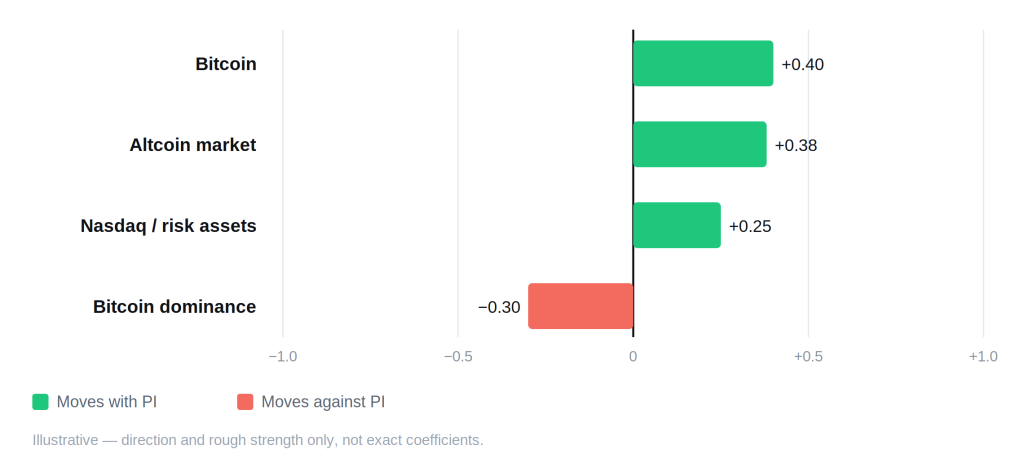
Pi Network is one of the more decoupled coins in the top 100. Where most altcoins take their cue from Bitcoin, PI moves mainly on its own supply and story: unlock dates, KYC and migration progress, and recurring speculation about a big exchange listing. That gives it only a loose positive link to Bitcoin and the wider altcoin market, and an even weaker tie to risk assets like the Nasdaq. Its clearest relationship is the inverse one to Bitcoin dominance — capital rotating into Bitcoin tends to starve thin alts like PI first. These are rough, directional readings, and PI’s habit of gapping on its own news makes them looser still.
Fundamental factors
Pi Network launched its app in 2019 on a simple pitch: tap a button once a day and accumulate PI, no hardware or electricity required. The “mining” is not mining in any technical sense, just a daily engagement loop that inflated a headline user count past 60 million “Pioneers.” The hard number underneath is far smaller. Around 19 million users had completed KYC verification by late 2025, and roughly 16 million had migrated tokens to the mainnet, which means a large share of that 60 million holds balances they cannot yet touch.
Supply is the fundamental that overrides the rest. PI has a maximum supply of 100 billion, of which only about 11 billion circulated by mid-2026 — barely a tenth. The remainder unlocks on schedules tied to mining history and multi-year lock-ups, and around 775 million more tokens are set to enter circulation by the end of 2026 alone as three-year locks expire. Early tappers received their coins for nothing, so any price above zero is a rational sale, which is why fresh supply keeps meeting weak demand. On the utility side, Protocol 23 enabled smart contracts in May 2026 and a native decentralized exchange has been targeted, but working applications with real usage remain scarce, and the persistent criticism, that PI is a large user base in search of a purpose, has not been answered.
Listing status compounds the problem. PI trades on second-tier venues such as OKX, Bitget, MEXC, Gate, and HTX, but Binance, Coinbase, and Kraken have not listed it, and some smaller platforms quote IOUs rather than native tokens. For a coin whose bull case leans heavily on “a major listing,” the continued absence of one is the most honest read on how the wider industry views its tokenomics.
Upcoming catalysts
Only confirmed, dated events are listed. For PI, the supply calendar matters more than the macro one, which is the reverse of most large-cap coins.
| Date | Event | Potential impact |
|---|---|---|
| Through December 2026 | Scheduled token unlocks (~775M PI as three-year lock-ups expire) | Bear: steady new supply into thin demand |
| September 15–16, 2026 | FOMC meeting (with economic projections) | Bull if the Fed signals cuts; bear if it holds higher for longer |
| October 27–28, 2026 | FOMC meeting | Sets broad risk appetite, though PI tracks it loosely |
| December 8–9, 2026 | FOMC meeting (with economic projections) | Year-end policy signal for 2027 positioning |
| Date not yet confirmed | Protocol 27 network upgrade | Further smart-contract capability; no mainnet date announced |
FOMC dates follow the Federal Reserve’s published 2026 schedule. Protocol 27 is listed without a date because none has been confirmed, and a listing on Binance or Coinbase, the event the community argues about most, is left off entirely because it has not been announced.
Bull case vs bear case
Bull case:
- A top-tier exchange finally lists native PI, pulling in liquidity and a wave of new demand.
- The KYC and migration backlog clears, and dormant Pioneers turn into active holders rather than sellers.
- Smart contracts and a working DEX give the ecosystem genuine on-chain activity for the first time.
- A broad risk-on turn lifts thin alts, and PI catches a bid alongside them.
Bear case:
- Monthly unlocks keep adding supply that zero-cost holders are happy to sell.
- Major listings never arrive, and PI stays quarantined on second-tier venues.
- Ecosystem promises slip again, and the “no real utility” critique hardens.
- Momentum stays weak, and PI slides to fresh lows below its old floor.
Invalidation levels. The bull case weakens on a sustained daily close below $0.085, the support that has held the recent range. The bear case is invalidated only on a decisive reclaim of the 200-day average near $0.145, roughly 60% above the late-August price and the line that would mark the long downtrend as broken. Between those two levels, PI is doing what it has done all year: drifting sideways while supply bleeds in.
Historical performance
PI’s on-chain price history is short and brutal. Open mainnet went live on February 20, 2025 near $1.47, PI spiked to an all-time high of about $2.99 within days, and it has fallen almost without pause since — down roughly 97% to near $0.09 by August 2026, with intermittent all-time lows along the way. That is not a cyclical drawdown of the kind Bitcoin or Ethereum have recovered from; it is the first act of a coin still discovering what, if anything, it is worth once supply meets an open market.
Is Pi Network a good investment in 2026?
Start with what is verifiable. PI has a 100 billion supply that is barely a tenth circulated, no listing on a top exchange, thin daily volume, and an ecosystem still short of working applications, and it trades 97% below a launch spike driven by scarcity that is now unwinding. PrimeXBT’s outlook sees it grinding sideways-to-slightly-higher, averaging near $0.095 in 2026 and near $0.17 by 2030, well short of its old highs. For a buyer, the entire thesis rests on events that have not happened: a major listing, cleared migration, real usage. That is a speculative bet on execution, not an investment in a proven asset, and position sizing should reflect it. A grounding in crypto portfolio allocation is worth more here than any single price target.
How to trade Pi Network on PrimeXBT
Pi Network is not currently listed on PrimeXBT, so PI itself cannot be traded on the platform today. What PrimeXBT does offer is CFD trading on a broad set of crypto assets, which lets you take a position long or short depending on your own read of the market. Leverage magnifies gains and losses alike, so position sizing and a stop-loss matter on any trade, and thin, headline-driven coins are exactly where risk controls earn their keep. Trade on your own analysis and risk tolerance, and never risk more than you can afford to lose. Opening an account gives access to the coins currently supported and to the tools for managing volatility in either direction.
Trading involves risk.
How we build this forecast
PrimeXBT’s analysts assemble this outlook rather than lift it from one price feed. For PI the starting point is unusual: supply mechanics come first, since the unlock schedule and the gap between claimed users and verified holders drive the token more than any chart pattern does. From there the read takes in the position against the 50- and 200-day moving averages and the current support and resistance, the state of the ecosystem and listings, and the macro backdrop that sets risk appetite for thin alts. The yearly ranges combine that supply-first read with the technical and macro picture; the long-range figures lean on direction over precision.
None of this is a guarantee. PI is unusually speculative, trades on its own news, and one listing decision or one large unlock can move it faster than any model expects. Treat every figure here as a considered estimate, not a promise, revisited and updated monthly as the data changes.
Author



 Risk Disclaimer
The content provided here is for informational purposes only. It is not intended as personal investment advice and does not constitute a solicitation or invitation to engage in any financial transactions, investments, or related activities. Past performance is not a reliable indicator of future results.
The financial products offered by the Company are complex and come with a high risk of losing money rapidly due to leverage. These products may not be suitable for all investors. Before engaging, you should consider whether you understand how these leveraged products work and whether you can afford the high risk of losing your money.
The Company does not accept clients from the Restricted Jurisdictions as indicated in our website/ T&C. Some services or products may not be available in your jurisdiction.
The applicable legal entity and its respective products and services depend on the client’s country of residence and the entity with which the client has established a contractual relationship during registration.