14 min read
 Sui (SUI) trades around $0.85 in late August 2026, roughly 84% below the record high it set in January 2025. SUI is the native token of the Sui blockchain, a Move-based layer-1 built by Mysten Labs for high-throughput consumer and DeFi applications; it pays network fees, secures the chain through delegated staking, and serves as on-chain collateral. This page lays out PrimeXBT’s price outlook for SUI through 2030 and out to 2050, the levels traders are watching now, and the catalysts, including a multi-year token-unlock schedule, that could move it. Figures are given as ranges rather than single points, and where the picture is genuinely open, the text says so.
Sui outlook at a glance
- 2026 base case: $0.790–$0.975, a consolidation year with the unlock schedule capping upside rather than a fresh bull run.
- Main bullish catalyst: a genuine pickup in on-chain activity, with DeFi fee revenue across Sui exchanges climbing sharply in August 2026, plus Fed rate cuts feeding risk appetite back into small-cap layer-1s.
- Biggest downside risk: monthly token unlocks meeting thin demand, which would pressure SUI back toward the $0.76 and $0.65 support shelf.
- Long-term view: a gradual re-rating toward and beyond the current cycle looks plausible into 2028, but anything past 2030 reads as a direction, not a target.
Live Sui price chart
The chart below tracks SUI in real time; the levels that matter right now are set out in the technical section further down.
Trading involves risk.
Sui price prediction 2026–2030 (yearly forecast)
The table sets PrimeXBT’s expected range for each year. The wider institutional and algorithmic targets, which rest on very different assumptions about the unlock schedule and adoption, are kept separate in the analyst section rather than blended in here.
| Year | Minimum | Average | Maximum |
|---|---|---|---|
| 2026 | $0.790 | $0.873 | $0.975 |
| 2027 | $0.864 | $1.207 | $1.661 |
| 2028 | $1.330 | $1.658 | $1.993 |
| 2029 | $1.199 | $1.557 | $1.894 |
| 2030 | $1.079 | $1.453 | $1.797 |
Sui price prediction 2026
PrimeXBT’s 2026 outlook keeps SUI close to its late-August level near $0.85, a full-year range of $0.790–$0.975 averaging near $0.87, with no return to the 2025 highs. That reflects a market absorbing steady token supply rather than one trending, and the give-back visible after August’s overbought push.
For the remainder of 2026, the month-by-month path holds SUI in a narrow band, easing back from the August spike before steadying into year-end:
| Month (2026) | Minimum | Average | Maximum |
|---|---|---|---|
| August | $0.790 | $0.850 | $0.909 |
| September | $0.797 | $0.860 | $0.923 |
| October | $0.803 | $0.870 | $0.937 |
| November | $0.814 | $0.885 | $0.956 |
| December | $0.825 | $0.900 | $0.975 |
Sui price prediction 2027
2027 is the recovery leg: PrimeXBT’s path climbs from the low $0.90s early in the year toward roughly $1.50 by December, a full-year range of $0.864–$1.661 averaging near $1.20. The step up leans on maturing network usage and a lighter insider-unlock load, not a single headline.
| Month (2027) | Minimum | Average | Maximum |
|---|---|---|---|
| January | $0.864 | $0.946 | $1.028 |
| February | $0.903 | $0.992 | $1.081 |
| March | $0.942 | $1.038 | $1.135 |
| April | $0.980 | $1.085 | $1.189 |
| May | $1.018 | $1.131 | $1.243 |
| June | $1.056 | $1.177 | $1.298 |
| July | $1.096 | $1.225 | $1.355 |
| August | $1.137 | $1.276 | $1.416 |
| September | $1.178 | $1.327 | $1.477 |
| October | $1.219 | $1.378 | $1.538 |
| November | $1.259 | $1.429 | $1.599 |
| December | $1.299 | $1.480 | $1.661 |
Sui price prediction 2028
2028 holds the cycle high in this outlook: the path peaks around mid-year before easing, for a range of $1.330–$1.993 and an average near $1.66. With most early-backer tokens already in circulation by then, the float stops growing as fast, and a stronger risk cycle can do more of the work.
| Month (2028) | Minimum | Average | Maximum |
|---|---|---|---|
| January | $1.330 | $1.522 | $1.713 |
| February | $1.362 | $1.563 | $1.764 |
| March | $1.393 | $1.605 | $1.817 |
| April | $1.423 | $1.646 | $1.869 |
| May | $1.454 | $1.688 | $1.922 |
| June | $1.484 | $1.729 | $1.975 |
| July | $1.487 | $1.740 | $1.993 |
| August | $1.465 | $1.720 | $1.975 |
| September | $1.442 | $1.700 | $1.958 |
| October | $1.420 | $1.680 | $1.940 |
| November | $1.397 | $1.660 | $1.923 |
| December | $1.375 | $1.640 | $1.905 |
Sui price prediction 2029
2029 cools off after the peak, a measured drift lower through the year, ranging $1.199–$1.894 with an average near $1.55. The outlook treats this as digestion of the prior year’s gains rather than a new downtrend.
| Month (2029) | Minimum | Average | Maximum |
|---|---|---|---|
| January | $1.358 | $1.626 | $1.894 |
| February | $1.341 | $1.612 | $1.883 |
| March | $1.325 | $1.598 | $1.872 |
| April | $1.308 | $1.585 | $1.861 |
| May | $1.291 | $1.571 | $1.850 |
| June | $1.275 | $1.557 | $1.839 |
| July | $1.260 | $1.545 | $1.830 |
| August | $1.248 | $1.536 | $1.825 |
| September | $1.236 | $1.527 | $1.819 |
| October | $1.223 | $1.518 | $1.813 |
| November | $1.211 | $1.509 | $1.807 |
| December | $1.199 | $1.500 | $1.801 |
Sui price prediction 2030
PrimeXBT’s 2030 view spans $1.079–$1.797, averaging near $1.45. By this point almost the entire supply is unlocked and price leans more on network revenue than on scarcity, so read the month-by-month path below as a shape rather than a set of dated targets.
| Month (2030) | Minimum | Average | Maximum |
|---|---|---|---|
| January | $1.188 | $1.492 | $1.797 |
| February | $1.177 | $1.485 | $1.792 |
| March | $1.166 | $1.477 | $1.788 |
| April | $1.155 | $1.469 | $1.783 |
| May | $1.144 | $1.462 | $1.779 |
| June | $1.133 | $1.454 | $1.774 |
| July | $1.124 | $1.447 | $1.771 |
| August | $1.115 | $1.442 | $1.769 |
| September | $1.106 | $1.436 | $1.767 |
| October | $1.097 | $1.431 | $1.765 |
| November | $1.088 | $1.425 | $1.763 |
| December | $1.079 | $1.420 | $1.761 |
Sui long-term price prediction: 2035, 2040–2050
Put a number on SUI a decade out and you are really sketching a scenario. No model can price ten years of adoption S-curves, competing layer-1s, and macro regimes that have not happened yet, so the figures below widen their error bars with every step forward. Held to that caveat, PrimeXBT’s long-range path drifts higher without ever going vertical:
| Year | Minimum | Average | Maximum |
|---|---|---|---|
| 2035 | $1.656 | $2.300 | $2.944 |
| 2040 | $2.112 | $3.200 | $4.288 |
| 2050 | $2.784 | $4.800 | $6.816 |
What analysts and models say (compared)
SUI forecasts sit far apart, and the gap is the point. Algorithmic aggregators cluster well under $1 for 2026, while some editorial desks pencil in multiples of that on a faster adoption case. Averaging targets built on incompatible assumptions would mislead, so they are laid out side by side.
| Source | Method | Sui view (2026 unless noted) |
|---|---|---|
| CoinLore | Algorithmic | Base ~$0.52 (range $0.31–$3.23) |
| Changelly | Algorithmic | Avg ~$0.71 (range $0.61–$0.81) |
| Phemex | Editorial / scenario | $0.80–$1.20 base, range-bound consolidation |
| KuCoin | Editorial / scenario | Late-2026 base $1.50–$2.50, bull $2.50–$4.00 |
| PrimeXBT | Synthesis | Avg ~$0.87 (range $0.790–$0.975) |
The spread runs from CoinLore’s sub-$0.55 base case to KuCoin’s $2.50-plus, more than a fourfold gap on the same 12-month view. The bearish models weight the unlock schedule heavily; the bullish desks weight rising DeFi activity and the prospect of Fed easing. Anyone hunting a single consensus number will not find one here, which is exactly why the disagreement is shown rather than smoothed over.
Track record of this forecast
This is the first published PrimeXBT price forecast for Sui. From the next monthly review onward, this section will hold the previous forecast against SUI’s actual price on the update date and explain any miss instead of quietly revising it away.
Sui technical analysis
As of late August 2026, SUI trades near $0.85 after a sharp rally off the $0.66 area, and it sits between its key moving averages. Price has pushed above the 50-day exponential average near $0.73 but remains below the 200-day average near $0.97, so the longer trend is still down while the short-term one has turned up. The daily RSI spiked to roughly 76, an overbought reading that often precedes a pullback, having climbed from the high-30s only days earlier.
The support and resistance levels in play now: support at $0.76, then a firmer shelf around $0.65 that held through the summer; resistance at the $0.95 zone, then the 200-day average near $0.97, with the psychological $1.00 just above. Reclaiming and holding $0.97 would be the clearest sign the year-long downtrend has broken. The August surge came with a jump in on-chain fee revenue rather than on air alone, which gives the move more substance than a purely technical bounce. For the mechanics behind these signals, see PrimeXBT’s guide to crypto technical analysis.
Correlation with other assets
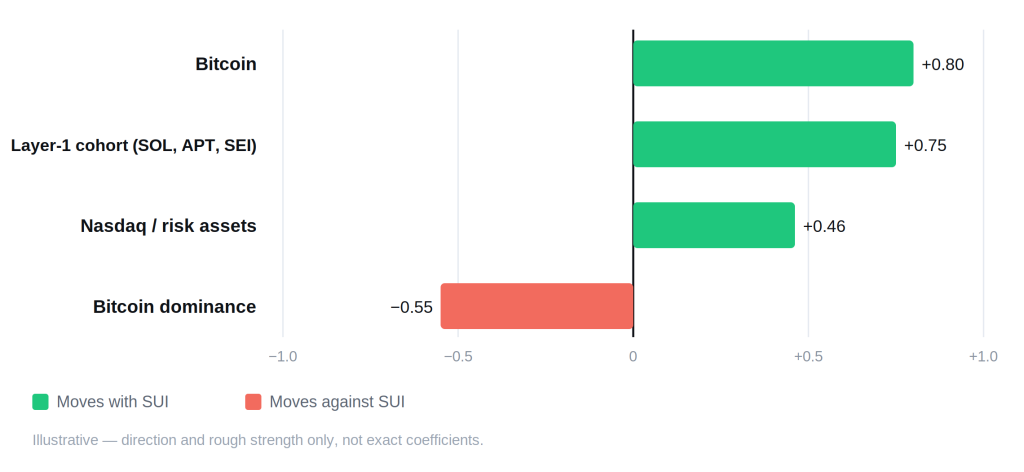
SUI trades as a high-beta bet on the broader risk cycle, and its tightest link is not to Bitcoin alone but to its own peer group. It moves almost in lockstep with the newer layer-1 cohort, Solana, Aptos, and Sei, because capital tends to rotate into and out of “fast-chain” alts as a block. That makes SUI acutely sensitive to alt-season timing: when Bitcoin dominance rises, small-cap layer-1s like SUI usually bleed against BTC, and when it falls, they tend to outrun it. Since institutions began treating crypto as a risk asset, SUI has also tracked the Nasdaq more closely, which is why Fed policy shows up quickly in its chart. These are directional tendencies that drift with the market, not fixed coefficients.
Fundamental factors
Sui is a layer-1 blockchain built by Mysten Labs, a team drawn largely from the engineers behind Meta’s shelved Diem and Novi projects, the same lineage that produced rival chain Aptos. It runs on Move, an asset-oriented programming language, and stores state as discrete objects rather than one global ledger, which lets independent transactions settle in parallel instead of single file. In practice that design targets very high throughput and low latency, the pitch Sui makes against both Aptos and Solana for consumer apps, gaming, and DeFi.
The ecosystem has filled out around that base: DeepBook, an on-chain central-limit order book that other apps build on, and Walrus, a decentralized storage layer, sit alongside a growing set of consumer and gaming projects. On-chain DeFi fee revenue jumped sharply in August 2026, a sign the activity is real rather than purely speculative. The chain’s credibility was tested in May 2025, when the Cetus decentralized exchange lost roughly $220 million to an overflow bug in an open-source library. Sui validators moved fast to freeze about $162 million of the stolen funds, and a community governance vote later approved returning that sum to affected users; Cetus relaunched afterward. The episode cut both ways: it showed the network could coordinate a rescue, but it also fed a debate about how much power a small validator set should hold.
Tokenomics are the overhang no SUI holder can ignore. The supply is capped at 10 billion, of which about 4.1 billion, roughly 41%, circulates today; the rest vests on a schedule that runs to 2030, with the largest tranche cliff-locked until after that date. Around 64 million SUI has been unlocking each month, equal to 1% to 1.7% of the circulating float, and the next scheduled release lands on September 1, 2026. The composition is shifting, though: the heavy early-investor and team cliffs are winding down, and newer unlocks tilt toward community reserves, which eases the concentrated insider selling that weighed on price through 2025. Staking offsets some of this by locking tokens up to secure the chain, thinning the float available to sell.
Upcoming catalysts
Only confirmed, dated events are listed. With SUI now tracking risk assets closely, macro policy is the clearest near-term driver, and the token’s own unlock calendar is the clearest crypto-specific one.
| Date | Event | Potential impact |
|---|---|---|
| September 1, 2026 | Scheduled SUI token unlock (community reserve) | Bearish if fresh supply meets thin demand; muted if activity keeps absorbing it |
| September 15–16, 2026 | FOMC meeting (with economic projections) | Bull if the Fed signals cuts; bear if it holds rates higher for longer |
| October 27–28, 2026 | FOMC meeting | Rate path steers risk appetite across small-cap layer-1s |
| December 8–9, 2026 | FOMC meeting (with economic projections) | Year-end policy signal for 2027 positioning |
FOMC dates follow the Federal Reserve’s published 2026 schedule. SUI token unlocks recur monthly through 2030; the September 1 date is listed as the next confirmed release, and later monthly unlocks continue on the same vesting cadence.
Bull case vs bear case
Bull case:
- On-chain activity keeps building, with DeFi fee revenue and app usage giving the token real cash-flow backing.
- The Fed shifts to rate cuts and capital rotates back into higher-beta layer-1s.
- The early-investor unlock cliff finishes, removing the biggest source of insider supply.
- Move-based consumer and gaming apps win users away from Aptos and Solana.
Bear case:
- Monthly unlocks keep adding supply faster than demand can absorb it, capping every rally.
- SUI stays below its 200-day average with rates higher for longer.
- A fresh security scare, after Cetus, dents confidence in the ecosystem.
- Competing layer-1s pull developers and liquidity away.
Invalidation levels. The bull case weakens if SUI loses the $0.76 support and closes back beneath it, and it is in real trouble on a break of the $0.65 shelf. The bear case is invalidated on a sustained reclaim of the 200-day average near $0.97 and a clean hold above $1.00, the line that would mark the year-long downtrend as broken. Those are the same levels drawn in the technical section above.
Historical performance
Sui’s mainnet went live in May 2023, so its record is short and violent rather than long and smooth. SUI climbed from an all-time low near $0.36 in late 2023 to a peak of $5.35 on January 4, 2025, then gave back the bulk of that run over the following eighteen months to trade near $0.85 today. One full boom-and-bust cycle is thin evidence, and a young chain carrying a heavy unlock schedule has less price history to lean on than an older asset. The pattern to watch is the shape, not any single past print.
Is Sui a good investment in 2026?
Sui’s case rests on a specific bet: that a fast, Move-based chain can win real users while it digests one of crypto’s heavier unlock schedules. PrimeXBT’s outlook sees SUI roughly flat into year-end, an average near $0.87 for 2026, with the recovery weighted toward 2027 and 2028. The facts underneath are mixed: on-chain revenue is rising and the worst insider unlocks are ending, but the token still trades far below its high and adds supply every month. Whether that balance reads as a discounted entry or a value trap depends on the holder’s time horizon and tolerance for volatility.
How to trade Sui and other crypto on PrimeXBT
PrimeXBT offers CFD trading on a broad range of crypto and other markets, with positions available in either direction, long or short, on the assets it lists. Leverage magnifies gains and losses alike, so position sizing and a stop-loss matter on any trade. Available instruments can change over time, so check the platform for the current lineup. Trade on your own analysis and risk tolerance, and never risk more than you can afford to lose.
Trading involves risk.
How we build this forecast
PrimeXBT’s analysts assemble this outlook rather than lift it from one price feed. The starting point is where SUI trades today, read against its 50- and 200-day moving averages and the support and resistance levels that matter now. On top of that sits the fundamental picture, network activity, DeepBook and Walrus, the Cetus aftermath, and above all the token-unlock schedule, set against the macro backdrop of U.S. interest rates. The yearly ranges combine that technical read with the fundamental and macro view; the long-range figures lean on trajectory over precision.
None of this is a promise. Crypto is volatile, the inputs move, and a single macro or security surprise can push SUI faster than any model expects. Treat every figure here as a considered estimate rather than a guarantee, and note that the outlook is revisited and updated monthly as the data changes.
How much will Sui be worth in 2026?
PrimeXBT's outlook is roughly $0.790–$0.975 for 2026, averaging near $0.87.
How much will Sui be worth in 2030?
The long-range view is roughly $1.079–$1.797, averaging near $1.45. A target this far out swings on adoption and unlock dynamics that have not played out yet, so treat it as a direction rather than a set number.
What will Sui be worth in five years?
See 2030 above. On this horizon treat any single figure as a direction rather than a target; the plausible range is wide.
Can Sui reach $5 again?
Not within PrimeXBT's modeled window through 2030, where the outlook tops out well under that. SUI last traded near $5.35 in January 2025, and reclaiming it would take a stronger cycle and lighter supply than the current picture shows.
Is Sui a good investment in 2026?
Mixed. On-chain revenue is rising and the worst insider unlocks are ending, but SUI trades far below its high and keeps adding supply each month. The case runs both ways and depends on time horizon.
How much of the SUI supply is still locked?
About 41% of the 10 billion cap circulates today, with the rest vesting through 2030 and the largest tranche cliff-locked until after that date. Roughly 64 million SUI, around 1% to 1.7% of the float, has been unlocking each month, though newer releases tilt toward community reserves rather than insiders.
Author



 Risk Disclaimer
The content provided here is for informational purposes only. It is not intended as personal investment advice and does not constitute a solicitation or invitation to engage in any financial transactions, investments, or related activities. Past performance is not a reliable indicator of future results.
The financial products offered by the Company are complex and come with a high risk of losing money rapidly due to leverage. These products may not be suitable for all investors. Before engaging, you should consider whether you understand how these leveraged products work and whether you can afford the high risk of losing your money.
The Company does not accept clients from the Restricted Jurisdictions as indicated in our website/ T&C. Some services or products may not be available in your jurisdiction.
The applicable legal entity and its respective products and services depend on the client’s country of residence and the entity with which the client has established a contractual relationship during registration.