15 min read
 Avalanche (AVAX) trades near $6.40 in early August 2026, roughly 96% below the record high it set in late 2021. AVAX is the native token of Avalanche, a layer-1 smart-contract platform built for high throughput, low fees, and custom application-specific chains. The token pays network fees, secures the chain through staking, and anchors an ecosystem that has leaned hard into tokenized real-world assets and institutional use. This page lays out PrimeXBT’s price outlook for AVAX through 2030 and out to 2050, the technical levels traders are watching now, and the catalysts that could move it. Every figure is a range built from current data, not a promise, and where the picture is honestly murky we flag it rather than paper over it.
Avalanche outlook at a glance
- Current price: $11.404 per AVAX.
- 2026 base case: $5.85–$7.20, a year of basing near current levels rather than a fresh trend.
- Main bullish catalyst: real-world-asset and institutional adoption on Avalanche L1s, amplified if the Fed shifts to rate cuts and capital rotates back into risk.
- Biggest downside risk: a broad crypto downturn and higher-for-longer policy, confirmed by a sustained break below the $5.97 support.
- Long-term view: the base case is a slow, cyclical recovery off depressed levels, but anything past 2030 is a direction of travel, not a target.
Live Avalanche price chart
Today (6 October 2026) Avalanche (AVAX/USD) is trading at $11.404 per AVAX, with a market cap of $5,052,352,343 USD. The 24-hour trading volume amounts to $580,578,913 USD. AVAX price has changed by 4.99% in the last 24 hours. Avalanche’s circulating supply is 443,277,845 AVAX.
Trading involves risk.
AVAX price prediction 2026–2030 (yearly forecast)
The table below sets PrimeXBT’s expected range for AVAX in each year from 2026 to 2030. It reads as a cycle: a base near today’s price, a gradual climb as the next broad crypto upswing builds, a peak later in the decade, then a cool-down. Far-out institutional and algorithmic targets diverge wildly, so those are kept in the analyst section rather than blended into this view.
| Year | Minimum | Average | Maximum |
|---|---|---|---|
| 2026 | $5.85 | $6.46 | $7.20 |
| 2027 | $6.18 | $7.95 | $10.11 |
| 2028 | $8.24 | $11.54 | $15.25 |
| 2029 | $11.21 | $14.36 | $17.70 |
| 2030 | $9.20 | $12.61 | $16.19 |
AVAX price prediction 2026
PrimeXBT’s 2026 outlook holds AVAX close to its early-August level of about $6.40, an average near $6.40 across a range of $5.85–$7.20. That is a basing year: the token has already given back nearly all of its last-cycle gains, and the near-term picture points to consolidation around the current zone rather than a decisive move in either direction. The month-by-month path below stays inside a tight band for the rest of the year.
| Month (2026) | Minimum | Average | Maximum |
|---|---|---|---|
| August | $5.89 | $6.40 | $6.91 |
| September | $5.87 | $6.40 | $6.93 |
| October | $5.85 | $6.40 | $6.95 |
| November | $5.93 | $6.50 | $7.07 |
| December | $6.00 | $6.60 | $7.20 |
AVAX price prediction 2027
The 2027 view lifts AVAX to an average near $8.00, ranging $6.18–$10.11. This is the first recovery leg: the forecast assumes the broad market turns higher into the next halving cycle and that Avalanche’s real-world-asset and L1 adoption keeps translating into on-chain activity. The rise is gradual, not a vertical repricing.
| Month (2027) | Minimum | Average | Maximum |
|---|---|---|---|
| January | $6.18 | $6.82 | $7.45 |
| February | $6.35 | $7.03 | $7.71 |
| March | $6.53 | $7.25 | $7.96 |
| April | $6.70 | $7.46 | $8.22 |
| May | $6.88 | $7.68 | $8.48 |
| June | $7.05 | $7.89 | $8.74 |
| July | $7.20 | $8.09 | $8.98 |
| August | $7.34 | $8.27 | $9.20 |
| September | $7.48 | $8.45 | $9.43 |
| October | $7.62 | $8.64 | $9.65 |
| November | $7.76 | $8.82 | $9.88 |
| December | $7.89 | $9.00 | $10.11 |
AVAX price prediction 2028
For 2028 the outlook centers on an average near $11.50, with a range of $8.24–$15.25. Bitcoin’s next halving falls in this window, and AVAX has historically run as a high-beta bet on the wider cycle, so the model carries the recovery forward here while the band widens to reflect thinner visibility.
| Month (2028) | Minimum | Average | Maximum |
|---|---|---|---|
| January | $8.24 | $9.43 | $10.62 |
| February | $8.59 | $9.86 | $11.13 |
| March | $8.94 | $10.29 | $11.64 |
| April | $9.29 | $10.72 | $12.16 |
| May | $9.63 | $11.15 | $12.68 |
| June | $9.97 | $11.58 | $13.20 |
| July | $10.23 | $11.93 | $13.62 |
| August | $10.42 | $12.18 | $13.94 |
| September | $10.60 | $12.44 | $14.27 |
| October | $10.79 | $12.69 | $14.59 |
| November | $10.97 | $12.95 | $14.92 |
| December | $11.15 | $13.20 | $15.25 |
AVAX price prediction 2029
2029 is the peak year in this forecast: an average near $14.50 across a range of $11.21–$17.70. That marks the high point of the modeled cycle, roughly in line with how altcoin tops have historically trailed a Bitcoin halving by 12 to 18 months. Even at the top of the band, AVAX would sit far below its 2021 record, a reminder of how deep the drawdown has been.
| Month (2029) | Minimum | Average | Maximum |
|---|---|---|---|
| January | $11.37 | $13.51 | $15.64 |
| February | $11.59 | $13.82 | $16.04 |
| March | $11.81 | $14.12 | $16.43 |
| April | $12.03 | $14.43 | $16.83 |
| May | $12.25 | $14.74 | $17.23 |
| June | $12.47 | $15.05 | $17.63 |
| July | $12.45 | $15.07 | $17.70 |
| August | $12.20 | $14.82 | $17.44 |
| September | $11.95 | $14.56 | $17.18 |
| October | $11.70 | $14.31 | $16.92 |
| November | $11.45 | $14.05 | $16.65 |
| December | $11.21 | $13.80 | $16.39 |
AVAX price prediction 2030
The 2030 view eases to an average near $12.50, ranging $9.20–$16.19. After a cyclical peak the forecast steps down rather than crashing, the same rhythm AVAX has shown after past tops. Five years out, treat the monthly path as the shape of a trajectory and nothing finer; the further the horizon, the more any single number is guesswork.
| Month (2030) | Minimum | Average | Maximum |
|---|---|---|---|
| January | $11.01 | $13.60 | $16.19 |
| February | $10.81 | $13.40 | $15.99 |
| March | $10.62 | $13.20 | $15.78 |
| April | $10.42 | $13.00 | $15.58 |
| May | $10.23 | $12.80 | $15.37 |
| June | $10.03 | $12.60 | $15.17 |
| July | $9.87 | $12.44 | $15.00 |
| August | $9.73 | $12.31 | $14.88 |
| September | $9.60 | $12.18 | $14.76 |
| October | $9.47 | $12.05 | $14.64 |
| November | $9.34 | $11.93 | $14.52 |
| December | $9.20 | $11.80 | $14.40 |
Avalanche long-term price prediction: 2035, 2040–2050
Put a number on AVAX in 2050 and you are really describing a mood, not a measurement. No model prices a quarter-century of protocol shifts, competing chains, and macro regimes that have not been invented yet, so the figures below are a slow upward drift rather than destinations, and the error bars grow with every year. On that footing, PrimeXBT’s long-range path trends higher without ever going parabolic: an average near $18 in 2035, near $26 in 2040, and near $45 in 2050.
| Year | Minimum | Average | Maximum |
|---|---|---|---|
| 2035 | $13.32 | $18.00 | $22.68 |
| 2040 | $17.68 | $26.00 | $34.32 |
| 2050 | $27.00 | $45.00 | $63.00 |
What analysts and models say (compared)
AVAX forecasts split sharply depending on the method. Algorithmic momentum models, which extrapolate the current downtrend, are outright bearish through 2030. One widely quoted forecaster’s figures, by contrast, sit an order of magnitude higher and appear not to have re-anchored to AVAX’s real price. Averaging views built on incompatible assumptions would mislead more than it informs, so they are laid out side by side.
| Source | Method | AVAX view |
|---|---|---|
| CoinCodex | Algorithmic | 2026 avg ~$6.13; declining to ~$2.50 avg by 2030 |
| Changelly | Algorithmic | 2026 avg ~$6.07; ~$2.61 by 2030, ~$9.56 by 2040 |
| DigitalCoinPrice | Algorithmic | 2026 avg ~$89.68; ~$194 by 2030 (figures appear un-anchored to spot) |
| PrimeXBT | Synthesis (technical + fundamental + macro) | 2026 avg ~$6.40; peak avg ~$14.50 in 2029 |
The spread is the point. Two of the three algorithmic models track the momentum and see AVAX drifting toward $2–$3 by 2030; the third publishes 2026 numbers near $90 while the token trades under $7, a gap large enough that the figures look stale rather than bullish. PrimeXBT’s own view lands between them, closer to the anchored models on level but leaning against their permanent-decline assumption because it weights Avalanche’s adoption trajectory and the historical cyclicality of crypto over pure trend extrapolation. Anyone waiting for a single agreed number will wait a long time.
Track record of this forecast
This is PrimeXBT’s first published price forecast for Avalanche. From the next monthly review onward, this section will hold the previous forecast up against AVAX’s actual price on the update date and account for any miss plainly, without smoothing the number to look better after the fact.
Avalanche technical analysis
As of early August 2026, AVAX sits below its most important trend line: the 200-day exponential moving average near $9.37, which caps the price and marks the longer downtrend as still intact. Nearer in, the token hovers around its 50-day EMA near $6.78 and its 20-day EMA near $6.53, so the short-term picture is a coin fighting to hold a floor rather than one trending. The RSI reads about 43 on the daily, below the neutral line but not oversold, and the Fear and Greed Index sits at 42, in neutral-to-fearful territory.
The support and resistance levels that matter now: support at $6.37, then $6.12, with a deeper floor near $5.97; resistance at $6.77, then $7.00 and $7.25, with heavier ceilings at the 100-day EMA near $7.48 and the 200-day EMA near $9.37. Reclaiming that 200-day line is the cleanest signal that the multi-month downtrend has actually broken, as the chart above shows. For a primer on reading these signals, see PrimeXBT’s guide to crypto technical analysis.
Correlation with other assets
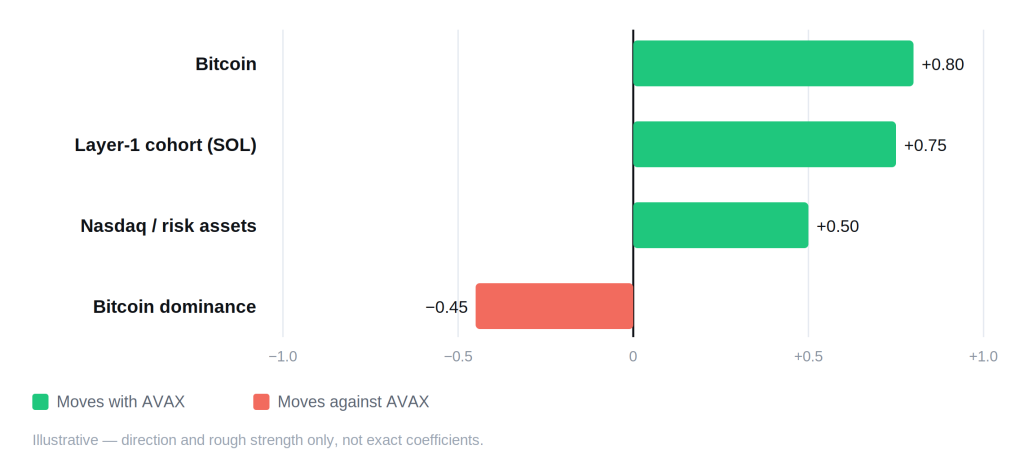
Avalanche trades as a high-beta layer-1, which means it usually amplifies Bitcoin’s moves in both directions and rises or falls with the rest of the smart-contract cohort. Its tightest peer link is Solana, and it tends to move as part of the broader “ETH alternatives” basket, so a rotation into or out of that group pulls AVAX along with it. When Bitcoin dominance climbs and capital concentrates in Bitcoin, AVAX and its layer-1 peers typically lag. Since institutions arrived, the token also tracks risk assets like the Nasdaq more closely, which is why Fed policy shows up quickly in the price. What sets AVAX apart from most alts is how reactive it has become to its own adoption headlines, tokenization deals, institutional L1 launches, and network milestones can move it independently of the broader tape. These are tendencies that drift over time, not fixed numbers.
Fundamental factors
Avalanche is a layer-1 smart-contract platform built around three coordinated chains: the C-Chain, an EVM-compatible chain that runs DeFi and most applications; the P-Chain, which manages staking and validators; and the X-Chain, which handles native asset transfers. It settles transactions using the Snowman consensus from Avalanche’s Snow family of protocols, a proof-of-stake design tuned for fast finality. The network was built by Ava Labs, co-founded by Cornell computer scientist Emin Gün Sirer along with Kevin Sekniqi and Ted Yin.
The defining shift of the current era is the Avalanche9000 upgrade, anchored by the Etna changes, which turned the old “subnets” model into what are now called Avalanche L1s and slashed the cost of launching one. Etna dropped the C-Chain minimum base fee from 25 nAVAX to 1 nAVAX and let independent L1s run their own validators through smart contracts instead of shouldering the full Primary Network burden. Cheaper, lighter custom chains are the pitch to institutional builders, and the adoption has followed: Securitize has tokenized hundreds of millions of dollars of assets on the network, Progmat migrated billions in securities to an Avalanche L1, Aave deployed its V4 release on Avalanche as its first chain after Ethereum, and Kenya’s examinations council anchored roughly 15 million academic records on the C-Chain. Gaming and real-world assets remain the two ecosystem themes management pushes hardest.
On supply, AVAX is capped at a maximum of 720 million tokens, with roughly 432 million in circulation as of August 2026. Every transaction burns a portion of its fee, which offsets new issuance, though emissions continue until the cap is reached, so the token is disinflationary rather than strictly scarce. Holders can stake AVAX to help secure the chain and earn a reward in the region of 6% to 7% a year, which locks up part of the float and thins the supply available to sell.
Upcoming catalysts
Only confirmed, dated events are listed. Because AVAX now moves with risk assets, U.S. monetary policy is the clearest near-term driver on the calendar.
| Date | Event | Potential impact |
|---|---|---|
| September 15–16, 2026 | FOMC meeting (with economic projections) | Bull if the Fed signals cuts; bear if it holds rates higher for longer |
| October 27–28, 2026 | FOMC meeting | Rate path steers risk appetite across the crypto market |
| December 8–9, 2026 | FOMC meeting (with economic projections) | Year-end policy signal that frames 2027 positioning |
| 2026 (no confirmed date) | Next Avalanche protocol milestone | Continued L1 and cost improvements; no mainnet date announced, so not treated as a dated catalyst |
FOMC dates follow the Federal Reserve’s published 2026 schedule. Avalanche’s next network milestone is listed without a date because none has been confirmed, and an invented date would be a guess rather than information.
Bull case vs bear case
Bull case:
- Real-world-asset and institutional deployments on Avalanche L1s keep growing, turning adoption into sustained demand for block space and AVAX.
- The Fed pivots to rate cuts and capital rotates back into higher-beta assets, where AVAX has historically outperformed.
- Cheaper L1 launches after Avalanche9000 pull more builders onto the network and away from rival chains.
- Staking continues to lock up a meaningful share of supply, tightening the tradable float.
Bear case:
- Rates stay higher for longer and the broad crypto market grinds sideways or lower, dragging high-beta alts down hardest.
- Rising Bitcoin dominance keeps capital in Bitcoin and starves the layer-1 cohort, AVAX included.
- Solana and other competitors capture the smart-contract and RWA mindshare Avalanche is chasing.
- Emissions keep adding supply faster than fee burns and staking can absorb.
Invalidation levels. The bull case loses its footing if AVAX loses the $5.97 floor on a daily-close basis, since that is the last defended support before open air below. The bear case is invalidated on a sustained reclaim of the 200-day EMA near $9.37, roughly 46% above the early-August price and the line that would confirm the downtrend is broken; the intermediate hurdles are $7.25 and the 100-day EMA near $7.48. The nearer downside trigger at $5.97 sits about 7% under spot.
Historical performance
Avalanche launched in September 2020 near $0.50, ran to its record high of about $146.22 in November 2021, then bled roughly 96% of that value over the years that followed. The story is not a steady climb but a violent boom and a long grind lower, with sharp counter-trend rallies in between. In August 2026 AVAX trades in single digits, below every major moving average, a fraction of what it once was. History says the token can move fast when the cycle turns, in both directions, and it owes no one a repeat of 2021.
Is Avalanche a good investment in 2026?
Start with what is measurable. AVAX trades around $6.40, some 96% below its record, below its 200-day average, with sentiment stuck in neutral-to-fear. PrimeXBT’s outlook sees it basing near current levels through 2026, an average near $6.40, before a slow cyclical recovery, so the near-term reads as accumulation-or-avoid rather than obvious upside. Against that, the network is winning real institutional and tokenization business that most of its rivals are not. Whether a deeply discounted asset with genuine adoption and an unproven price recovery is opportunity or trap depends on the holding period and the appetite for volatility. PrimeXBT’s explainer on what Avalanche is and how it works covers the fundamentals in more depth, and its Avalanche vs. Solana comparison weighs it against its closest peer.
How to trade Avalanche on PrimeXBT
On PrimeXBT you can take a position on Avalanche in either direction, whichever way you read the market. CFDs on AVAX can be traded long or short, so a bearish view is as tradable as a bullish one. Leverage magnifies gains and losses alike, which makes position sizing and a stop-loss part of the trade rather than an afterthought, especially on an asset as volatile as AVAX. Trade on your own analysis and risk tolerance, and never risk more than you can afford to lose.
Trading involves risk.
How we build this forecast
PrimeXBT’s analysts assemble this outlook rather than copying it from one price feed. We begin at where AVAX trades today, read its position against the 50- and 200-day moving averages and the support and resistance levels that matter, weigh the fundamentals, staking demand, the Avalanche9000 L1 model, and real-world-asset adoption, and set all of it against the macro backdrop, chiefly the path of U.S. interest rates. The yearly ranges fuse that technical read with the fundamental and macro picture; the long-range figures lean on trajectory rather than precision.
None of this is a guarantee. Crypto is volatile, the inputs change, and one macro or protocol surprise can move AVAX faster than any model expects. Treat every figure here as a considered estimate rather than a promise; we revisit and update the outlook each month as the data moves.
How much will AVAX be worth in 2026?
PrimeXBT's outlook is a range of $5.85–$7.20 for 2026, averaging near $6.40, a year of basing rather than a fresh trend.
How much will AVAX be worth in 2030?
The long-range view is a range of $9.20–$16.19, averaging near $12.50. Five-year numbers carry low confidence and should be read as a direction, not a target.
Can Avalanche reach $100?
Not within this forecast. The top of PrimeXBT's modeled range through 2030 sits well under $20, and $100 would require a cycle stronger than anything the current picture supports, close to the 2021 record of about $146. It is not impossible over a longer horizon, but it is not the base case.
Is Avalanche a good investment in 2026?
Mixed. The price is deeply discounted and the network is winning real institutional adoption, but the near-term outlook is flat and sentiment is cautious. The case runs both ways and depends on time horizon and risk tolerance.
What is the maximum supply of AVAX?
Avalanche is capped at 720 million AVAX, with roughly 432 million circulating as of August 2026. A share of every transaction fee is burned, which offsets new issuance over time.
Author



 Risk Disclaimer
The content provided here is for informational purposes only. It is not intended as personal investment advice and does not constitute a solicitation or invitation to engage in any financial transactions, investments, or related activities. Past performance is not a reliable indicator of future results.
The financial products offered by the Company are complex and come with a high risk of losing money rapidly due to leverage. These products may not be suitable for all investors. Before engaging, you should consider whether you understand how these leveraged products work and whether you can afford the high risk of losing your money.
The Company does not accept clients from the Restricted Jurisdictions as indicated in our website/ T&C. Some services or products may not be available in your jurisdiction.
The applicable legal entity and its respective products and services depend on the client’s country of residence and the entity with which the client has established a contractual relationship during registration.