14 min read
 NEAR Protocol (NEAR) is a layer-1 blockchain that runs smart contracts on a sharded proof-of-stake design, and since 2023 it has rebuilt its pitch around one idea: becoming the settlement layer for artificial intelligence. NEAR is the token that pays fees on that network and secures it through staking. In early August 2026 it trades near $1.60, more than 90% below its January 2022 record. This page lays out PrimeXBT’s price outlook for NEAR through 2030 and out to 2050, the levels traders are watching right now, and the events that could shift the picture. Numbers here are our own estimates expressed as ranges; where a decade-out forecast is closer to a guess than a projection, that is said plainly rather than dressed up.
NEAR Protocol outlook at a glance
- Current price: $5.041 per NEAR.
- 2026 base case: $1.45–$1.77, a year of basing near current levels rather than a trend reversal.
- Main bullish catalyst: a broad crypto risk-on turn on Fed rate cuts, amplified if NEAR’s “blockchain for AI” narrative pulls capital from the AI-token cohort.
- Biggest downside risk: a sustained loss of the $1.55 support, which opens the door back toward the $1.41 area, especially if rates stay high and Bitcoin dominance keeps climbing.
- Long-term view: our base case is a slow, uneven recovery well short of the old highs; the further out the year, the more the figures describe a direction than a destination.
Live NEAR Protocol price chart
Today (17 October 2026) NEAR Protocol (NEAR/USD) is trading at $5.041 per NEAR, with a market cap of $6,585,080,041 USD. The 24-hour trading volume amounts to $1,268,491,849 USD. NEAR price has changed by -5.40% in the last 24 hours. NEAR Protocol’s circulating supply is 1,309,163,649 NEAR.
Trading involves risk.
NEAR Protocol price prediction 2026–2030 (yearly forecast)
The table sets PrimeXBT’s expected range for NEAR in each year from 2026 to 2030. The far more optimistic long-horizon targets that circulate for NEAR rest on different assumptions and are kept out of this table; they sit in the analyst-comparison section below, where the disagreement can be seen for what it is.
| Year | Minimum | Average | Maximum |
|---|---|---|---|
| 2026 | $1.45 | $1.60 | $1.77 |
| 2027 | $1.51 | $1.88 | $2.30 |
| 2028 | $1.86 | $2.38 | $2.87 |
| 2029 | $1.71 | $2.22 | $2.74 |
| 2030 | $1.52 | $2.01 | $2.48 |
NEAR Protocol price prediction 2026
Our 2026 outlook holds NEAR close to its early-August level, an average near $1.60 across the remaining months and a full-year range of $1.45–$1.77. This is a basing year: price sits below its 50-day moving average but roughly on its 200-day line, the posture of a market that has stopped falling without yet turning up.
The month-by-month path for the rest of 2026 stays flat, drifting rather than trending:
| Month (2026) | Minimum | Average | Maximum |
|---|---|---|---|
| August | $1.47 | $1.60 | $1.73 |
| September | $1.46 | $1.59 | $1.72 |
| October | $1.45 | $1.58 | $1.71 |
| November | $1.46 | $1.60 | $1.74 |
| December | $1.47 | $1.62 | $1.77 |
NEAR Protocol price prediction 2027
2027 is where our model allows the first real recovery, with an average near $1.90 and a range of $1.51–$2.30. The lift rests on the broader market clearing its current cycle rather than on any single NEAR event, so the climb is gradual rather than vertical.
| Month (2027) | Minimum | Average | Maximum |
|---|---|---|---|
| January | $1.51 | $1.66 | $1.82 |
| February | $1.54 | $1.71 | $1.87 |
| March | $1.58 | $1.75 | $1.92 |
| April | $1.61 | $1.79 | $1.97 |
| May | $1.64 | $1.84 | $2.03 |
| June | $1.68 | $1.88 | $2.08 |
| July | $1.70 | $1.91 | $2.12 |
| August | $1.72 | $1.94 | $2.16 |
| September | $1.74 | $1.97 | $2.19 |
| October | $1.76 | $2.00 | $2.23 |
| November | $1.78 | $2.02 | $2.27 |
| December | $1.80 | $2.05 | $2.30 |
NEAR Protocol price prediction 2028
2028 carries the cycle high in our outlook, an average near $2.40 and a range of $1.86–$2.87. A new Bitcoin halving falls in this window, and high-beta layer-1 tokens like NEAR have historically run hardest in the quarters around it. This is the peak year in the five-year view.
| Month (2028) | Minimum | Average | Maximum |
|---|---|---|---|
| January | $1.86 | $2.12 | $2.39 |
| February | $1.91 | $2.19 | $2.48 |
| March | $1.97 | $2.27 | $2.56 |
| April | $2.03 | $2.34 | $2.65 |
| May | $2.08 | $2.41 | $2.74 |
| June | $2.14 | $2.48 | $2.83 |
| July | $2.15 | $2.51 | $2.87 |
| August | $2.13 | $2.49 | $2.85 |
| September | $2.10 | $2.47 | $2.83 |
| October | $2.08 | $2.44 | $2.81 |
| November | $2.05 | $2.42 | $2.79 |
| December | $2.03 | $2.40 | $2.77 |
NEAR Protocol price prediction 2029
2029 cools off after the peak, an average near $2.20 and a range of $1.71–$2.74. Post-cycle years have tended to hand back part of the advance rather than hold the top, and the monthly path reflects that gentle give-back.
| Month (2029) | Minimum | Average | Maximum |
|---|---|---|---|
| January | $1.99 | $2.37 | $2.74 |
| February | $1.96 | $2.34 | $2.71 |
| March | $1.93 | $2.31 | $2.68 |
| April | $1.90 | $2.28 | $2.66 |
| May | $1.87 | $2.25 | $2.63 |
| June | $1.84 | $2.22 | $2.60 |
| July | $1.81 | $2.19 | $2.57 |
| August | $1.79 | $2.17 | $2.56 |
| September | $1.77 | $2.15 | $2.54 |
| October | $1.75 | $2.14 | $2.53 |
| November | $1.73 | $2.12 | $2.51 |
| December | $1.71 | $2.10 | $2.49 |
NEAR Protocol price prediction 2030
Our 2030 view centers on an average near $2.00 within a range of $1.52–$2.48. Five years out, the outlook leans on trajectory, so read the monthly figures below as the shape of a path, not dated targets anyone can hold us to.
| Month (2030) | Minimum | Average | Maximum |
|---|---|---|---|
| January | $1.69 | $2.08 | $2.48 |
| February | $1.67 | $2.07 | $2.47 |
| March | $1.65 | $2.05 | $2.46 |
| April | $1.63 | $2.04 | $2.44 |
| May | $1.62 | $2.02 | $2.43 |
| June | $1.60 | $2.01 | $2.42 |
| July | $1.58 | $2.00 | $2.41 |
| August | $1.57 | $1.99 | $2.40 |
| September | $1.56 | $1.98 | $2.40 |
| October | $1.55 | $1.97 | $2.39 |
| November | $1.53 | $1.96 | $2.38 |
| December | $1.52 | $1.95 | $2.38 |
NEAR Protocol long-term price prediction: 2035, 2040–2050
Push the horizon past 2030 and precision collapses. Nobody can price where a smart-contract platform lands after another decade of halving cycles, AI adoption curves, and interest-rate regimes that have not been set yet, so treat the figures below as a slope rather than a set of prices. On our numbers the long-range path grinds higher in single digits, never snapping back toward the 2022 record:
| Year | Minimum | Average | Maximum |
|---|---|---|---|
| 2035 | $2.07 | $2.80 | $3.53 |
| 2040 | $2.58 | $3.80 | $5.02 |
| 2050 | $3.30 | $5.50 | $7.70 |
Our modeled averages work out near $2.80 in 2035, roughly $3.80 in 2040, and about $5.50 in 2050 — a recovery measured in years, not a return to the old peak.
What analysts and models say (compared)
NEAR forecasts split into two camps that barely overlap. Algorithmic aggregators that track recent price action sit close to spot, projecting NEAR in the low single digits through 2030. A second set of models extrapolates a full bull cycle and lands many times higher. Blending them would produce a number that no method actually supports, so they are laid out side by side.
| Source | Method | NEAR view |
|---|---|---|
| CoinCodex | Algorithmic | 2026 avg ~$1.59; 2030 avg ~$1.34 |
| Changelly | Algorithmic | 2026 avg ~$1.60; 2030 avg ~$1.35 |
| DigitalCoinPrice | Algorithmic | 2026 ~$11; 2030 avg ~$24.74 |
The gap is the point. Two of these models see NEAR essentially where it trades today five years out; the third sees a fifteen-fold move. They run on different inputs — one weights current momentum, the other assumes the next cycle carries NEAR back toward its former range — and there is no honest average of the two. Our own base case sits nearer the conservative camp, with a modest cyclical bump into 2028, because that is what NEAR’s actual trading behaviour over the past two years supports.
Track record of this forecast
This is PrimeXBT’s first published price outlook for NEAR Protocol. From the next monthly revision on, this section will hold the prior forecast up against NEAR’s real price on the update date, and where the call was wrong it will say why rather than quietly re-baseline.
NEAR Protocol technical analysis
NEAR trades below its 50-day moving average of about $1.89 and roughly on its 200-day average near $1.58 at the time of writing — a market that has arrested its decline but not yet reclaimed short-term momentum. The 14-day RSI sits near 38, in neutral territory but leaning weak, and the crypto Fear & Greed Index reads 29 (Fear).
The support and resistance levels in play now: support at $1.55, then a deeper floor near $1.41; resistance at $1.76, then the 50-day average at $1.89, with the round $2.00 level above that. Reclaiming $1.89 and holding it would be the first technical sign that the short-term trend has flipped up; losing $1.55 on a closing basis would put the $1.41 floor back in question. A primer on reading these signals lives in PrimeXBT’s guide to crypto technical analysis.
Correlation with other assets
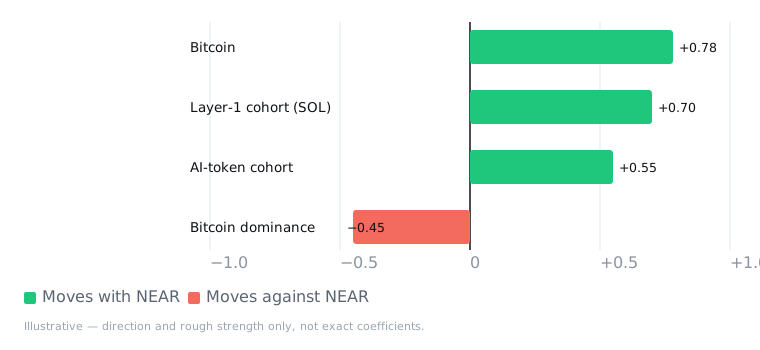
NEAR trades as a high-beta bet on Bitcoin’s direction, but with a second engine most large caps lack. As a layer-1 it rises and falls with the broader altcoin and layer-1 cohort — Solana and its peers move in the same rhythm — and it loses ground fast when capital rotates into Bitcoin and Bitcoin dominance climbs. The wrinkle is NEAR’s AI positioning: because the project sells itself as the chain for AI, headlines and sentiment around AI tokens tend to drag NEAR with them, tightening its link to that narrative cohort. Against equities it behaves like a risk asset, tracking the Nasdaq more closely since institutions entered crypto, which is why Fed policy shows up quickly in its price. There is no gold or dollar-index story here worth trading — those relationships are noise for NEAR. Every link above is a tendency that shifts as the market re-prices, not a number you can pin to the calendar.
Fundamental factors
NEAR Protocol is a sharded proof-of-stake layer-1 built for high throughput and low fees. Its sharding design, Nightshade, splits the network so it can process transactions in parallel rather than forcing everything through one chain, and human-readable account names (yours might be a plain word, not a hex string) lower the barrier for ordinary users. It was founded in 2017 by Illia Polosukhin and Alexander Skidanov, with mainnet live since April 2020. Polosukhin’s background matters to the current story: he co-authored Google’s 2017 “Attention Is All You Need,” the paper that introduced the transformer architecture behind modern AI — the credential NEAR now leans on as it repositions as user-owned AI infrastructure.
Two pieces of that repositioning carry the fundamental case. Chain Abstraction and intents aim to let a user act across many blockchains from one NEAR account without touching bridges, and Aurora gives the ecosystem an Ethereum-compatible (EVM) layer so existing Solidity apps can deploy. On tokenomics, NEAR has no hard supply cap. The protocol issues roughly 5% new NEAR a year to fund staking rewards for validators, while a portion of transaction fees is burned, so net inflation runs a touch below the gross rate and tightens when the network is busy. Circulating supply is about 1.3 billion NEAR. There is an active governance debate about trimming that issuance, which would matter for holders, but no change is confirmed at the time of writing, so the current ~5% rate is what our outlook assumes.
Upcoming catalysts
Only confirmed, dated events appear here. For NEAR the clearest near-term drivers are macro, because the token now moves with risk appetite across the whole crypto market.
| Date | Event | Potential impact |
|---|---|---|
| September 15–16, 2026 | FOMC meeting (with economic projections) | Bull if the Fed signals cuts; bear if it holds rates higher for longer |
| October 27–28, 2026 | FOMC meeting | Rate path steers risk appetite across altcoins, NEAR included |
| December 8–9, 2026 | FOMC meeting (with economic projections) | Year-end policy signal that frames 2027 positioning |
These dates follow the Federal Reserve’s published 2026 schedule. No NEAR-specific event — a network upgrade, a token-issuance change, or a headline AI partnership — has a confirmed date at the time of writing, so none is listed; an invented date would be a guess, not information.
Bull case vs bear case
Bull case:
- The Fed pivots to cuts and capital rotates back into high-beta alts, where NEAR carries more upside than large caps.
- The AI-crypto narrative catches a second wind and NEAR captures flows as the layer-1 most tied to it.
- Chain Abstraction and Aurora pull real usage on-chain, giving the token a demand story beyond speculation.
- A reduction in NEAR’s ~5% issuance passes governance, thinning future supply.
Bear case:
- Rates stay high, Bitcoin dominance keeps climbing, and altcoins including NEAR keep bleeding relative to BTC.
- The AI-token trade unwinds, and NEAR gets sold with the cohort it chose to align with.
- Persistent ~5% inflation outruns on-chain fee burning, so supply grows faster than demand.
- Price loses the $1.55 support and drifts toward the $1.41 floor with sentiment stuck in Fear.
Invalidation levels. The bull case weakens on a decisive close below $1.55, and a break of $1.41 would confirm the sellers have the tape. The bear case is invalidated when NEAR reclaims its 50-day average at $1.89 and holds it, with a push through $2.00 turning the near-term structure constructive.
Historical performance
NEAR’s chart is a story of one violent cycle. From an all-time low of about $0.53 in November 2020 it ran to a record $20.44 on January 16, 2022 — a move of nearly 40x — then gave almost all of it back, and it trades roughly 92% below that peak today. The token has never revisited its highs the way some peers have; each attempt has faded. What the history argues is caution about straight-line recoveries, not that another cycle is impossible.
Is NEAR Protocol a good investment in 2026?
That comes down to how long you are willing to wait and how much drawdown you can stomach. Our outlook sees NEAR basing near $1.60 through 2026 before a modest cyclical recovery, not a fast return to former glory. The bull thesis leans almost entirely on the AI narrative paying off and on a broad risk-on turn; the bear thesis needs neither, only for rates and Bitcoin dominance to stay where they are. NEAR sits below its 50-day average with fearful sentiment and steady token issuance working against it, but with a genuine technology story and a founder credential few competitors can match. Whether that balance reads as cheap or as a value trap is a judgment the reader has to make. PrimeXBT’s explainer on what NEAR Protocol is and how it works covers the mechanics behind the debate.
How to trade NEAR Protocol on PrimeXBT
On PrimeXBT you can take a position on NEAR in either direction. CFDs on NEAR can be traded long or short, so a bearish view is as tradable as a bullish one — see the basics of short selling if that is new to you. Leverage enlarges gains and losses alike, which makes position sizing and a stop-loss part of the trade, not an afterthought. Trade on your own analysis and risk tolerance, and never stake more than you can afford to lose.
Trading involves risk.
How we build this forecast
This outlook is assembled by PrimeXBT’s analysts rather than copied from one price feed. We start from where NEAR trades today, read it against its 50- and 200-day moving averages and the support and resistance levels that matter now, weigh the fundamentals — the sharded proof-of-stake design, the AI positioning, staking demand, and ~5% issuance — and set all of it against the macro backdrop, chiefly the path of U.S. interest rates and Bitcoin dominance. The yearly ranges fuse that technical read with the fundamental and macro picture; the long-range figures lean on trajectory over precision.
None of this is a promise. NEAR is volatile, its inputs move, and a single macro or AI-narrative surprise can shift it faster than any model expects. Treat every figure as a considered estimate, not a guarantee — we revisit and update this outlook each month as the data changes.
How much will NEAR Protocol be worth in 2026?
Our outlook puts NEAR at $1.45–$1.77 for 2026, averaging near $1.60. It reads as a basing year rather than a breakout.
How much will NEAR Protocol be worth in 2030?
Our 2030 view is $1.52–$2.48, averaging near $2.00. A crypto forecast this far out carries heavy uncertainty, so weigh it as a direction, not a fixed target.
Can NEAR Protocol reach $100?
Not on our numbers. NEAR has never traded above about $20, its January 2022 record, and our long-range path tops out near $5.50 by 2050. Reaching $100 would require a cycle far beyond anything in the current data.
Is NEAR Protocol a good investment in 2026?
It is a mixed picture: a price below its long-term average, fearful sentiment, and steady issuance on one side; a real AI-infrastructure story and a modest projected recovery on the other. The case runs both ways.
Why is NEAR called a blockchain for AI?
NEAR has repositioned around artificial intelligence, marketing itself as infrastructure for user-owned AI, and its co-founder Illia Polosukhin co-authored the 2017 transformer paper behind modern AI models. That framing is why NEAR's price tends to move with AI-token sentiment.
Author



 Risk Disclaimer
The content provided here is for informational purposes only. It is not intended as personal investment advice and does not constitute a solicitation or invitation to engage in any financial transactions, investments, or related activities. Past performance is not a reliable indicator of future results.
The financial products offered by the Company are complex and come with a high risk of losing money rapidly due to leverage. These products may not be suitable for all investors. Before engaging, you should consider whether you understand how these leveraged products work and whether you can afford the high risk of losing your money.
The Company does not accept clients from the Restricted Jurisdictions as indicated in our website/ T&C. Some services or products may not be available in your jurisdiction.
The applicable legal entity and its respective products and services depend on the client’s country of residence and the entity with which the client has established a contractual relationship during registration.