14 min read
 Zcash (ZEC) trades near $850 in late August 2026, a level it last saw in early 2018 and reached again only after a roughly tenfold run over the summer. ZEC is the token of the Zcash blockchain, a privacy-focused, proof-of-work cryptocurrency that uses zk-SNARK zero-knowledge proofs to let users send fully shielded transactions while the chain stays verifiable. This page lays out PrimeXBT’s price outlook for ZEC through 2030 and out to 2050, the technical levels that matter after such a fast move, and the privacy-coin catalysts capable of extending or ending it. Figures are given as ranges, and where a decade-out number is little more than a direction, the text says so plainly.
Zcash outlook at a glance
- 2026 base case: $763.20–$1,026.15 — a year that has already delivered its explosive leg, with the forward months more about holding gains than extending them.
- Main bullish catalyst: the pending conversion of the Grayscale Zcash Trust into an ETF and open institutional accumulation of ZEC as a private store of value, with a network halving due in late 2028.
- Biggest downside risk: a momentum unwind after an overbought sprint, with a close back below the $800 breakout and then the $730 support turning the parabola into a retrace.
- Long-term view: the privacy-store-of-value thesis supports a multi-year uptrend, but targets beyond 2030 are broad scenarios shaped by regulation and adoption, not precise price points.
Live Zcash price chart
The chart below tracks ZEC/USD in real time; the levels worth watching after this summer’s move are set out in the technical section further down.
Trading involves risk.
Zcash price prediction 2026–2030 (yearly forecast)
The table below sets PrimeXBT’s expected range for each year. The far more aggressive multi-year targets published by some models and investors rest on different assumptions and are kept separate in the analyst section rather than blended in here.
| Year | Minimum | Average | Maximum |
|---|---|---|---|
| 2026 | $763.20 | $884.40 | $1,026.15 |
| 2027 | $848.25 | $1,211.75 | $1,719.08 |
| 2028 | $1,267.69 | $1,661.68 | $2,096.01 |
| 2029 | $1,119.23 | $1,542.94 | $1,927.28 |
| 2030 | $1,015.00 | $1,471.47 | $1,885.00 |
Zcash price prediction 2026
Our 2026 view runs $763.20–$1,026.15. Most of the year’s work is done: ZEC entered late August near $850 after multiplying roughly tenfold from its spring levels, so the forward months read as consolidation of an outsized gain rather than the start of a fresh leg. A pause, or a partial giveback, would be the healthier outcome after a move that carried the RSI deep into overbought territory.
| Month (2026) | Minimum | Average | Maximum |
|---|---|---|---|
| August | $763.20 | $848.00 | $932.80 |
| September | $776.52 | $866.50 | $956.48 |
| October | $789.69 | $885.00 | $980.31 |
| November | $801.84 | $902.50 | $1,003.16 |
| December | $813.85 | $920.00 | $1,026.15 |
Zcash price prediction 2027
2027 is where the outlook expects the market to decide whether the privacy-store-of-value narrative is a cycle or a re-rating. Our range for the year is $848.25–$1,719.08, a step up from 2026 that leans on continued institutional accumulation and ETF-driven access rather than another retail melt-up.
| Month (2027) | Minimum | Average | Maximum |
|---|---|---|---|
| January | $848.25 | $963.08 | $1,077.91 |
| February | $882.32 | $1,006.15 | $1,129.99 |
| March | $916.06 | $1,049.23 | $1,182.40 |
| April | $949.47 | $1,092.31 | $1,235.15 |
| May | $982.54 | $1,135.38 | $1,288.22 |
| June | $1,015.29 | $1,178.46 | $1,341.63 |
| July | $1,051.06 | $1,225.45 | $1,399.85 |
| August | $1,089.82 | $1,276.36 | $1,462.91 |
| September | $1,128.18 | $1,327.27 | $1,526.36 |
| October | $1,166.15 | $1,378.18 | $1,590.21 |
| November | $1,203.73 | $1,429.09 | $1,654.45 |
| December | $1,240.92 | $1,480.00 | $1,719.08 |
Zcash price prediction 2028
2028 carries the cycle high in our model, at $1,267.69–$2,096.01. Two forces line up in the same window: the third Zcash halving, expected around November 2028, which cuts new issuance again, and a crypto cycle that has historically peaked in the year of or after a supply cut. The path rises into the halving and eases afterward rather than holding a permanent plateau.
| Month (2028) | Minimum | Average | Maximum |
|---|---|---|---|
| January | $1,273.75 | $1,526.15 | $1,778.56 |
| February | $1,306.22 | $1,572.31 | $1,838.39 |
| March | $1,338.34 | $1,618.46 | $1,898.58 |
| April | $1,370.11 | $1,664.62 | $1,959.12 |
| May | $1,401.51 | $1,710.77 | $2,020.02 |
| June | $1,432.57 | $1,756.92 | $2,081.28 |
| July | $1,431.26 | $1,763.64 | $2,096.01 |
| August | $1,398.04 | $1,730.91 | $2,063.78 |
| September | $1,365.08 | $1,698.18 | $2,031.29 |
| October | $1,332.36 | $1,665.45 | $1,998.55 |
| November | $1,299.90 | $1,632.73 | $1,965.55 |
| December | $1,267.69 | $1,600.00 | $1,932.31 |
Zcash price prediction 2029
2029 is the cool-down. Our range settles to $1,119.23–$1,927.28, a controlled retreat from the 2028 high as post-halving euphoria fades and the market digests the prior year’s gains. Nothing about the fundamental case has to break for this to happen; cycles give back part of a peak as a matter of course.
| Month (2029) | Minimum | Average | Maximum |
|---|---|---|---|
| January | $1,254.26 | $1,590.77 | $1,927.28 |
| February | $1,240.90 | $1,581.54 | $1,922.18 |
| March | $1,227.61 | $1,572.31 | $1,917.01 |
| April | $1,214.39 | $1,563.08 | $1,911.76 |
| May | $1,201.24 | $1,553.85 | $1,906.45 |
| June | $1,188.17 | $1,544.62 | $1,901.07 |
| July | $1,175.91 | $1,536.36 | $1,896.82 |
| August | $1,164.46 | $1,529.09 | $1,893.72 |
| September | $1,153.07 | $1,521.82 | $1,890.57 |
| October | $1,141.73 | $1,514.55 | $1,887.36 |
| November | $1,130.45 | $1,507.27 | $1,884.09 |
| December | $1,119.23 | $1,500.00 | $1,880.77 |
Zcash price prediction 2030
Our 2030 view spans $1,015.00–$1,885.00. Five years out, the outlook rests on the direction of privacy demand and regulatory tolerance more than on any single level, so treat the month-by-month path below as a trajectory rather than a set of dated targets.
| Month (2030) | Minimum | Average | Maximum |
|---|---|---|---|
| January | $1,110.04 | $1,495.38 | $1,880.73 |
| February | $1,100.88 | $1,490.77 | $1,880.66 |
| March | $1,091.75 | $1,486.15 | $1,880.56 |
| April | $1,082.66 | $1,481.54 | $1,880.41 |
| May | $1,073.61 | $1,476.92 | $1,880.24 |
| June | $1,064.59 | $1,472.31 | $1,880.02 |
| July | $1,055.96 | $1,468.18 | $1,880.40 |
| August | $1,047.71 | $1,464.55 | $1,881.38 |
| September | $1,039.49 | $1,460.91 | $1,882.33 |
| October | $1,031.30 | $1,457.27 | $1,883.24 |
| November | $1,023.14 | $1,453.64 | $1,884.14 |
| December | $1,015.00 | $1,450.00 | $1,885.00 |
Zcash long-term price prediction: 2035, 2040–2050
No model can honestly price where a privacy coin sits after a decade of regulatory swings, competing protocols, and macro regimes that have not happened yet. The figures below are a slope, not a promise, and the error bars widen with every year added. On that understanding, our long-range path drifts higher as the shielded-asset thesis matures, without pretending to know the exact number:
| Year | Minimum | Average | Maximum |
|---|---|---|---|
| 2035 | $1,221.00 | $1,850.00 | $2,479.00 |
| 2040 | $1,410.00 | $2,350.00 | $3,290.00 |
| 2050 | $1,728.00 | $3,200.00 | $4,672.00 |
What analysts and models say (compared)
Few coins split forecasters as sharply as Zcash does right now. Algorithmic trackers range from models still anchored to pre-rally prices to ones extrapolating the parabola into five figures, and the institutional case is framed as a multiple of Bitcoin rather than a dollar target. Averaging inputs built on such different premises would mislead, so they sit side by side.
| Source | Method | Zcash view |
|---|---|---|
| CoinCodex | Algorithmic | ~$1,386 for 2026; ~$5,362 by 2030 |
| Coinpedia | Editorial / model blend | 2026 ~$700 (range $480–$1,000); 2030 ~$5,500 |
| Changelly | Algorithmic | 2026 avg ~$546; 2030 avg ~$2,716 |
| Grayscale | Institutional thesis | ZEC is ~0.3% of “currency” crypto; a 5% share implies roughly an 18x re-rating |
| Arthur Hayes (BitMEX co-founder) | Institutional, structural | Frames a path to ZEC reaching ~10% of Bitcoin’s market cap |
The spread is the point. The bullish institutional voices argue from scarcity and store-of-value share, not chart extrapolation: Grayscale Chairman Barry Silbert has argued investors who once mistook Bitcoin for private money are only now finding the coin that actually shields balances, while Multicoin Capital’s Tushar Jain has staked a public position on ZEC as “the main private” store of value. Anyone looking for a single agreed number will not find one here, and our own base case sits deliberately below the loudest bulls.
Track record of this forecast
This is the first published PrimeXBT price forecast for Zcash. Starting with the next monthly review, this section will hold the prior forecast up against ZEC’s actual price on the update date and account for any gap instead of quietly revising it away.
Zcash technical analysis
Zcash trades far above both of its most-watched moving averages, a structure that only appears after a violent trend change. At the time of writing the 50-day simple moving average sits near $520 and the 200-day near $405, with the 50-day having crossed above the 200-day to complete a golden cross. Price above both, and both rising, confirms an uptrend; the distance between price and those averages also flags how stretched the move is. The RSI pushed toward 88, an overbought reading that historically precedes either a pause or a sharp reset.
The support and resistance levels that matter now: resistance clusters at $850–$870, then the recent high near $883–$888, with $900 the next psychological test and breakout projections pointing to $920 and $1,080. Support starts at $820–$830, then the $800 line that ZEC reclaimed for the first time since 2018, with a deeper shelf around $730–$750. Price has been compressing near $840 in a tightening range, buyers defending the lower edge while sellers cap the $850–$870 band. For readers new to these tools, PrimeXBT’s guide to crypto technical analysis covers how to read them.
Correlation with other assets
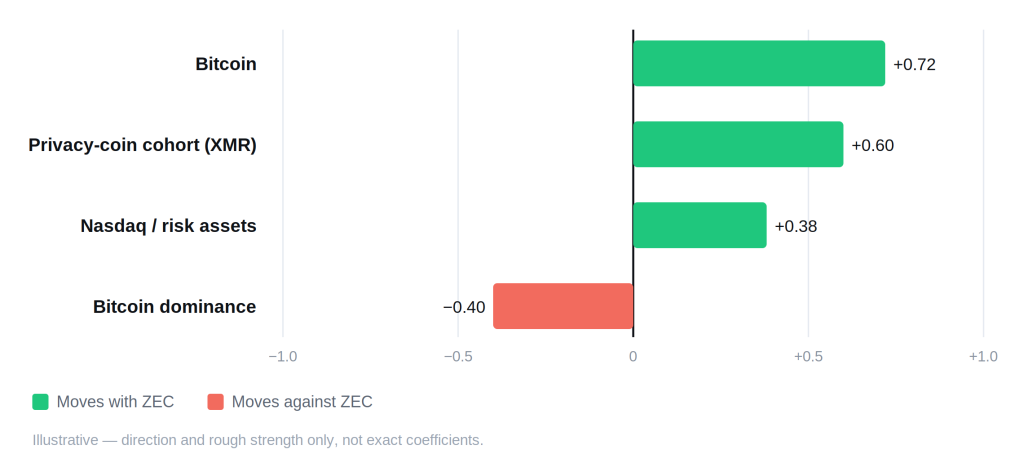
Zcash carries the DNA of two families at once. As a 21-million-capped, proof-of-work coin, it tracks Bitcoin closely through the mining economy and the shared “digital hard money” story, and it moves with the broader privacy cohort, Monero above all, when regulators or surveillance headlines put anonymity back in play. Against risk assets like the Nasdaq the link is looser, tightening only when a macro shock drags every risk market the same way. And like most alts, ZEC runs inverse to Bitcoin dominance, gaining when capital rotates out of Bitcoin into alternatives. The wrinkle specific to Zcash: a strong privacy narrative can snap those links entirely, as it did this summer, when ZEC ran multiples while Bitcoin barely moved. Correlations here are tendencies that hold until the privacy trade overrides them.
Fundamental factors
Zcash borrows Bitcoin’s monetary spine and adds real privacy on top. Supply is capped at 21 million ZEC, with roughly 16.9 million, about 80%, already circulating, and issuance falls on the same four-year halving schedule. The second halving, in November 2024, cut the block reward to 1.5625 ZEC; the third, expected around November 2028, halves it again to 0.78125. What sets ZEC apart is the shielded pool: zk-SNARK proofs let holders move funds without exposing sender, receiver, or amount, and the share of supply held in shielded addresses has been climbing, thinning the liquid float that trades on exchanges.
The 2025–2026 rally turned that mechanism into a story institutions could buy. Grayscale’s move to convert its Zcash Trust into an ETF put a regulated wrapper within reach, echoing the access shift a Bitcoin ETF once delivered. Cypherpunk Technologies, backed by Gemini co-founder Tyler Winklevoss, accumulated close to 295,000 ZEC, about 1.78% of supply, and has signaled a target near 5%. The framing across these buyers is consistent: ZEC as the private counterpart to Bitcoin’s digital gold, valuable precisely as taxation, wealth-seizure proposals, and AI-driven surveillance make on-chain transparency a liability. The obvious counterweight is regulatory. Privacy coins have been delisted from some regulated venues before, and any exchange or jurisdiction that restricts shielded assets removes demand at the source, which is why the same feature driving the bull case doubles as the sharpest risk.
Upcoming catalysts
Only confirmed, dated events are listed. Macro policy remains the clearest near-term swing factor, since Fed decisions still set the risk appetite that even a decoupled ZEC eventually answers to.
| Date | Event | Potential impact |
|---|---|---|
| September 15–16, 2026 | FOMC meeting (with economic projections) | Bull if the Fed signals cuts; bear if it holds rates higher for longer |
| October 27–28, 2026 | FOMC meeting | Rate path steers risk appetite across crypto |
| December 8–9, 2026 | FOMC meeting (with economic projections) | Year-end policy signal for 2027 positioning |
| Expected November 2028 | Third Zcash halving (block reward to 0.78125 ZEC) | Cuts new issuance again; timing is set by block height, not a fixed calendar date |
FOMC dates follow the Federal Reserve’s published 2026 schedule. The halving is shown without an exact day because its timing depends on block height rather than the calendar; a precise date would be a guess. The Grayscale ETF conversion is a live driver but carries no confirmed effective date at the time of writing, so it stays in the fundamentals discussion rather than this table.
Bull case vs bear case
Bull case:
- The Grayscale Zcash ETF conversion completes, opening regulated, at-scale institutional demand.
- Named buyers keep accumulating ZEC as a private store of value, tightening an already thin liquid float.
- Surveillance, tax, and wealth-seizure headlines keep the privacy narrative front of mind.
- The late-2028 halving cuts issuance into a market that has learned to price the story.
Bear case:
- An overbought sprint unwinds, and momentum traders exit as fast as they arrived.
- Regulators restrict or delist shielded assets on major venues, cutting demand at the source.
- The ETF conversion stalls or disappoints against expectations now priced in.
- Broad risk-off pressure pulls crypto lower and ZEC gives back its outperformance.
Invalidation levels. The bull case weakens on a decisive close back below $800, the 2018 breakout line, and turns outright fragile beneath the $730–$750 shelf. The bear case is invalidated on a sustained break above the $883–$888 high, which would put $900 and then the $920–$1,080 projection zone back in play. Both triggers come straight from the technical section above.
Historical performance
Zcash’s chart is a study in extremes. Its nominal record, listed between roughly $3,200 and $5,900 depending on the tracker, was printed on October 29, 2016, in the coin’s first hours of trading, when almost no supply was liquid and a handful of orders sent the price to figures that collapsed within days. The honest benchmark is the January 2018 peak near $875, the high of the last privacy-coin cycle, a level ZEC is testing again for the first time in about eight years. Between those poles it spent years grinding down, bottoming near $16 in mid-2024 before this year’s move multiplied it many times over. The pattern is violent boom and long bust, and no cycle is required to rhyme with the last.
Is Zcash a good investment in 2026?
Zcash in 2026 is a high-conviction bet on one idea: that on-chain privacy becomes scarce and valuable as everything else gets watched. The case for it is unusually concrete right now, real institutional buyers, a regulated ETF wrapper in progress, a fixed 21-million cap, and a shrinking liquid float. The case against it is written in the same chart, an asset up roughly tenfold in weeks, RSI near 88, and a regulatory profile that can turn hostile with a single delisting. Our base case holds ZEC broadly around current levels into year-end rather than extending the parabola, so whether that reads as an entry or a warning depends entirely on time horizon and tolerance for a coin that moves in multiples.
How to trade the privacy-coin theme on PrimeXBT
PrimeXBT offers CFDs across a broad range of cryptocurrencies, traded long or short, so a position can profit whether the privacy trade extends or retraces. Going short lets a trader act on the overbought-reset scenario as readily as the breakout. Leverage magnifies gains and losses alike, so on an asset this volatile, position sizing and a stop-loss carry more weight than the entry itself. Trade on your own analysis and risk tolerance, and never risk more than you can afford to lose.
Trading involves risk.
How we build this forecast
This outlook is assembled by PrimeXBT’s analysts rather than pulled from one price feed. We start from where ZEC trades today, weigh its position against the 50- and 200-day moving averages and the support and resistance that formed during the run, read the fundamentals, the shielded-pool dynamics, the halving schedule, the ETF and accumulation story, and set all of it against the macro backdrop and the specific regulatory risk that privacy coins carry. The yearly ranges fold that technical read into the fundamental and macro picture; the long-range figures lean on trajectory over precision.
None of it is a guarantee. Zcash is more volatile than most, the inputs shift week to week, and a single regulatory headline can move it faster than any model expects. Treat every figure here as a considered estimate rather than a promise, and note that we revisit and update this outlook monthly as the data changes.
Author



 Risk Disclaimer
The content provided here is for informational purposes only. It is not intended as personal investment advice and does not constitute a solicitation or invitation to engage in any financial transactions, investments, or related activities. Past performance is not a reliable indicator of future results.
The financial products offered by the Company are complex and come with a high risk of losing money rapidly due to leverage. These products may not be suitable for all investors. Before engaging, you should consider whether you understand how these leveraged products work and whether you can afford the high risk of losing your money.
The Company does not accept clients from the Restricted Jurisdictions as indicated in our website/ T&C. Some services or products may not be available in your jurisdiction.
The applicable legal entity and its respective products and services depend on the client’s country of residence and the entity with which the client has established a contractual relationship during registration.