14 min read
 Theta Network (THETA) is the governance and staking token of a decentralized video-streaming and edge-computing network, where users share spare bandwidth and GPU power in exchange for rewards. It runs a two-token system: THETA secures the chain and votes on governance, while a separate token, TFUEL, pays for streaming and compute. THETA trades far below its 2021 peak in August 2026, and its story now hinges less on video delivery than on Theta EdgeCloud, the network’s push into GPU compute for artificial-intelligence workloads. This page lays out PrimeXBT’s price outlook for THETA through 2030 and out to 2050, the technical levels traders are watching now, and the catalysts that could shift the trend. Every figure here is PrimeXBT’s own estimate, and each is a range because a small-cap coin this far below its peak does not lend itself to precise numbers.
Theta Network outlook at a glance
- Current price: $0.2139 per THETA.
- 2026 base case: $0.130–$0.188, a slow grind off multi-year lows rather than a new bull run.
- Main bullish catalyst: paying enterprise demand for Theta EdgeCloud GPU compute, which ties THETA to the DePIN and AI-infrastructure narrative.
- Biggest downside risk: a small-cap altcoin in a fearful market losing its $0.131 support, which would open the door back toward the yearly lows.
- Long-term view: a gradual recovery is the base case into the 2030s, but anything past 2030 is a broad scenario, not a dated target.
Live Theta price chart
Today (7 October 2026) Theta Network (THETA/USD) is trading at $0.2139 per THETA, with a market cap of $216,411,989 USD. The 24-hour trading volume amounts to $6,224,331 USD. THETA price has changed by -9.63% in the last 24 hours. Theta Network’s circulating supply is 1,000,000,000 THETA.
Trading involves risk.
Theta price prediction 2026–2030 (yearly forecast)
The table below sets our expected range for each year, built from a single continuous monthly path. The far-apart institutional and algorithmic targets, which rest on clashing assumptions, are kept in the analyst section rather than averaged in here.
| Year | Minimum | Average | Maximum |
|---|---|---|---|
| 2026 | $0.130 | $0.156 | $0.188 |
| 2027 | $0.163 | $0.217 | $0.281 |
| 2028 | $0.225 | $0.282 | $0.336 |
| 2029 | $0.203 | $0.263 | $0.326 |
| 2030 | $0.183 | $0.241 | $0.296 |
Theta price prediction 2026
Our 2026 outlook keeps THETA close to its August level near $0.14, with an average near $0.16 across the rest of the year. That is a modest lift off the lows, not a breakout: the token sits between its 50- and 200-day averages, sentiment reads as fear, and nothing in the current data supports a fast move higher. The forward-month path holds a narrow, slightly rising band into December.
| Month (2026) | Minimum | Average | Maximum |
|---|---|---|---|
| August | $0.130 | $0.141 | $0.152 |
| September | $0.136 | $0.148 | $0.160 |
| October | $0.142 | $0.155 | $0.168 |
| November | $0.149 | $0.163 | $0.178 |
| December | $0.156 | $0.172 | $0.188 |
Theta price prediction 2027
2027 is the first recovery leg in our model, with an average near $0.22. The step up leans on EdgeCloud converting pilots into recurring compute revenue and on the broader altcoin market finding a firmer footing after 2026. A single quarter of strong AI-compute demand would do more for THETA here than any macro tailwind.
| Month (2027) | Minimum | Average | Maximum |
|---|---|---|---|
| January | $0.163 | $0.179 | $0.196 |
| February | $0.169 | $0.187 | $0.205 |
| March | $0.175 | $0.194 | $0.213 |
| April | $0.181 | $0.202 | $0.222 |
| May | $0.187 | $0.209 | $0.231 |
| June | $0.193 | $0.216 | $0.239 |
| July | $0.198 | $0.223 | $0.247 |
| August | $0.203 | $0.228 | $0.254 |
| September | $0.207 | $0.234 | $0.261 |
| October | $0.211 | $0.239 | $0.267 |
| November | $0.215 | $0.245 | $0.274 |
| December | $0.219 | $0.250 | $0.281 |
Theta price prediction 2028
2028 holds the cycle high in our outlook, averaging near $0.29. This is the window where a post-halving altcoin rotation and maturing EdgeCloud adoption could overlap, and it is where our path peaks before easing. Even so, the modeled top stays well under $0.35 and a long way below the old record.
| Month (2028) | Minimum | Average | Maximum |
|---|---|---|---|
| January | $0.225 | $0.257 | $0.289 |
| February | $0.230 | $0.264 | $0.298 |
| March | $0.235 | $0.271 | $0.306 |
| April | $0.241 | $0.278 | $0.315 |
| May | $0.246 | $0.285 | $0.323 |
| June | $0.251 | $0.292 | $0.332 |
| July | $0.252 | $0.294 | $0.336 |
| August | $0.250 | $0.292 | $0.335 |
| September | $0.248 | $0.290 | $0.333 |
| October | $0.245 | $0.289 | $0.332 |
| November | $0.243 | $0.287 | $0.331 |
| December | $0.241 | $0.285 | $0.329 |
Theta price prediction 2029
2029 is the cool-down after the peak, with an average near $0.26. A gentle drift lower through the year is the base case as speculative demand fades and the token settles into a range supported by whatever real EdgeCloud usage has stuck.
| Month (2029) | Minimum | Average | Maximum |
|---|---|---|---|
| January | $0.237 | $0.281 | $0.326 |
| February | $0.233 | $0.277 | $0.322 |
| March | $0.229 | $0.273 | $0.318 |
| April | $0.225 | $0.270 | $0.314 |
| May | $0.221 | $0.266 | $0.311 |
| June | $0.217 | $0.262 | $0.307 |
| July | $0.214 | $0.259 | $0.304 |
| August | $0.212 | $0.257 | $0.303 |
| September | $0.210 | $0.255 | $0.301 |
| October | $0.207 | $0.254 | $0.300 |
| November | $0.205 | $0.252 | $0.298 |
| December | $0.203 | $0.250 | $0.297 |
Theta price prediction 2030
Our 2030 view averages near $0.24. Five years out, trajectory matters more than any single figure, so read the month-by-month path as a shape rather than a set of dated targets. The direction is a token that has recovered meaningfully from 2026 without reclaiming its speculative-era highs.
| Month (2030) | Minimum | Average | Maximum |
|---|---|---|---|
| January | $0.201 | $0.248 | $0.296 |
| February | $0.199 | $0.247 | $0.295 |
| March | $0.197 | $0.245 | $0.293 |
| April | $0.195 | $0.244 | $0.292 |
| May | $0.194 | $0.242 | $0.291 |
| June | $0.192 | $0.241 | $0.290 |
| July | $0.190 | $0.240 | $0.289 |
| August | $0.189 | $0.239 | $0.289 |
| September | $0.187 | $0.238 | $0.288 |
| October | $0.186 | $0.237 | $0.288 |
| November | $0.185 | $0.236 | $0.287 |
| December | $0.183 | $0.235 | $0.287 |
Theta long-term price prediction: 2035, 2040–2050
A ten-to-twenty-year price tag on any crypto is closer to a bet than a forecast. No model can price a decade of AI-infrastructure competition, halving cycles, and macro regimes that do not exist yet, and THETA’s small size makes it more sensitive to all three than a large-cap coin would be. Read the table as a rough upward drift, with error bars that widen every year:
| Year | Minimum | Average | Maximum |
|---|---|---|---|
| 2035 | $0.259 | $0.350 | $0.441 |
| 2040 | $0.340 | $0.500 | $0.660 |
| 2050 | $0.480 | $0.800 | $1.120 |
Our long-range path assumes Theta stays a going concern and EdgeCloud keeps winning some share of decentralized AI compute. If that thesis breaks, these figures are too high; if EdgeCloud becomes a genuine player in the GPU market, they are too low. Both outcomes are live.
What analysts and models say (compared)
Forecasts for THETA disagree more than for almost any coin its size. Algorithmic models split between outright decline and a multiple-x recovery, and no institutional bank publishes a Theta target at all, so there is no adult in the room to anchor the range. Averaging these would invent a consensus that does not exist.
| Source | Method | Theta view (2026 unless noted) |
|---|---|---|
| CoinCodex | Algorithmic | Bearish: ~$0.115 by year-end 2026, drifting toward ~$0.05 by 2030 |
| Changelly | Algorithmic | Avg ~$0.50 for 2026, ~$2.11 by 2030 |
| Coinpedia | Algorithmic / editorial | Avg ~$0.48 for 2026 (up to $0.91), ~$9.47 by 2030 |
| DigitalCoinPrice | Algorithmic | Avg ~$3.04 for 2026 — a clear outlier versus the live price near $0.14 |
The spread is the story. CoinCodex reads Theta’s chart as a slow bleed and models a decline; Coinpedia and Changelly bet on the EdgeCloud AI narrative and project a several-fold recovery; DigitalCoinPrice’s 2026 figure sits more than twenty times above the market and should be treated with caution. There is no cited bank or fund target to weigh against them. Our own outlook lands deliberately below the bullish models and above the bearish one, because Theta’s recovery depends on paying compute demand that has to be proven, not assumed.
Track record of this forecast
This is the first published PrimeXBT price forecast for Theta Network. Starting with the next monthly review, this section will hold the prior forecast up against THETA’s actual price on the update date and account for any gap instead of quietly dropping it.
Theta technical analysis
THETA sits between its two most-watched moving averages. It trades above the 50-day simple moving average of $0.137, which shows it has bounced off its local lows, but below the 200-day average of $0.179, so the longer trend is still down. The RSI read near 59 on the 14-day setting in early August, neutral with a slight upward lean and no overbought signal yet.
The support and resistance levels that matter now: support at $0.136, then $0.131, with a deeper floor near $0.127; resistance at $0.144, then $0.148, with a tougher ceiling around $0.153. Reclaiming the 200-day average at $0.179 is the level that would signal the longer downtrend has turned. Market sentiment, meanwhile, reads as fear, which historically caps rallies until conviction returns. For a primer on reading these signals, see PrimeXBT’s guide to crypto technical analysis.
Correlation with other assets
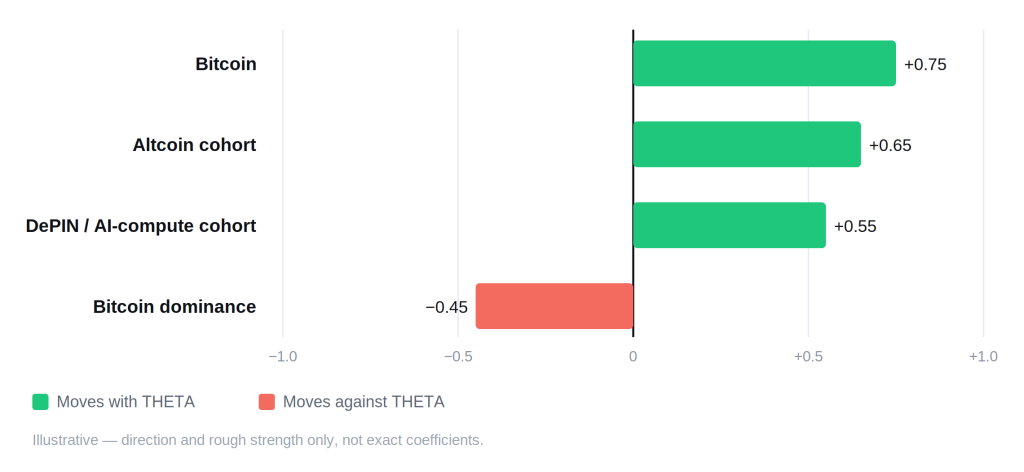
Theta trades as a high-beta altcoin: when Bitcoin rises, THETA tends to rise faster, and when Bitcoin falls, it usually falls harder. Its moves are tied to Bitcoin dominance — capital rotating into Bitcoin tends to drain small-cap alts like THETA, and it underperforms whenever dominance climbs. What increasingly sets Theta apart from a generic altcoin is its link to the DePIN and AI-compute narrative: headlines about GPU demand, decentralized-infrastructure tokens, or a new EdgeCloud enterprise customer can move THETA independently of the wider market. As a risk asset, it also leans on equity sentiment, tracking the Nasdaq more closely than most coins because the AI trade lives there too. Theta has no gold or dollar-index story worth trading; its drivers are Bitcoin, the alt cohort, and its own adoption news. Treat these as rough tendencies rather than stable numbers, because a single EdgeCloud headline can override the lot for a week.
Fundamental factors
Theta Network is a decentralized platform for video delivery and edge computing, where participants contribute spare bandwidth and GPU capacity and earn rewards for it. Its two-token design keeps the roles separate: THETA is the staking and governance token that validators lock to secure the chain, while TFUEL is the operational, gas-like token that users spend on streaming and compute. That split means day-to-day network usage burns and circulates TFUEL, whereas THETA’s value rests on staking demand and governance weight.
Theta’s credibility leans heavily on its backers. Google, Samsung, and Sony run enterprise validator nodes on the network, and Deutsche Telekom joined the strategic validator group as well, with advisors drawn from the early teams behind YouTube and Twitch. Supply is fixed at a maximum of one billion THETA, and effectively all of it already circulates, so there is no inflation schedule or large unlock overhang to dilute holders. The current growth story is Theta EdgeCloud, the network’s hybrid GPU compute platform launched on May 1, 2024, which sells AI training and inference capacity to academic, enterprise, and media customers. Whether that business scales into real, recurring revenue is the single fundamental question that decides where THETA goes from here.
Upcoming catalysts
Only confirmed, dated events are listed. For a small-cap altcoin tied to the AI trade, macro policy sets the risk backdrop while project-specific adoption does the heavy lifting.
| Date | Event | Potential impact |
|---|---|---|
| September 15–16, 2026 | FOMC meeting (with economic projections) | Bull if the Fed signals cuts and risk appetite returns; bear if it holds rates higher for longer |
| October 27–28, 2026 | FOMC meeting | Rate path steers risk-on demand across small-cap alts |
| December 8–9, 2026 | FOMC meeting (with economic projections) | Year-end policy signal for 2027 positioning |
FOMC dates follow the Federal Reserve’s published 2026 schedule. Theta’s own roadmap points to further EdgeCloud AI-agent features and new enterprise customers through 2026, but no specific launch date has been confirmed, so none is treated as a dated catalyst here — an invented date would be a guess, not information.
Bull case vs bear case
Bull case:
- EdgeCloud lands paying enterprise compute customers and turns AI demand into recurring revenue.
- The DePIN and AI-infrastructure narrative stays hot, pulling capital toward tokens like THETA.
- A broad altcoin rotation lifts small-caps once Bitcoin dominance rolls over.
- Fixed supply and heavy staking keep the tradable float thin, so real demand moves price quickly.
Bear case:
- EdgeCloud stays a promising pilot without the revenue to justify a higher token price.
- Bitcoin dominance keeps climbing and small-cap alts bleed against it.
- Bigger, better-funded GPU and DePIN networks out-compete Theta for AI workloads.
- Fearful sentiment persists and buyers stay on the sidelines below the 200-day average.
Invalidation levels. The bull case weakens if THETA closes below $0.131, the secondary support, which would put the deeper $0.127 floor in play. The bear case is invalidated on a sustained break above $0.153 and, more convincingly, a reclaim of the 200-day average at $0.179 — roughly a quarter above the early-August price and the line that would mark the downtrend as broken.
Historical performance
Theta’s chart is a single towering cycle, not a steady climb. THETA ran to an all-time high of $15.72 on April 16, 2021, on the back of the video-streaming narrative, then gave back more than 99% of that value over the following bear market. In early August 2026 it trades near $0.14, still roughly 99% below the record and below its own 200-day average. That history is the backdrop for every forecast on this page: the token has proven it can move violently in both directions, and the EdgeCloud pivot is its attempt to build a second act on firmer ground than the first.
Is Theta a good investment in 2026?
Whether Theta fits a portfolio comes down to conviction in EdgeCloud and tolerance for small-cap risk. Our outlook sees THETA averaging near $0.16 in 2026 — off the lows, but no breakout — with the trend gated by AI-compute adoption and the wider risk mood. The bullish read is a cheap token with a real product, blue-chip enterprise validators, and fixed supply; the bearish read is a coin 99% below its peak, in a fearful market, competing against far larger AI-infrastructure players. Both are defensible, and the position size should reflect that. PrimeXBT’s explainer on what THETA is and how Theta Network works covers the mechanics in more depth.
How to trade Theta on PrimeXBT
On PrimeXBT you can take a position on Theta in either direction. CFDs on THETA can be traded long or short, so you can act on a recovery thesis or a decline — see the guide to short selling if you lean bearish. Leverage magnifies gains and losses alike, and a thin-float small-cap like THETA can move fast, so position sizing and a stop-loss matter on every trade. Trade on your own analysis and risk tolerance, and never risk more than you can afford to lose.
Trading involves risk.
How we build this forecast
This outlook is put together by PrimeXBT’s analysts, not lifted from a single price feed. We start from where THETA trades today, read its position against the 50- and 200-day moving averages and the key support and resistance levels, weigh the fundamentals — the two-token model, staking demand, the enterprise validator roster, and above all EdgeCloud’s traction in AI compute — and set all of it against the macro backdrop, chiefly the path of U.S. interest rates and the appetite for risk. The yearly ranges combine that technical read with the fundamental and macro picture; the long-range figures lean on trajectory rather than precision.
None of this is a guarantee. Theta is a volatile small-cap, its adoption story is still unproven, and one shift in the AI-infrastructure trade can move THETA faster than any forecast expects. Treat every figure here as a considered estimate, not a promise — we revisit and update the outlook monthly as the data changes.
How much will Theta be worth in 2026?
Our outlook puts THETA at an average near $0.16 for 2026, a modest recovery off its multi-year lows rather than a breakout.
How much will Theta be worth in 2030?
Our long-range view averages near $0.24 for 2030. A five-year forecast on a small-cap coin is a direction, not a precise number, and the realistic range is wide.
Will Theta reach $10?
Not on our numbers. THETA hit $15.72 once, in April 2021, but the top of our modeled range through 2030 stays under $0.35. Reaching $10 again would require an adoption wave far beyond anything the current data shows.
Is Theta a good investment in 2026?
It depends on your view of EdgeCloud and your appetite for small-cap risk. The case is a cheap token with real enterprise backers and fixed supply against a coin 99% below its peak in a fearful market. Both sides are real, so size any position accordingly.
What is the difference between THETA and TFUEL?
THETA is the staking and governance token that secures the network, capped at one billion coins. TFUEL is the operational token spent on streaming and compute. Network usage flows through TFUEL, while THETA's value rests on staking and governance demand.
Author



 Risk Disclaimer
The content provided here is for informational purposes only. It is not intended as personal investment advice and does not constitute a solicitation or invitation to engage in any financial transactions, investments, or related activities. Past performance is not a reliable indicator of future results.
The financial products offered by the Company are complex and come with a high risk of losing money rapidly due to leverage. These products may not be suitable for all investors. Before engaging, you should consider whether you understand how these leveraged products work and whether you can afford the high risk of losing your money.
The Company does not accept clients from the Restricted Jurisdictions as indicated in our website/ T&C. Some services or products may not be available in your jurisdiction.
The applicable legal entity and its respective products and services depend on the client’s country of residence and the entity with which the client has established a contractual relationship during registration.